
The First 90 Days: A Marketing Plan for a New Triangle Service Business
What to set up in week one, what to spend in month two, and what to ignore until you have revenue. A real 90-day plan.
You registered the LLC last week. You’ve got a truck, a phone number and nine people who swore they’d hire you. Now one guy wants $9,000 for a website and another wants $2,500 a month for SEO. Here’s the plan we’d hand you if you called Falco on day one and we both knew you couldn’t afford us yet.
A marketing plan for a new small business should spend almost nothing in month one. Week one is free setup: your Google Business Profile, a one-page site, a phone that gets answered by a human, and a habit of asking every customer for a review. Weeks two through four build the real site. Month two buys search ads. Month three measures and cuts.
The Triangle is a real market, and that’s exactly why it’s crowded
Demand here is real. Wake County hit 1,257,235 residents as of July 2025, up 11.3% since 2020, and Johnston County is up 18.7%. Those are people who need HVAC service, a dentist, a roof, an electrician.
Now the part that should worry you. Raleigh-Cary ranks #4 among large US metros for small business growth. Every contractor who moved here from Ohio read the same articles. You’re not early. You’re on time.
Week 1: spend $0 and do the four things that beat money
Nothing here costs anything except a domain. Do all of it before you spend a dollar on ads. Ads pointed at a business with no profile and no answered phone are a donation to Google.
Week 1 to-do list (budget: $0, plus about $20 for a domain)
- Claim and verify your Google Business Profile, then pick your primary category deliberately
- Set your service area to towns you’ll actually drive to, not every county within 90 miles
- Buy the domain and stand up one page: your name, what you fix, where you work, a tap-to-call number
- Set up a phone a person answers in business hours, with a real greeting if you’re on a ladder
- Write the text message you’ll send every customer asking for a Google review
- Ask the first five people you’ve already worked for, including the friend-price jobs
Your primary category is the most important field in local search. In Whitespark’s 2026 Local Search Ranking Factors survey, 47 experts scored 187 factors and primary category came out on top at 227 points, ahead of proximity to the searcher at 225. Most owners pick one in four seconds and never look again. Spend twenty minutes on it. To Google, “HVAC contractor” and “air conditioning repair service” are different businesses.
Don’t stuff keywords into your business name. Yes, it’s a ranking factor. It’s also the fastest route to a suspension, and a suspension in month one costs you the quarter.
Then the phone. Invoca analyzed more than 60 million calls and found only 61% of callers reach a person when they call from a digital marketing source. Four in ten inquiries hit a wall. Cheapest fix on this list, and it costs nothing but discipline.
Reviews are the other free thing, and the math is in your favor. BrightLocal found 83% of consumers who were asked to leave a review did so. Asking works. It just about always works. And you need volume fast: 47% won’t use a business with fewer than 20 reviews, and 74% want reviews from the last three months.
Don’t get clever with review collection
Sterling Sky’s analysis of review posting blocks found they correlate with reviews left inside your building, QR codes at the counter, and bursts of ten or more in one day. Blocks usually run the full 30 days and survive appeals. One business lost 342 of its 595 reviews. Text the customer a link the next morning instead.
Weeks 2-4: build the smallest website that can actually sell ($1,200 to $3,500)
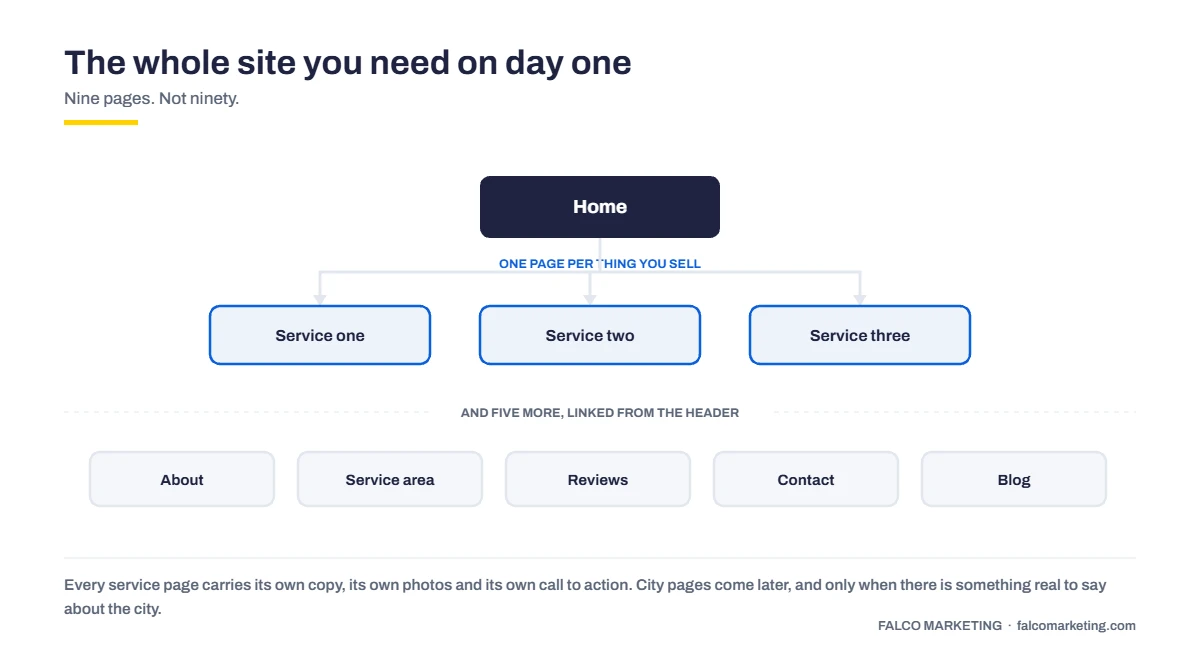
Now you spend real money, once. Not thirty pages. A homepage, a page for each service you want to be hired for, a page for your main town, an about page with your face on it, a contact page.
Service pages carry more weight than anything else you could build. In that same Whitespark study, a dedicated page for each service scored 210 points as the #1 local organic ranking factor. One page listing eleven services ranks for nothing. Eleven pages rank.
Weeks 2-4 to-do list (budget: $1,200 to $3,500, one-time)
- One page per money service, written like you’d explain it standing in a driveway
- One page for your primary town, plus a second only if you genuinely serve it
- Photos of your own crew and your own work, not stock models in hard hats
- A pricing signal: a starting-at number, a range, or “most jobs run between X and Y”
- A form that emails and texts you, plus a phone number in the header of every page
- Confirm the domain, DNS, hosting login and site files are in your name
That last one isn’t paperwork. It decides if you can ever leave the guy who built it. If a shop says the site lives on their “proprietary platform” and can’t be exported, you’re renting your own business. How we scope a small build is on the website design page.
Skip the blog. 68.01% of Google searches ended without a click in early 2026, and AI Overviews appear on 92% of informational local queries. “5 Tips For Fall Furnace Maintenance” in month one is unpaid labor.
Month 2: your first ad dollar goes to search intent ($1,000 to $2,000)
Somebody will tell you to run Instagram ads. Not yet. Month two goes to people typing your service into Google right now with a broken water heater.
Here’s what a lead costs, from WordStream’s benchmark study of 13,474 US search campaigns:
| Category | Cost per click | Conversion rate | Cost per lead |
|---|---|---|---|
| All industries | $5.42 | 8.18% | $66.69 |
| Home & home improvement | $8.33 | 8.05% | $90.92 |
| Dental | $8.00 | 10.67% | $72.97 |
| Attorneys & legal | $9.87 | 5.55% | $131.63 |
Caption: Median Google Search benchmarks, WordStream/LocaliQ 2026. A “lead” is a form fill or a call, not a booked job.
Run that against your average ticket first. At $90.92 a lead and a 40% close rate you’re paying about $227 for a booked job. On a $12,000 system replacement that’s nothing. On an $89 service call it’s a disaster.
Plumbing, HVAC, electrical, roofing and pest control should look at Local Services Ads first. SearchLight’s benchmark across 888 contractors put LSA cost per lead at $39 for electrical, $51 for HVAC and $57 for plumbing. Know this before you build habits around that dashboard: beginning August 2026 LSA is absorbed into Google Ads for home service advertisers, manual bidding goes away, and historical reports don’t transfer.
Good news for starting small. WordStream found accounts spending under $1,000 a month convert 32% better than accounts spending $10,000 or more, 18.8% against 14.2%. A tight budget on four keywords in Apex beats a sloppy one on four hundred statewide. How we build new accounts is on the Google Ads page.
Meta? A Facebook lead is cheaper, $27.66 all-industry and $41.26 in home improvement, and colder, because nobody scrolling at 9pm has a leaking pipe. Cheaper lead, not better lead. Meta earns a slot in month five.
Not sure your first campaign is built right?
Send us read-only access and we’ll send back a one-page benchmark of your cost per lead against your industry median, plus the biggest sources of waste we find. Takes about a week. You keep the document whether or not we ever speak again, and no proposal comes with it.
Get a Google AuditBrand new with nothing to audit? Tell us what you’re starting and we’ll tell you what to do first.Month 3: measure what happened, then cut ($1,500 to $2,500)
Month three is where new owners lose the plot. Ads are running, the phone rings sometimes, and nobody can say which dollar did it. So they keep paying for all of it.
The average account wasted $1,127.54 a month out of $3,127.38 in spend. In that data, 29% recorded zero conversions over 90 days and 25% had never added one negative keyword.
Month 3 to-do list (budget: $1,500 to $2,500, mostly the same spend reallocated)
- Read the search terms report weekly and add negative keywords every time
- Put a separate tracking number on your ads, your profile, your truck and your yard signs
- Ask every caller how they found you and write it down, even though it’s annoying
- Kill your worst campaign outright instead of shaving 10% off it
- Move that money to whichever service page or town is already converting
- Add the second and third service pages you skipped in month one
One honest limit: attribution lies at the edges. Somebody sees your truck in Fuquay-Varina, Googles your company name three days later, and the report calls it organic. Branded search isn’t a channel, it’s an echo. Judge channels on the leads they start, not the ones they finish.

The ignore list: what not to buy in your first 90 days
Nobody writes this section, because most of it is what agencies sell. Every item below is worth money later. None of it belongs in your first quarter.
A full brand identity package
Logo suite, color system, guidelines PDF. Several thousand dollars and six weeks, and it won’t produce one phone call. You need a name people can spell over the phone, one logo file that reads at an inch on an invoice and six feet on a truck door, two colors and one font. Do the real brand work in year two.
A thirty-page website
Pages aren’t free. Every one is a page nobody proofreads and Google has to judge. Five sharp pages beat thirty thin ones. Add them as you add services, not ahead of them.
An SEO retainer before the website exists
This one costs the most and stings the worst. A $1,500-a-month retainer starting in week two buys optimization of a site that isn’t built. Get the pages up, the profile claimed and twenty reviews in, then talk to someone about local SEO in month four.
A social media content retainer
Nine posts a month about National Donut Day for $800. If you sell to homeowners in an emergency, Instagram is not where the decision happens. Post from your own phone when you finish a job you’re proud of, and put the $800 into search.
Printed brochures and a home show booth
Print works, but not that kind. A brochure arrives with no distribution plan attached, so five hundred ride around in your truck for two years. Yard signs and door hangers beside a job you just finished land at the moment it’s relevant.
A CRM with a monthly license
In month one your CRM is a spreadsheet and your calendar. Buy software when you hire the second person who needs to see what you see.
The pattern: in your first 90 days, buy things that produce a phone call this week. Everything else is infrastructure for a business that doesn’t exist yet.
What a marketing plan for a new small business costs
| Stage | What you’re doing | Spend |
|---|---|---|
| Week 1 | Profile, phone, review process, one page | $0 to $20 |
| Weeks 2-4 | Real site, service pages, own your assets | $1,200 to $3,500 one-time |
| Month 2 | First search ads and LSA | $1,000 to $2,000 |
| Month 3 | Tracking, cutting, more service pages | $1,500 to $2,500 |
Caption: Falco’s recommended ranges for a new Triangle service business. Yours move with your average ticket and category.
Call it $4,000 to $8,000 across the quarter, front-loaded into the website and back-loaded into ads. If that’s more than you have, do week one exactly as written and stop there. It’s free, and it’s the highest-return work on the list.
Frequently asked questions
What should a new business spend on marketing in the first 90 days?
Plan on $4,000 to $8,000 for a Triangle service business, with the website taking the biggest bite. If cash is tight, do the free week-one work and delay the rest. A claimed profile with twenty real reviews beats a half-funded ad account.
How long before a new business sees leads from Google Ads?
Days, if the account is built narrow and the landing page matches the search. Map pack and organic visibility takes months, which is why month two buys ads and month four buys SEO.
How many reviews do I need to be competitive?
Twenty is the threshold worth chasing first, since 47% of consumers won’t use a business with fewer. After that, recency beats volume. Ten reviews from this quarter beat sixty from 2023.
What if I serve several towns in the Triangle?
Build a page per town you genuinely work in, not per town within driving distance. Proximity is one of the strongest local pack factors, so a Raleigh address will struggle to rank in Clayton. Use ads to cover the rest.
Starting something in the Triangle this quarter?
Book a 20-minute call. Tell us what you’re launching, what you’ve spent and what you’re being pitched, and we’ll tell you which of it we’d do first. No proposal, no follow-up sequence, no deck. If the honest answer is “you don’t need an agency yet,” that’s what you’ll hear.
Book the 20-minute callWant the whole menu first? Here’s everything we do and the towns we cover.Benchmarks current as of July 2026. We update this post when the source data refreshes.