
How Long Does Local SEO Take? An Honest Timeline
Month by month, what local SEO actually does and when. Plus the three situations where it moves in weeks, and the one where it never works.
Every owner who signs a local SEO contract starts counting days by about week six. Nobody says it out loud. Then month three arrives, the invoice looks like month one’s, and the phone sounds the same as it did in June.
Here’s the real timeline, uncomfortable parts left in.
How long local SEO takes depends on the shape your profile and website are in when you start, but the honest range is three to six months for a measurable lift in calls and nine to twelve months to hold competitive terms. Month one is repair work and you will see almost nothing. Anyone promising page one in 30 days is describing a keyword nobody searches.
Why month one feels like nothing is happening
Month one is repair, and repair is invisible from outside. A competent first month is unglamorous cleanup:
- Fixing the Google Business Profile, starting with the primary category. Whitespark’s 2026 ranking factors study, where 47 experts scored 187 factors, put primary category at 227 points, the highest-scored local pack factor.
- Making your name, address and phone match across every listing that has them wrong, including ones a previous agency created and never mentioned.
- Building a dedicated page for every service you sell. That’s the top-scored localized organic factor at 210 points, ahead of geographic keyword relevance at 190.
- Setting a baseline you can argue with later: a geo-grid scan, call tracking, and where you rank today from several points around town.
None of that produces a phone call in 30 days. Google has to recrawl the pages, re-score the profile, then decide whether the change sticks. That decision isn’t fast, and isn’t supposed to be.

What local SEO actually does, month by month
| Phase | What’s happening under the hood | What you should see |
|---|---|---|
| Month 1 | Profile repair, service pages, citation cleanup, tracking | Nothing. Sometimes a small dip while pages reindex |
| Months 2-3 | Google recrawls the profile, new pages get indexed | Long-tail terms rank, map pack improves near your address, a few “found you on Google” calls |
| Months 4-6 | Pages age, reviews accumulate, first links land | Head terms reach the top 10 to 20, pack visibility widens |
| Months 6-12 | Compounding authority, reviews, content depth | Lead flow you can forecast and rankings you can defend |
Caption: Assumes an established business with a claimed profile and a working site. Add two to three months if you’re starting from zero.
Months 2 and 3: long-tail terms and the close-in map pack
First movement happens on searches nobody brags about. “Ductless mini split repair Apex.” “Emergency electrician near Wake Forest.” Low volume, low competition, and they close well because the person typing knows exactly what they need.
The map pack moves first for people standing near you. That isn’t a fluke.
So in month two you’ll rank well in Garner and poorly in Durham on the same afternoon, and both are normal. If your agency reports one rank number for the whole metro, they’re either searching from their own office or rounding in their favor.
Months 4 to 6: the terms you actually wanted
This is where the service pages built in month one start earning. Not the blog. A page saying exactly what you do and where you do it beats a clever article on the money terms, which is why the structure of your website matters more than its color palette.
Reviews start to matter here too, for a reason people misread. They influence rank. They influence whether anyone calls you far more. BrightLocal’s 2026 survey found 68% of consumers require at least 4 stars before considering a business, and 47% won’t use one with fewer than 20 reviews.
Ranking and getting picked are two different problems. Month four is when you find out you have the second one.
Months 6 to 12: when it compounds
Pages indexed for six months rank better than the same pages published yesterday. Links earned in month four still work in month eleven. Review volume builds on itself once you have a process for asking, since 83% of people asked for a review leave one. But review work never ends, because recency decays.
Don’t try to catch up all at once
Behind on reviews? The instinct is to blast the whole customer list in one afternoon. Google reads that pattern. Sterling Sky found review posting blocks correlate with bursts of 10 or more reviews in a day, reviews submitted inside the business, and counter QR codes. Blocks usually run 30 days and survive appeals. One documented business ran 2.75x its normal volume and lost 342 of 595 reviews. Ask steadily, and read the full breakdown first.
Three situations where local SEO moves in weeks
Sometimes the timeline collapses, more often than agencies admit, because a fast win makes a retainer look easy.
Your profile was suspended, unclaimed or duplicated. If your Google Business Profile is off the map, reinstating and verifying it can put you back in the pack in a couple of weeks. You aren’t building anything. You’re turning the lights back on.
Your website has no service pages. Plenty of Triangle businesses run a five-page site where every service gets one paragraph. Publishing a real page per service, on a domain that already has age, can move rankings inside a month. The gap was structural, not competitive.
Nobody in your category is trying. Some categories here are wide open. Audiology and home security have a handful of competitors in the county with a claimed profile and a site written after 2019. If that’s your industry, month two can look like someone else’s month eight.
The honest read: that’s neglect being corrected, not an SEO win. If someone quotes a twelve-month program to fix a six-week problem, ask about it before signing.
The one situation where local SEO never works
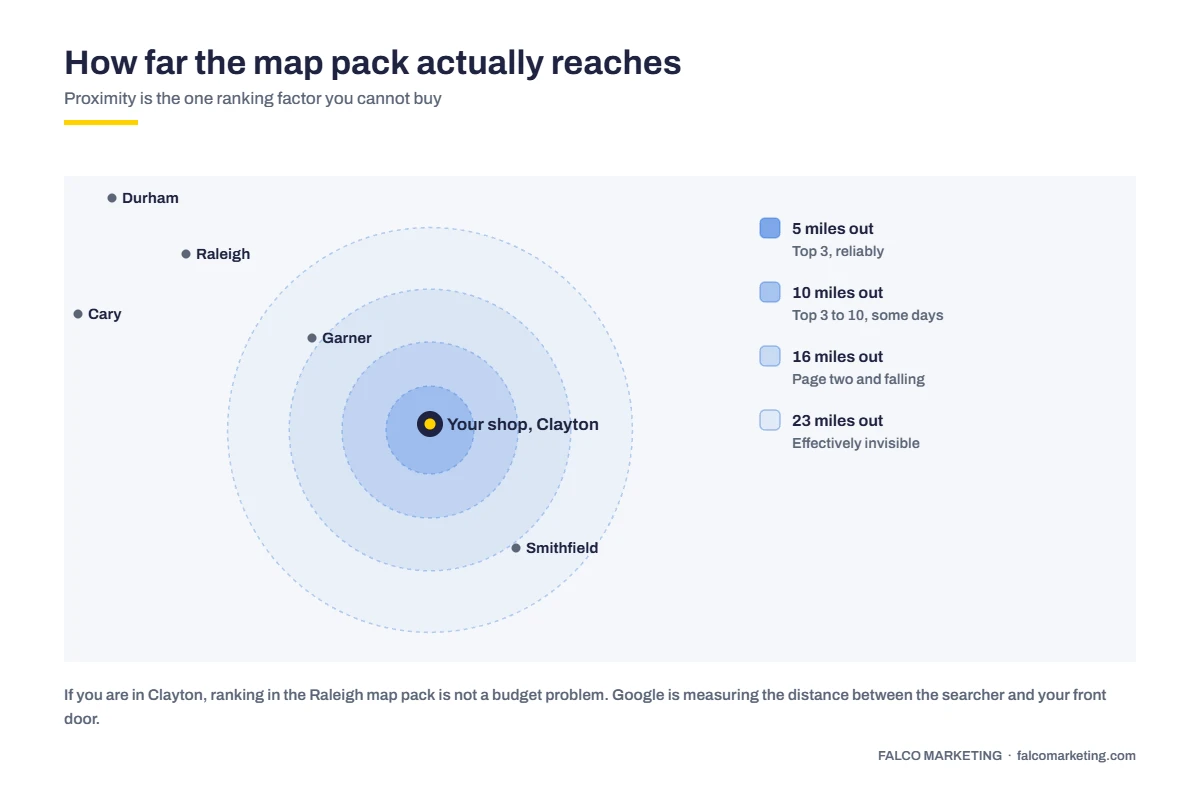
You cannot rank in the map pack for a place you are not.
Proximity is the #2 pack factor at 225 points, and “physical address in the city of search” scores 213 on its own. Both describe a pin on a map, and your pin sits where your lease says it sits. A shop in Clayton will not hold the map pack in North Raleigh, no matter how good the content is.
Hiding your address doesn’t move it
Service area businesses can hide the street address, and owners assume that frees them to rank anywhere they deliver. It doesn’t. Google still knows the address, and the pack still sorts by distance from the searcher. Renting a virtual office or using a friend’s garage as a second location is the fastest route to a suspension.
You’re not stuck. The map pack is simply the wrong target for that geography. Rank organically for the town with a real page for it, which still works at distance because geographic keyword relevance is a separate organic factor worth 190 points. Or buy the visibility with Google Ads, which has no proximity rule at all.
An agency selling a retainer aimed at a town where you have no address, without saying so in the first meeting, is selling twelve months of something that cannot happen.
Not sure whether month five is normal or a stall?
Send us your rankings report and your Google Business Profile and we’ll spend 20 minutes on the phone telling you which it is. No proposal, no follow-up sequence. If your agency is doing the work properly, we’ll say so and you can get back to your day.
Book a 20-minute callOr see what we do month to month on our local SEO page.Why the agency that promised 30 days was lying
Not always lying, to be fair. Sometimes just picking easy targets.
A 30-day promise is nearly always one of two tricks. The first is branded search. They report that you rank first for “Falcon Heating and Air Fuquay-Varina,” which you already did, because nobody else is named that. Your business name is not a ranking. It’s an echo of demand you created somewhere else.
The second is the invented phrase. “24 hour emergency AC repair Willow Spring same day” has essentially no search volume, so ranking for it in three weeks is easy and worth nothing.
Here’s the tell. Ask for the monthly search volume next to every keyword, and ask what location was used to pull the rankings. An agency doing real work answers both in under a minute.
The market is also getting harder in ways nobody controls: Sterling Sky found local pack ads went from roughly 1% of tracked mobile reports in early 2025 to almost 22% by December, so the free results keep sliding down the screen.
How to tell at month four whether it’s working
You don’t have to wait out the contract. Four months in, the signal is already there.
The month-four check on your local SEO
- Profile impressions and calls are up against the same months last year, since month over month hides seasonality
- Service pages are indexed and picking up Search Console impressions for terms with a town name
- Rankings improved on a geo-grid, not a single-point report pulled from the agency’s office
- Review count grew steadily and your newest review is under 30 days old
- You can name one closed job from a search you didn’t already own
- The report lists work done, not a summary of what happened
Four or more trending the right way means it’s working, even if revenue hasn’t caught up. Two or fewer means something is wrong, usually that no real work happened after month one. More common than anybody likes to print.
While you wait, run paid search as the bridge. WordStream’s 2026 benchmarks, from 13,474 US campaigns, put the median cost per lead at $66.69, which works when a job is worth $400. And ask every customer for a review, starting today. That part is free.

Want these checks run on your own business?
We’ll pull your profile, run a geo-grid from the towns you actually serve, check which services have a real page, and check your review recency. You get back a one-page list of what’s missing and the order to fix it, yours whether we work together or not.
See how our local SEO worksPrefer to talk it through? Tell us what’s going on and we’ll give you a straight answer.Frequently asked questions
How long does local SEO take to show results?
Three to six months for a measurable lift in calls, nine to twelve for competitive head terms. Month one shows nothing because it’s repair work. A suspended profile or a site with no service pages can move in weeks.
Why isn’t my SEO working yet after three months?
Usually because nothing was actually done after month one. Then check the report. If the keywords on it are your business name or phrases with no search volume, that’s a document built to look good, not a measurement.
How long does it take to rank on Google Maps?
Often two to three months, but only within a few miles of your address. Proximity is the #2 pack factor, so it depends on where the searcher stands. One “we rank #4” number for a whole metro isn’t a measurement.
Can I rank in a town where I don’t have an office?
In the map pack, realistically no. Proximity and a physical address in the city of search are two of the strongest pack factors, and neither has a workaround short of moving. You can still rank organically there with a dedicated page, and run ads with no location limit.
Ranking factor scores come from Whitespark’s 2026 study, published November 2025. Benchmarks are current as of July 2026. We update this post when the sources refresh.