
Why Your Business Doesn’t Show Up on Google Maps Five Miles From Your Office
It's not a penalty. It's proximity — the #2 map pack ranking factor. Here's what actually beats it, and the scan that shows your real radius.
You haven’t been penalized. You’ve hit the edge of your radius.
Here’s how it usually goes. A customer in Apex mentions, casually, that they searched for your service and you didn’t come up. Three competitors did. So you pull out your phone in the parking lot, type it in yourself, and confirm it. No you.
You didn’t get flagged. Google’s map results are ranked partly on how close your address sits to whoever is doing the searching, and in Whitespark’s 2026 study of 187 local ranking factors, proximity to the point of search scores 225 points. Second highest of anything on the list. That’s why you own downtown Raleigh and vanish in a driveway in Apex.
The fix isn’t a better profile. It’s a different structure.
If your business doesn’t show up on Google Maps a few miles away, it’s almost never a penalty. Google ranks map results partly on how close your address is to the person searching, and proximity is the second strongest local pack factor in Whitespark’s 2026 study. You beat it with the right primary category and a real page for every service in every town you serve.
Why your business doesn’t show up on Google Maps: proximity, category, then everything else
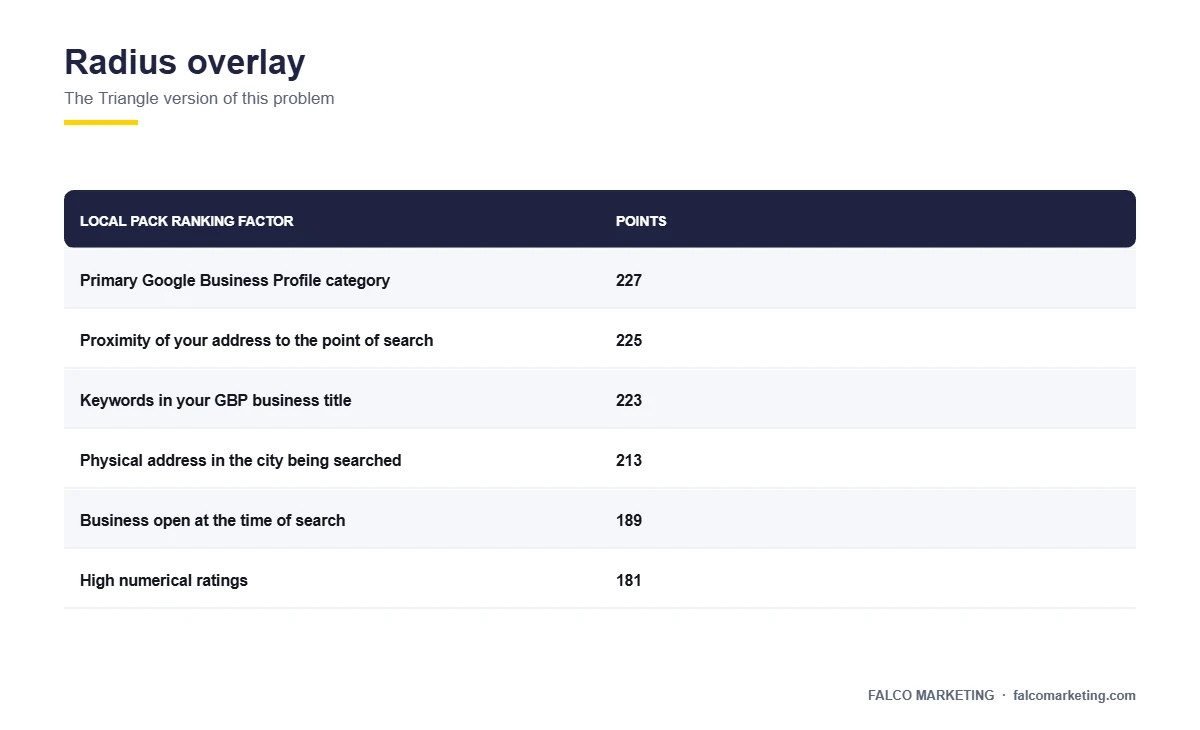
Whitespark’s 2026 edition, published November 2025, had 47 practitioners score 187 factors. Here’s the top of the local pack list.
| Local pack ranking factor | Points |
|---|---|
| Primary Google Business Profile category | 227 |
| Proximity of your address to the point of search | 225 |
| Keywords in your GBP business title | 223 |
| Physical address in the city being searched | 213 |
| Business open at the time of search | 189 |
| High numerical ratings | 181 |
Caption: Top six local pack ranking factors, Whitespark 2026 Local Search Ranking Factors.
Read that list again and notice the uncomfortable part. Two of the six are pure geography, and you can’t edit either one. Your address is your address. Where the customer is standing is where the customer is standing.
So this post starts with what you can’t win, then spends the rest on the levers that do move.
What your real radius looks like
The map pack you see on your own phone is not the map pack anyone else sees. You’re standing at your shop. Of course you rank.
The tool that settles it is a geo-grid scan. It drops a grid of virtual pins across a region, runs your keyword from each one, and colors the pin by where you actually land. Green in the middle, red past the edge of your pull.
The reaction we get when an owner sees his own grid is usually relief. The shape is a blob centered on his building, not a random mess, and a blob you can plan around.

What a blob is not is evidence of a penalty. A suspension removes your profile from search entirely, and you’ll know, because your phone stops instead of slowing down. If that’s your situation, we wrote the reinstatement playbook separately.
The one thing that outranks proximity: your primary category
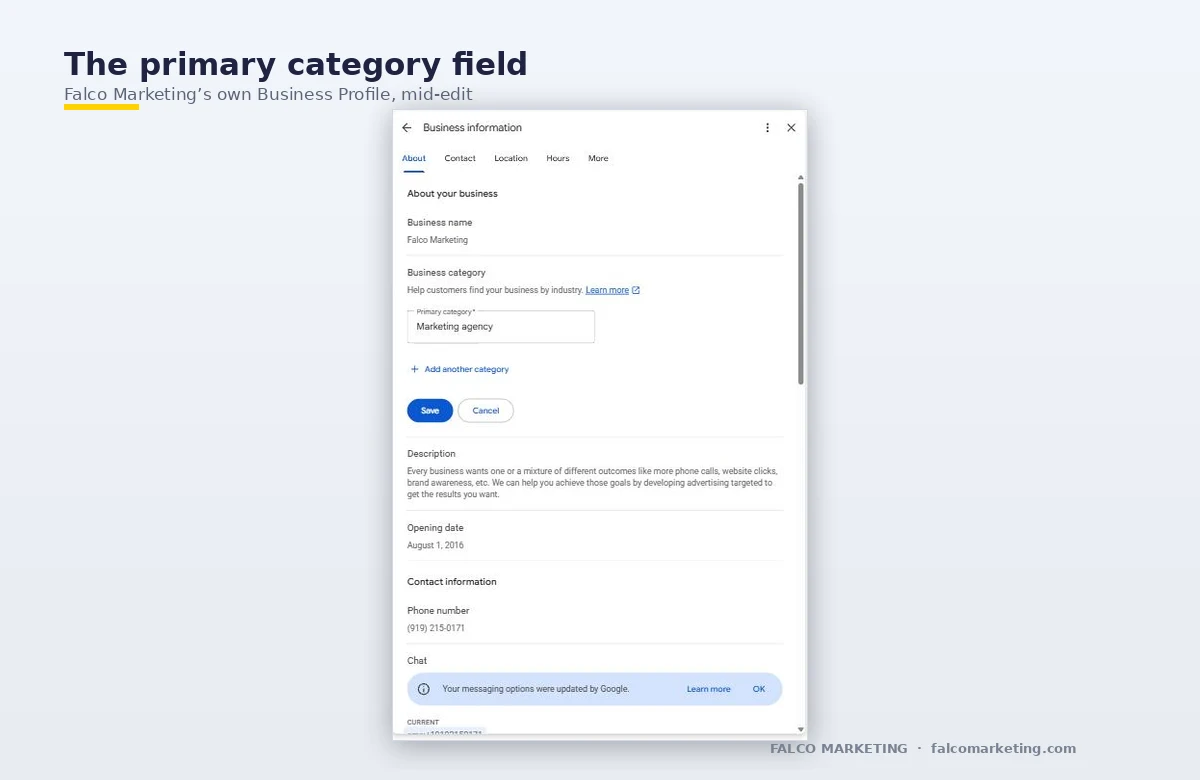
Primary category scored 227 points, the highest factor in the entire local pack study. It beats geography. And it’s the single most commonly botched field on a Google Business Profile in the Triangle.
The mistake is picking a category that describes your business instead of the job someone is hiring you for. “Contractor” instead of “Roofing contractor.” “Lawyer” instead of “Personal injury attorney.” Those swaps cost you the searches you actually want, because Google treats your primary category as the strongest single statement of what you are.
Your secondaries fill in around it and carry far less weight. So if your primary and your best-selling service don’t match, that’s your afternoon. Check the full list while you’re in there, too. Google adds categories constantly, and a better fit than the one you picked in 2019 may be sitting there now.
“Business is open at time of search” is now a ranking factor
Most owners haven’t caught up to this one. Being open at the moment somebody searches scored 189 points in the 2026 study.
Read that plainly: your hours are no longer a courtesy. They’re a visibility setting.
Which makes wrong hours expensive in a way they never used to be. A profile that says you close at 5 when your dispatcher answers until 8 hands three prime hours of emergency searches to whoever bothered to update. Holidays are worse, because Google prompts you, you ignore the prompt, and Thanksgiving week runs on a schedule you set two years ago. More on what “closed” now costs you here.
Set special hours for every holiday you observe. Once, in January, for the whole year.
What you cannot fix
Here’s the part the fifteen-tips posts leave out, because it doesn’t sell anything.
You cannot move your pin. No citation cleanup and no posting schedule relocates your building closer to Holly Springs. Anybody selling “map pack domination” across the whole Triangle from one address is selling a thing that does not exist.
And the two shortcuts owners reach for are the fastest ways to lose the profile they already have. The first is a virtual office or mailbox address in the town you want. Google requires a location you actually staff, and address violations are a leading cause of suspension.
The second is stuffing your business name. “Apex Emergency Plumber Repair” is not your name unless it’s on your signage and your invoices. Keywords in the business title do carry weight, 223 points of it, which is why owners get tempted and why Google enforces it hard.
So now I’m basically invisible online and getting little to no new customers.
A plumbing business owner describing a suspended Google Business Profile, r/smallbusiness
That’s the trade. A few miles of extra map reach against your entire online presence. Not close.
How to rank in a town you don’t sit in
The map pack isn’t the only local result. Below it sit the regular blue links, and those play by rules that don’t care where your office is. In the same Whitespark study, the top local organic factor is a dedicated page for each service you offer, at 210 points, with geographic keyword relevance right behind at 190.
Put those together and you get the thing that works: a real page for each service, in each town you serve. Roof replacement in Apex. Gutter work in Fuquay-Varina. Not one “service areas” page with town names listed in the footer.
Now the uncomfortable part. This only works if the pages are genuinely different. Spinning one page 20 times with the town name swapped is something agencies still sell, and it produces exactly what it sounds like. A real page has photos from that town, the neighborhoods you work in, the permit office you deal with, and pricing that reflects what you charge there. Slower, and the only version that holds up. We broke down how the matrix gets built in a page for every service in every town.

Want to see your actual radius?
Send us your business name and the towns you want to be found in. We’ll run a geo-grid scan and send back the heat map, a grid of pins across the Triangle showing exactly where you rank and where you vanish. Ten minutes of our time, and it’s yours to keep. If the map looks fine, we’ll say so.
Get your grid scanOr see how we handle local SEO in Raleigh first.The Triangle version of this problem
Geography here is brutal for a single-location business. Raleigh to Holly Springs is roughly 20 miles. Wake Forest to Fuquay-Varina is closer to 30. Nobody covers that from one pin, and anyone saying otherwise hasn’t looked at a map.
It’s getting harder, too. Wake County sits at 1,257,235 residents as of July 2025, up 11.3% since April 2020, and picks up about 66 new residents a day. Johnston County is up 18.7%, the fastest in the region.
Those people land in Clayton and Knightdale, search from a driveway you’ve never driven past, and the proximity math runs against you from day one.
Reviews, and why the count matters more than you think
High numerical ratings scored 181 points in the local pack. Real, but not the whole reason to care.
Reviews don’t extend your radius. They win the close contests inside it, and they decide whether the person who does see you actually calls. BrightLocal’s 2026 consumer survey found 68% of consumers require a rating of 4 stars or better before they’ll consider a business, and 47% won’t use one with fewer than 20 reviews at all.
Recency is the piece almost everyone ignores. Whitespark named review recency the most underrated local ranking factor, and 74% of consumers in that BrightLocal survey want reviews from the last three months. Forty reviews that stopped in 2023 read worse than twelve still coming in.
So watch reviews per month rather than total reviews. If that line is falling, fix it before you touch anything else.
Run this scan on yourself this week
Twenty minutes, no tools you have to buy.
- Write down your primary category exactly as it reads, then the service that makes you the most money. If those don’t line up, fix the category first.
- Check your hours against what your phone actually does, after-hours line included. Set special hours for every holiday between now and December.
- Search your main service from your office and note who’s in the map pack.
- Drive to a town you want, park, and run the identical search. That gap is your radius problem, measured.
- Count your service-plus-town pages that are genuinely different from each other. Most owners land on zero.
- Check the date on your most recent Google review. Older than 60 days means your review flow is broken.
Before you try the shortcut
A mailbox address in the town you want, or a business name padded with keywords, will move you for a while. Then it gets your profile suspended and you spend weeks in a reinstatement queue with nothing showing at all.
Not sure which of these is your problem?
Grab 20 minutes with Trey. We’ll pull up your profile and your map results live, tell you whether you’ve got a category problem or plain geography, and give you the order to fix things in. No proposal afterward, no follow-up sequence.
Book a 20-minute callOr read next: a page for every service in every town you serve.Frequently asked questions
Did Google penalize my listing?
Almost certainly not. Penalties look like suspension, where your profile disappears from search entirely and you know within a day. Ranking well near your office and poorly ten miles out is normal map pack behavior.
Can I add a second address to cover another town?
Only if you genuinely staff and operate out of it. Virtual offices and mailbox addresses are a leading cause of suspension, and reinstatement takes weeks with your listing dark.
How far should I expect to rank?
In a dense area like inner Raleigh, a few miles. In lower-density parts of the Triangle, further, because there’s less competition per square mile. Run a grid scan and stop guessing.
Do more reviews extend my radius?
They strengthen you inside it and help you win close contests at the edge. They don’t create reach where there’s no proximity signal. Reviews are a tiebreaker, not a transmitter.
What’s the fastest thing I can fix today?
Your primary category. Highest-weighted local pack factor in the Whitespark study, five minutes to change, and plenty of Triangle businesses have one that describes the company rather than the job.
Why do competitors show up in towns they aren’t in either?
Usually a real page for that service in that town, ranking organically below the map, plus enough review volume and recency to win the close calls. That’s a structure you can copy.
Ranking factor scores come from the Whitespark 2026 Local Search Ranking Factors study, published November 2025. Population figures are July 2025 Census estimates.