
Why Your Beautiful New Website Doesn’t Make the Phone Ring
Your site looks great and the phone still doesn't ring. Here are the nine conversion leaks we find on almost every Triangle contractor and practice site.
Open your website on your phone. Not the desktop version you approved in a Zoom call. The phone in your hand.
Count the taps between the page loading and your number actually dialing.
More than one? You’ve found a real piece of your problem. And another redesign won’t fix it, because a redesign is what caused it. Somebody buried the phone number in a hamburger menu so the hero photo could breathe.
Here’s the part nobody says out loud at the kickoff meeting. A site that looks good and a site that books work are two different products. Most shops build the first one, because the first one is what you sign off on. You approved the design. You were never the person who was going to call.
A website not generating leads usually has a conversion problem, not a design problem. The nine common leaks: a phone number that isn’t tappable, ad traffic hitting the wrong page, one page covering every service, no proof, a long form, slow mobile load, unanswered leads, pages Google never indexed, and a template six competitors also bought.
Website not generating leads? Here are the nine reasons
The failures repeat on Triangle site after Triangle site, because the people who built them were graded on how the work looked in a portfolio. Roughly in order of how often we find them:
- The phone number isn’t tappable above the fold on mobile.
- The ad promises one thing and the page says another.
- One page is doing the work of twelve service pages.
- No proof: no reviews, no job photos, no town names.
- The form asks for eleven things.
- The site is slow on a phone on LTE.
- The leads it does produce sit unanswered.
- Google never indexed the pages.
- The template is the one your competitors bought too.
Seven of those nine are a day of work on the site you already own. Two are structural. None are about your color palette.

Leak 1: the phone number isn’t tappable above the fold on mobile
Most of your traffic is a thumb in a driveway, in a hurry. Not reading your About page.
Without scrolling, without opening a menu, can you tap something that dials you? If not, you’re asking a stranger with a broken water heater to do extra work to give you money.
The fix is a header phone number as a real `tel:` link on every page, visible without scrolling. Not an image of a number. Not a number in the footer. A sticky call bar at the bottom of the screen is better still, and it takes a competent developer under an hour.
Leak 2: the ad says “emergency AC repair” and the page says “About Us”
This one burns money fastest, because you’re paying by the click.
Somebody in Cary types “emergency AC repair near me” at 9pm. Your ad promises emergency AC repair. He taps it and lands on your homepage, where the hero says “Family Owned Since 1994” over a photo of a truck. Now he has to work out whether you do the thing he searched for. Most won’t bother.
An owner on r/smallbusiness, hunting for where three grand a month went:
the ad says “emergency service near me,” landing page is a generic homepage
r/smallbusiness, June 2026
Same thread, blunter: you’re paying three grand a month to host a monument to your own taste.
Message match means the page headline repeats the ad. Buy “emergency AC repair Apex,” and the headline says emergency AC repair in Apex, the first line says how fast you get there, the button says call now. It isn’t clever and isn’t supposed to be.
Leak 3: one page for twelve services
Plenty of sites list everything the company does in one bulleted column on a “Services” page. Then the owner wonders why he ranks for nothing. Google can’t tell whether you’re a drain company or a water heater company when both get one line on a shared page.
It converts better too. A page about tankless water heater installation answers the four questions a tankless buyer has. A page about everything answers nothing. Do the same by town and you’ve built the structure that earns calls, which we broke out in a page for every service in every town you serve.
Leak 4: no proof, anywhere
Look at your homepage and count the specifics. Real customer names. Photos of your crew on real jobs. Review stars with a count. Towns you serve, spelled out.
Most sites have stock photography and “quality service you can trust,” which every competitor in Wake County also claims.
Proof is cheap. Pull ten Google reviews onto the page with the reviewer’s first name and town. Put up six job photos your techs shot this month, badly lit, real. List Raleigh, Durham, Clayton and Wake Forest by name instead of “the greater Triangle area.”
A stock family in a stock kitchen convinces nobody. A blurry photo of your van in a Fuquay-Varina driveway convinces everybody.
Leak 5: the form asks for eleven fields
Every field is a chance to quit. Half exist because somebody in a planning meeting said it would be nice to know.
You need a name, a phone number, and one box for what’s going on. Add ZIP if you have a real service boundary. Skip “how did you hear about us,” which people lie on anyway, and skip the dropdown that makes a stranger diagnose his own problem before you’ll talk to him.
Then check what happens after submit. On a lot of sites the notification goes to an address nobody has opened since the web guy set it up.
Want the checklist we grade sites against?
The same ten-point list our team runs on every audit, written so you can work it yourself in twenty minutes with a phone and a laptop. Nothing to install, nothing to buy. Hand it to your web person if you have one.
See the checklistNot sure which of the nine is yours? Tell us what’s happening.Leak 6: the site is slow on a phone on LTE
You test on office wifi on a machine that has the site cached. Your customer tests on one bar in a parking lot in Knightdale.
The usual culprits: a hero image exported at full resolution, a video background nobody asked for, a slider, and tracking scripts loading before any text appears. All settings, not rebuilds.
Run the homepage through PageSpeed Insights and read only the mobile score. Better: turn wifi off and load the site cold. If you get bored waiting, that’s your data.
Leak 7: nobody’s answering the leads it does produce
Not the website’s fault, but it gets blamed on the website constantly, so it’s on the list.
More than half of consumers expect a response within the hour and only 20% of home service pros manage it, per Jobber’s 2026 Home Service Trends Report.
So before you spend a dollar on the site, count how many form fills last month got a call back the same day. If that number is embarrassing, the site is fine and your intake isn’t. Full argument in speed to lead.

Leak 8: the site was never actually indexed
Nobody writes about this one, and we find it more often than we’d like.
A site can be live, pretty and completely invisible. It happens when a staging build launches with noindex still switched on, when the robots file blocks everything, when a rebuild goes live on new URLs with no redirects, or when nobody ever submitted a sitemap.
Complaints against one national provider describe this, including a business whose organic traffic went from 124 visitors/month in October to 2 visitors per month, and another customer’s flat summary that a local SEO website that is never indexed cannot appear in search results.
Check it in ten seconds. Search `site:yourdomain.com` in Google. If you have twenty pages and Google shows three, stop reading and call your web person.
Leak 9: the template that six of your competitors also bought
Open four Triangle competitors in four tabs. If the layouts feel interchangeable, they are. A few national vendors sell the same few layouts to every contractor in a market.
One BBB complaint against a Charlotte-based provider called the result a “generic, template-based website that looked ai generated”. That phrase will describe more sites every year, and buyers are getting better at spotting it.
Templates aren’t automatically bad. A template carrying your crew’s faces and your town names beats a custom build full of stock photos. But when a homeowner can’t tell you apart from the other quotes he’s collecting, price is all that’s left. Expensive place to be.

How to run the teardown yourself in twenty minutes
Grab your phone and a laptop. Work in this order, because the first two answers can make the rest moot.
- Search `site:yourdomain.com`. Count the results against the pages you think you have.
- On your phone with wifi off, load the homepage cold. Time it. Count taps to call.
- If you run ads, click your own ad and read the headline you land on. Does it repeat the search?
- Open your services list. Count how many services share one page.
- Look above the fold for proof: a review count and a real job photo.
- Fill out your own form. Count the fields, see where the notification lands, time the call back.
- Hand your phone to somebody who’s never seen the site and ask them to call you. Say nothing.
Most owners finish with four or five items, and most are settings changes.
What it costs to fix versus what it costs to rebuild
Be suspicious of anyone who answers all nine with “new website.”
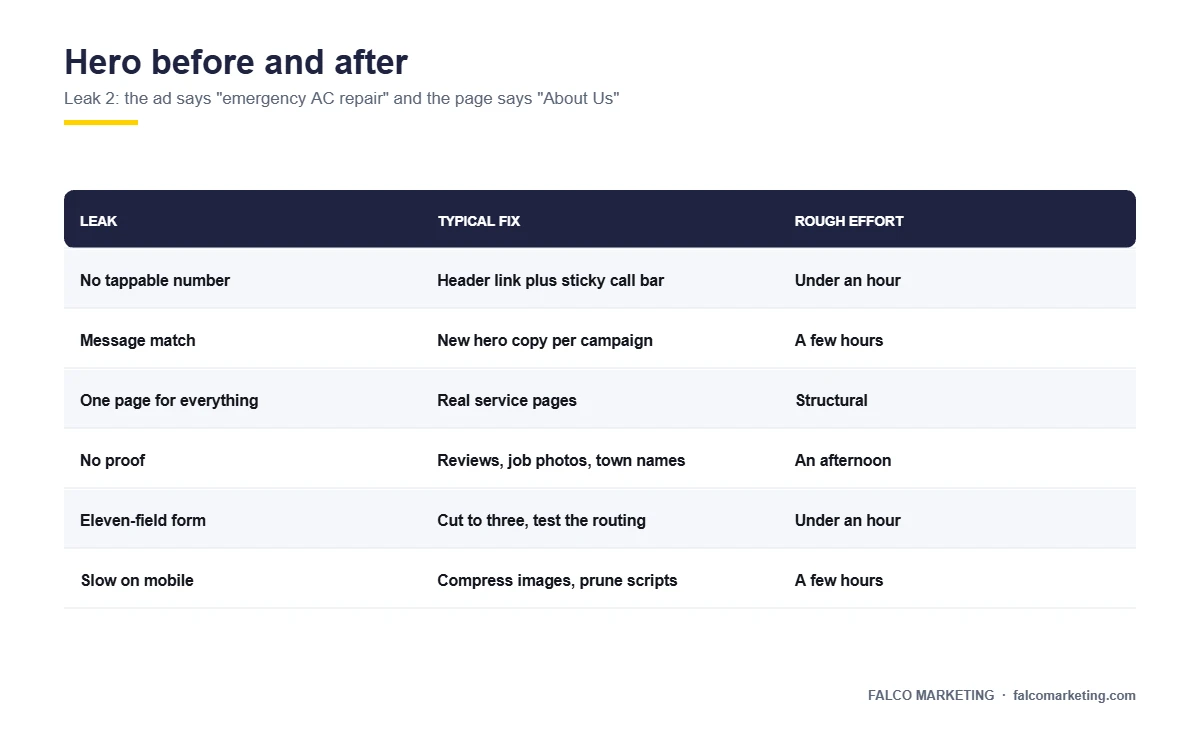
| Leak | Typical fix | Rough effort |
|---|---|---|
| No tappable number | Header link plus sticky call bar | Under an hour |
| Message match | New hero copy per campaign | A few hours |
| One page for everything | Real service pages | Structural |
| No proof | Reviews, job photos, town names | An afternoon |
| Eleven-field form | Cut to three, test the routing | Under an hour |
| Slow on mobile | Compress images, prune scripts | A few hours |
| Slow lead response | Intake process, not the site | Ongoing |
| Not indexed | Fix noindex or robots, submit sitemap | Under an hour |
| Template sameness | New photos and copy on the same shell | A week, in stages |
Caption: Seven of nine are settings and content work on the site you own.
Two things justify a rebuild: the structure is wrong (one page for twelve services, nowhere to put town pages), or you don’t control the thing at all. A site locked inside a vendor platform you can’t export is a rental. Read what your marketing company should hand over before you renew, and what a website actually costs in Raleigh before you price a build.
Last word to an owner in another r/smallbusiness thread: if they are trying to offer you seo/ads on a bad website the chances are you might be lucky to breakeven at best. Fix the leaks first. Then buy traffic.
While you’re in there
Dental, medical and legal practices should add accessibility. Screen reader problems are a legal exposure, and the check is in is your website an ADA lawsuit waiting to happen.
Send us your URL and we’ll tear it down on video.
We record a 10-minute screen share going through your homepage and top service page against the checklist above, then email you the video. Hand it to your web person and have them fix it. No proposal attached, and we do it whether or not you ever hire us.
Get my free teardownCurious what we build instead? Here’s our website design work.Frequently asked questions
Do I need a whole new website?
Usually not. Seven of the nine are a day of work on the site you have. Rebuild when the structure is wrong, not when the colors are.
How do I know if my site is even indexed?
Search `site:yourdomain.com` in Google. If your service pages don’t appear, that’s the first problem and nothing else matters yet.
My designer says the phone number ruins the layout. Is he wrong?
For a service business, yes. The header is not a portfolio piece.
How long before fixing this shows up in leads?
Conversion fixes show up in days, because the traffic is already there. Ranking fixes take months.
My site was expensive. Shouldn’t it be converting?
Price buys design hours, not booked jobs. Plenty of good-looking builds carry every leak here, because nobody was measured on phone calls.