
What a Website Actually Costs in Raleigh, NC (2026 Pricing)
What a small business website really costs in Raleigh in 2026, what's driving the price, and the four line items that quietly double a quote.
Nobody publishes real website pricing. You’ve noticed. Almost every agency site in the Triangle has a “Request a quote” button where the number should be, and by the time anyone gives you a range you’ve sat through a discovery call and a slide deck about their process.
So here are numbers. These are the ranges we quote and the ranges we see on other people’s proposals when an owner in Raleigh or Apex forwards one over for a second opinion. None of it comes from a study. There isn’t a credible one, and any agency citing a national average is quoting a survey of freelancers on the internet.
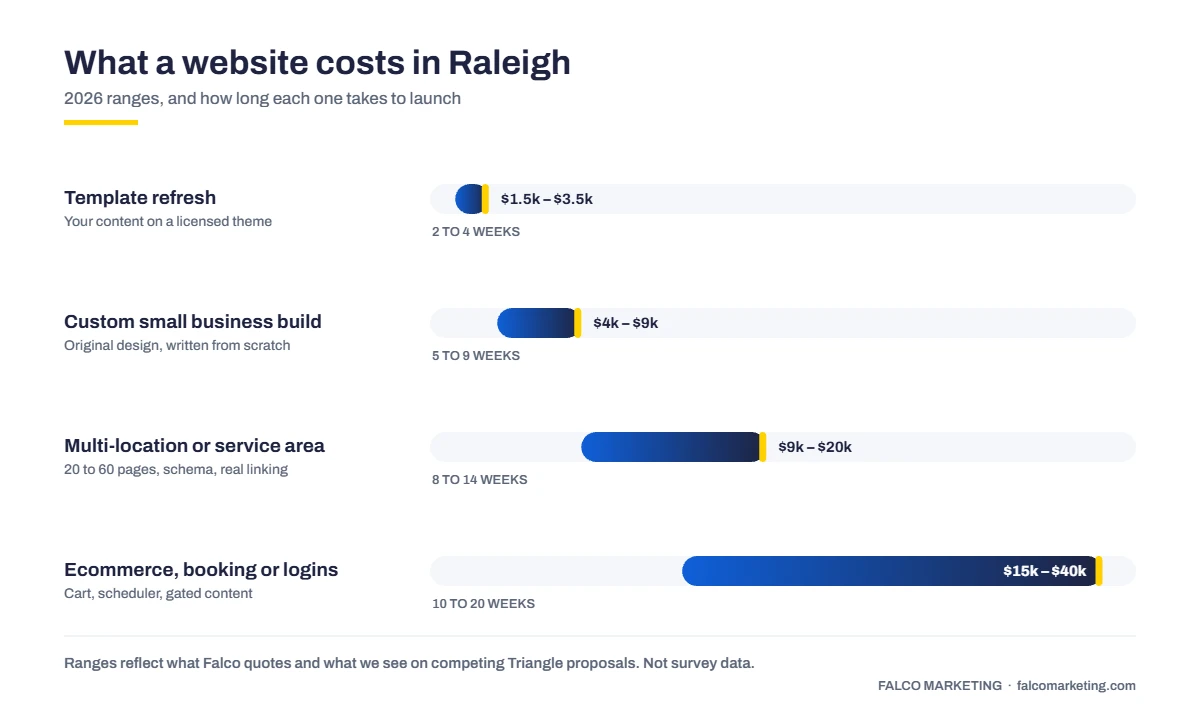
Website cost in Raleigh, NC in 2026 runs about $1,500 to $3,500 for a template refresh, $4,000 to $9,000 for a custom small business build, $9,000 to $20,000 for a multi-location or service-area site, and $15,000 and up once you add ecommerce or online booking. Budget another $50 to $300 a month for hosting and maintenance.
What a website costs in Raleigh, NC in 2026
Four tiers cover almost every quote a local service business will see.
| Tier | What you actually get | Price in 2026 | Time to launch |
|---|---|---|---|
| Template refresh | Your content moved onto a licensed theme, 5 to 8 pages, mobile fixed | $1,500 to $3,500 | 2 to 4 weeks |
| Custom small business build | Original design, 8 to 15 pages, service pages written from scratch, tracking installed right | $4,000 to $9,000 | 5 to 9 weeks |
| Multi-location or service area | 20 to 60 pages, a page per service and per town, schema, internal linking planned instead of accidental | $9,000 to $20,000 | 8 to 14 weeks |
| Ecommerce, booking or logins | The above plus a cart, a scheduler wired to your dispatch software, or gated customer content | $15,000 to $40,000 | 10 to 20 weeks |
Caption: What we quote, and what we see on competing quotes across the Triangle. Our pricing, not survey data.
Ranges reflect our July 2026 pricing for Triangle service businesses doing $500K to $5M. We update this post when our own numbers move.
Most owners reading this belong in tier two and get talked into tier three or scared into tier one.
A refresh is the right answer more often than agencies admit. If your phone rings and the only real problem is that the site looks like 2014 and breaks on an iPhone, you don’t need a rebuild. You need a good designer for three weeks.
Tier two is where most of our website design work lands, and the money goes into writing more than pixels. A dentist in Cary and a roofer in Wake Forest can run the same layout and get opposite results, because the roofer has a real page about storm damage inspections and the dentist has one line about implants buried in a services list.

What actually changes the price
Four things, in order of how much they move the number.
Who writes the words. Hand over finished copy and you’ll cut a build by 25% to 40%. Almost nobody does. Owners plan to write it, get busy in June, and the project sits until the agency writes it anyway.
Whether the design is original or a licensed theme with your colors dropped in. Sometimes that trade is smart. Sometimes you’re the fourth HVAC company in Johnston County running the same layout.
How many pages carry real content, which is not the same as how many exist.
What has to talk to what. Every system your site connects to adds a few hundred dollars and a support ticket you’ll file in eighteen months.
The four line items that quietly double a quote
Padded proposals pad in the same four places. Two of them are worth paying for.
Page count
Pages matter, which is exactly why this one is hard to spot. In Whitespark’s 2026 survey of 47 local search experts, a dedicated page for each service you offer scored 210 points, the highest local organic ranking factor of the 187 they scored, with geographic relevance of content close behind at 190. Drain cleaning, water heaters and repiping should be three pages, not one.
What isn’t worth paying for is 42 town pages with the name swapped and nothing else changed. We see it constantly on audits, and it’s the most common way a $5,000 project becomes a $14,000 project. The tell is easy. Open two of the pages and read them side by side. If the only difference is “Garner” and “Knightdale,” you’re paying by the page for a find-and-replace.
Custom photography
Worth it, and it’s the first thing owners cut.
Stock photos of a spotless technician read as fake to a homeowner in Fuquay-Varina who has already been burned by a contractor. Half a day with a photographer following your actual crew gives you images you’ll use for years, on the site and on your truck graphics and print. Figure $800 to $2,500 for a local shooter. Watch for photography bundled invisibly into the build price, or a $6,000 “brand shoot” that produces 12 pictures.
Integrations
Booking, payments, chat, a CRM push, review requests firing when a job closes. Each sounds small in a kickoff meeting and each is real work: mapping fields, testing failure states, fixing it when the CRM changes its API. Be honest about which you’ll use. A scheduler nobody staffs is worse than a phone number.
The platform you can never leave
The expensive one, and it never appears as a line item.
Some agencies build on a proprietary platform they own. The monthly fee looks reasonable. Then you decide to leave and find out the site can’t come with you. Not the design, not the pages, not the years of content you paid for.
Ask this before you sign anything
“If I fire you in a year, what exactly do I take with me?” If the answer contains the phrase “our platform,” you’re renting a website. That’s survivable at $150 a month for a two-person shop. It is not survivable at $600 a month for five years, and that’s the deal we find people trapped in most often.

Why a $500 site and a $25,000 site can both be wrong
The cheap site fails on math you can check yourself.
Your website’s job is converting traffic you already pay for. In home services, the median cost per lead from Google Ads is $90.92, on a median cost per click of $8.33, across 13,474 US search campaigns in WordStream’s 2026 benchmarks. Convert at 4% instead of 8% and you pay double for every lead, forever. Traffic is getting harder to earn too: 68.01% of Google searches ended without a click in early 2026, up from 60.45% in 2024. Fewer clicks reach you, so the ones that do have to work harder.
The $25,000 site fails differently. The build eats the whole budget and leaves nothing to create demand, and a beautiful site nobody visits is an expensive business card. Skip the animation and put that money into local SEO or ads.
The right number is the smallest one that buys a fast, clear site with a real page for every service you sell.
Not sure if your quote is fair?
Send us the proposal you’re holding. We’ll read it and send back a plain-English note on what’s standard, what’s padded and what’s missing, usually inside two business days. No pitch, no counter-proposal, and we’ll say so if the quote you have is a good deal.
Send us your quoteOr compare it against what our builds include, line by line.What you should own the day it launches
This is where we differ from most shops in town, so we’ll be blunt. You should own all of it. Not “have access to.” Own.
What has to be in your name before final payment
- The domain, registered in an account you control with your email on it
- DNS, wherever it’s managed, with your login
- The hosting account, billed to your card, even if we manage it
- Site files and database, exportable any time in a standard format
- Google Business Profile, Analytics and Ads accounts, with the agency added as a manager rather than an owner
- Vector logo files and the raw photography, not web-sized JPEGs only
Agencies hold these for retention. If leaving costs you your domain and eight years of reviews on a profile you don’t control, you won’t leave even when you should. Nobody says that out loud. Ours is the opposite bet: if you can walk any month you want, we have to be worth paying every month.
What you’ll pay every month after launch
Website maintenance cost gets waved off in the sales call and then shows up on your statement forever.
Hosting runs $15 to $60 a month. A care plan with updates, backups, monitoring and small edits runs $75 to $300 depending on how much editing you request. The domain is about $20 a year and plugin licenses add $200 to $600 a year.
If somebody quotes $500 a month, ask what’s inside it. Usually it’s SEO or ad management bundled in without a line item, which is fine as long as you know that’s what you’re buying. And don’t skip updates to save $75. A WordPress site left alone for two years gets defaced or filled with pharmacy spam, and cleanup costs more than three years of the plan.
What a redesign costs when you already have a site
Same tiers. If your content is good and your structure is sound, you’re in refresh territory. If you’re rewriting everything anyway, you’re building a new site regardless of what you call it.
The part people miss is migration. Keep your URLs, or redirect them one old page to one new page, and you keep your rankings. Change every URL without redirects and you can lose most of your organic traffic in a week. The cleanup always takes longer than doing it right would have.
How to compare two quotes
- Count the pages that get original writing and ignore the total page count.
- Ask who writes the copy and who approves it.
- Ask what happens to the site if you cancel in month 13.
- Ask for two sites they built over a year ago for businesses like yours, then check whether those businesses still use them.
- Get the monthly number in writing, including what a small edit costs after launch.
Those five tell you more than any portfolio. A shop that gets defensive about number three has already answered it.
One more thing on geography. A Raleigh shop and an agency three time zones away quote into the same national market now, so price isn’t the reason to hire local. Knowing the map is. Wake County added 27,760 residents in 2025, fifth most of any US county. Somebody remote builds you Raleigh, Cary and Durham pages, then stops, and misses Clayton entirely. Our service area list exists because that call is worth making on purpose.
Frequently asked questions
How much should a small business website cost in Raleigh?
For most service businesses doing $500K to $5M, $4,000 to $9,000 buys a custom build with real service pages and working tracking. Under $2,000 you’re getting a template with your logo on it. Over $15,000 you should be getting booking, ecommerce or a large multi-location structure.
Why are website quotes so different for the same project?
Because “website” describes a $500 product and a $50,000 product. The two hidden variables are who writes the copy and how many pages get original content. A 40-page quote and a 12-page quote aren’t comparable until you ask how many of the 40 say anything different.
Is WordPress still the right choice in 2026?
For most local service businesses, yes. It’s the least likely to trap you, and any developer in the Triangle can pick it up. The platform matters far less than whether you own the files and the domain.
Should I redesign or just fix what I have?
Fix it if the site is fast on a phone and already has a page per service. Rebuild if you’re rewriting the content anyway or the structure can’t hold the pages you need. Speed and structure decide this, not how dated it looks.
What should I pay monthly after launch?
$15 to $60 for hosting, $75 to $300 for a care plan with updates and backups, about $20 a year for the domain. Anything higher is usually marketing services bundled in, and you should see them itemized.
Want a straight number for your own site?
Tell us what you sell and which towns you cover and we’ll send back a fixed quote with the page list attached. About 20 minutes on the phone, no proposal deck, and the page list is yours to shop around with either way.
Get a fixed quoteRather ask one question first? Send it over and Trey answers it himself.