
Facebook and Instagram Ads for Local Service Businesses: What Actually Works
Why most local Facebook ads fail, the four campaign types that actually book jobs, and how to tell a cheap lead from a worthless one.
Most owners run Meta ads the way they run search ads. Put up an offer, wait for the phone, judge it in three weeks, shut it off. Then they tell everyone at the chamber breakfast that Facebook doesn’t work for contractors.
Facebook works fine. It just does a different job than Google, and if you grade it on Google’s report card it fails every time.
Facebook ads for a local service business work when you treat Meta as demand generation and Google as demand capture. Facebook interrupts people who weren’t looking for you, so the leads come in cheaper and colder. The four formats that actually book jobs are a strong offer to a tight radius, before-and-after creative shot on a phone, retargeting past site visitors, and hiring ads.
Facebook is demand generation. Google is demand capture.
Somebody typing “emergency ac repair raleigh” into Google at 9pm in July has already decided to spend money. Your ad has one job: be there and be easy to call. That’s capture.
Nobody scrolling Instagram on the couch has decided anything. Your ad has to manufacture the want from nothing, then survive the fact that the person came to look at their cousin’s beach photos.
Same dollar. Completely different job.
That’s what owners get wrong. They judge a generation channel with capture math: leads this week, jobs booked by Friday. Meta rarely looks good under that in month one, which is why so many businesses in Raleigh and Cary have a dead ad account sitting in Business Manager with $400 of spend on it.

What a Facebook lead actually costs compared to a Google lead
Here’s the number that starts most arguments. Meta leads are cheaper in almost every service category, and the gap is big.
| Industry | Meta cost per lead | Google Search cost per lead |
|---|---|---|
| Legal | $18.17 | $131.63 |
| Home and home improvement | $41.26 | $90.92 |
| Dental | $76.71 | $72.97 |
| All industries | $27.66 | $66.69 |
Caption: Median cost per lead, WordStream Facebook Ads benchmarks and WordStream 2026 Google Ads benchmarks (13,474 US search campaigns).
So why hasn’t every injury firm in Wake County moved its budget to Instagram? Because they’ve run the test. Legal keywords make up 19.4% of the 5,000 most expensive keywords on Google, and “motorcycle injury lawyer” tops the list at $210 a click, per Ahrefs data. Nobody pays $210 a click out of stubbornness. They pay it because the person clicking has already been in the wreck.
A cheaper lead is a colder lead. That’s the trade, not a better deal.
The cheap lead trap
Say you’re a roofer pulling Meta leads at $35 while search sits at $95. Great, until you see what comes after the form.
The search lead was standing in the yard looking at a missing ridge cap. The Meta lead was watching a video about a heat pump and tapped a form that said “free roof check.” One of those people has a problem. The other one has a Tuesday.
Both are worth having. They aren’t worth the same. The pattern we hit most on audits is an owner who blended both into one cost-per-lead number, decided the average looked fine, and never noticed the search leads were carrying the business.
The math that actually matters
Stop tracking cost per lead by platform and start tracking cost per booked job by platform. They tell opposite stories often enough that it’s the most useful change most owners can make in an afternoon. If your CRM can’t do it, a spreadsheet column can.
The four Facebook ads for a local service business that actually book jobs
Everything else is noise. These four earn their spend for local businesses across the Triangle.
1. A genuinely good offer to a tight radius
The radius Meta suggests will happily sell you impressions in Sanford and Smithfield whether or not you’d drive there. Wake County alone has 1,257,235 people and adds roughly 66 residents a day, so there’s no shortage of audience inside 12 miles of your shop. Pin the radius to where your trucks actually go. If you’re in Apex, that’s Apex, Cary, Holly Springs and Morrisville, not the whole metro.
Then make the offer worth interrupting somebody for. “Contact us for a quote” is a request, not an offer. “$89 drain camera inspection, we’ll show you the footage” is an offer. So is “we’ll pull your panel cover and send you photos, no charge, 20 minutes.” The bar: would a stranger scrolling past hand over a phone number for this?
2. Before and after, shot on your phone
This one beats the fancy stuff. A 20-second vertical video of a filthy crawl space and then a clean, encapsulated one will outperform a produced brand spot that cost $3,000. Same for a rotted fascia board, a scorched breaker panel, a fire ant mound, a set of veneers. The work is the ad.
Shoot it on the phone in your pocket. Vertical, decent light, no music, your tech’s real voice explaining what went wrong. The ad that works looks like a person posted it, not like a company bought it. Every agency selling polished 16:9 video to local clients knows that and sells it anyway, because polished video is easier to bill for.

3. Retargeting people who already came to your site
If you only run one Meta campaign, run this one.
Traffic to your site is scarcer than it used to be. 68.01% of Google searches now end without a click, up from 60.45% in 2024. So the people who did click through, read your service page and then got pulled away by a work call are the warmest audience you can buy, and reaching them again costs almost nothing.
Show them proof. 74% of consumers want reviews from the last three months and 68% won’t consider a business rated under four stars. A retargeting ad that’s just a screenshot of a recent five-star review, neighborhood name and all, beats any headline you’ll write.
4. Hiring ads
Nobody expects this one on the list, and it’s often the highest-value campaign a growing service business runs. Meta beats Google for recruiting because the best techs aren’t searching for jobs. They’re employed and annoyed, and they’re on Facebook at lunch. You can’t capture demand that doesn’t exist yet, but you can create it in a feed. If your growth is capped by crews instead of leads, recruitment marketing is where the next ad dollar goes.

Find out if your paid spend works before you add another platform
Send us read-only access to your Google Ads account for a week. We’ll send back a one-page benchmark of your cost per lead against your industry median, the biggest sources of waste we find, and a straight answer on whether Meta belongs in your mix at all. You keep the document whether or not we ever speak again.
Get a Google AuditRather just talk it through? Tell us what’s going on.Lead form ads produce garbage unless you call within minutes
Meta’s instant forms are frictionless by design. Two taps, name and number prefilled, done. That’s the feature and the problem: the person spent four seconds deciding, and plenty won’t remember doing it by dinner.
The form isn’t the failure. The 40 minutes between the submission and your callback is.
If four in ten people who deliberately dialed you can’t get through, think about the odds on someone who tapped a button by accident.
Two fixes. Route instant-form leads to a phone somebody answers within five minutes, or skip the form and send Meta traffic to a landing page. The landing page costs more per lead and the leads are better, because typing your own number is a small act of commitment and tapping an autofilled button isn’t.
Before you turn on a single Meta campaign
- One person owns calling new leads inside five minutes during business hours
- Your radius matches where the trucks actually go, not what Meta suggested
- You have at least four pieces of real job footage, not stock
- A tracking number or source field tells you which platform each lead came from
- You know what a booked job is worth, so you know what a lead can cost
- Your site has enough recent reviews and real work on it to survive a click
Dental is the one category where Meta competes head to head
Look back at that table. Dental is the outlier: $76.71 on Meta against $72.97 on Google Search. Search is the cheaper lead there, and getting cheaper, with dental cost per lead down 13.1% year over year and conversion rates up 17.5%.
That flips the usual advice. In most home service categories Meta is the cheap-and-cold channel and search the expensive-and-hot one. For a dental practice they cost about the same, so pick on what you’re selling, not on price.
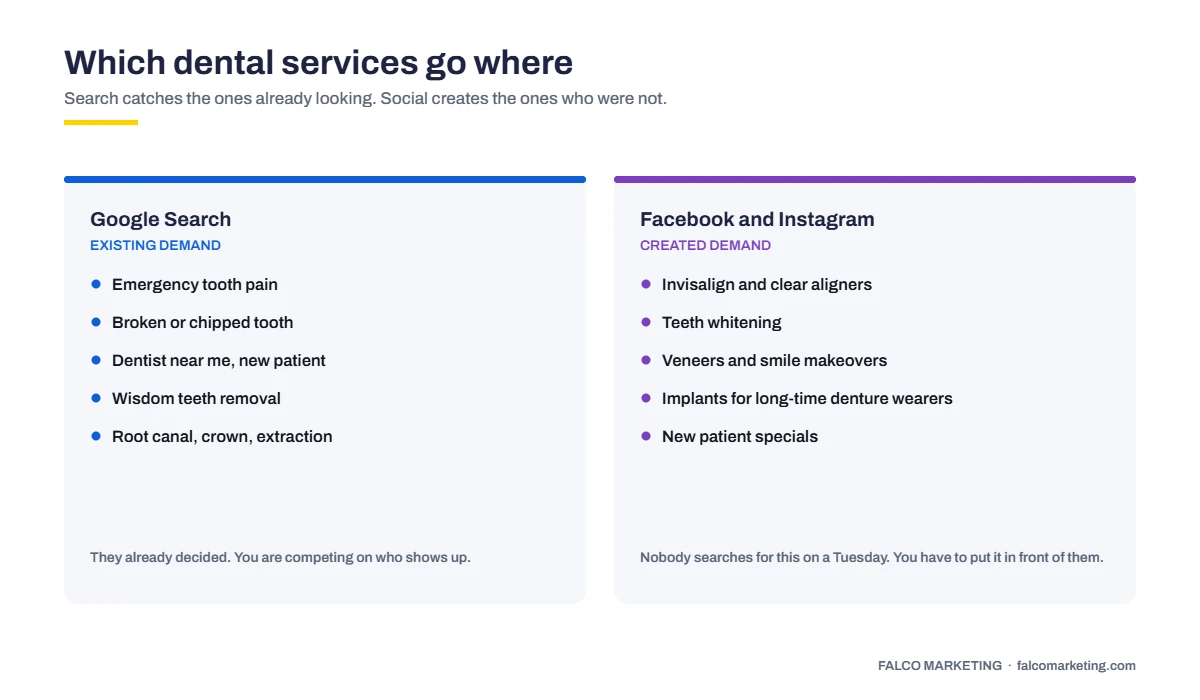
Emergencies, extractions, crowns, a new patient exam: search, every time. Invisalign, whitening, veneers, implants somebody has been quietly embarrassed about for six years: Meta, because nobody searches for a treatment they can’t name. That’s where before-and-after creative earns its keep, and it’s why marketing for a dental practice splits across two platforms in a way an HVAC company’s never will.
What to spend, and how to tell in 60 days whether it’s working
Don’t split a small budget across two platforms. If you have $1,000 a month, put it in one place. Split budgets buy two campaigns that never gather enough data to optimize and one owner who can’t tell which half failed.
If people already search for what you sell, start with Google Ads and add Meta once search is capped out. If they don’t know they want it yet, start with social.
Give it 60 days, and judge it on two numbers you write down before you start: cost per booked job, and how many leads were reachable on the first call. If your Meta leads book at a third the rate of your search leads but cost a quarter as much, the channel is working, whatever the lead-quality griping sounds like.
Kill it if you fixed your response time and reachability stayed bad anyway. That’s a real signal. A high cost per lead in week two is not.
One thing to check before you blame the ads
Pull up your Meta lead list and count how many you called back inside ten minutes. If the honest answer is “not many,” the ads may be fine and your intake is the leak. Cheaper problem to fix, and fixing it makes every other channel you run more profitable too.
Frequently asked questions
Are Facebook ads worth it for a service business?
Yes, if you have something to show and somebody to answer the phone. Meta leads cost less than half what search leads cost in most categories, per WordStream’s benchmarks, but they’re colder, so they need faster follow-up and a longer measuring window. Fix your callback time first.
How much should a local service business spend on Facebook ads?
Enough for the algorithm to learn, which in practice means $600 to $1,000 a month in one campaign for at least 60 days. Spending $200 across four campaigns produces no data and no leads. If that’s your whole budget, put it into search instead.
Why are my Facebook lead form leads so bad?
Because instant forms take two taps and autofill the number, so people submit without really deciding. Only 61% of people who call a business from a digital source even reach a human, and a tapped form is a weaker signal than a dialed call. Either call within five minutes or send traffic to a landing page and make people type.
Should I use Facebook or Instagram for a local business?
Run both. Same ad account, same campaign, and Meta allocates to whichever placement performs. Instagram does better with visual results work like dental and remodeling. Facebook does better for hiring and for older homeowners in towns like Wake Forest and Fuquay-Varina.
Do boosted posts work?
Rarely. Boosting gives you almost no targeting or objective control and optimizes for engagement, so you pay for likes from people who will never buy. Build it properly in Ads Manager or spend the money elsewhere.
Not sure Meta belongs in your mix at all?
Twenty minutes on the phone with Trey. Tell us what you sell, what a job is worth and what you’ve already tried, and we’ll tell you which platform gets the next dollar. No proposal and no follow-up sequence afterward. If the answer is that you shouldn’t be running ads yet, we’ll say that.
Book a 20-minute callWe work with service businesses across the Triangle.Cost per lead figures are medians from benchmarks published through 2026. Your category and radius will move them.