
The Google Business Profile Checklist for Triangle Businesses
The 22 settings that decide whether you show up on Google Maps, ranked by how much they actually matter in 2026.
Most Google Business Profile checklists run 30 items long and treat every item the same. Add a post. Upload a logo. Fill in the description. Which is how an owner ends up spending a Saturday writing Google Posts nobody reads while the one field that decides everything sits wrong.
So here’s the same checklist, ranked. The order comes from the scores 47 local search experts gave 187 factors.
A Google Business Profile checklist works best ranked by what Google actually weighs. In the 2026 Whitespark study, primary category scored 227 points in the local pack, proximity to the searcher 225, keywords in the business title 223, a physical address in the city of search 213, being open at the time of search 189, and high ratings 181. Fix those before anything else on the profile.
The 2026 local pack factors, in the order that matters
Whitespark’s 2026 Local Search Ranking Factors study came out in November 2025. Forty-seven people who do this for a living scored 187 factors, weighted into point totals. It’s the closest thing local search has to a scoreboard.
Here’s the top of the pack list. Watch the fourth column: half of these aren’t things you can edit.
| Rank | Local pack factor | Points | Can you change it today? |
|---|---|---|---|
| 1 | Primary GBP category | 227 | Yes, in about 90 seconds |
| 2 | Proximity of your address to the searcher | 225 | No. Not without moving |
| 3 | Keywords in the business title | 223 | Carefully, and only if it’s your real name |
| 4 | Physical address in the city of search | 213 | No, short of a second real location |
| 5 | Business open at the time of search | 189 | Yes, but only if someone answers |
| 6 | High numerical ratings | 181 | Yes, over weeks, not overnight |
Caption: Local pack ranking factor scores, Whitespark 2026 Local Search Ranking Factors, 47 contributors, 187 factors.
Look at what isn’t there. Google Posts. The business description. Q&A. Products. All of it gets sold as profile optimization and none of it cracks the scoring. Not worthless. Just not first.
Primary category: the one field most owners get wrong (227 points)
Your primary category is the highest-scored field on the profile, and you picked it once during setup, in a hurry.
The mistake is choosing the category that describes what you do instead of what you are. A dental practice doing a lot of veneers sets primary to “Cosmetic dentist” and quietly leaves the “Dentist” pack, where the volume lives. An HVAC company sets primary to “Air conditioning repair service” and disappears in October.
Check yours in ten minutes. Open an incognito window, search the term you most want to win, and click each listing in the pack. The label under the business name is their primary. If everyone beating you shares a category and you’re using a different one, there’s your answer.
Then add every other service you sell as a secondary. Secondaries carry far less weight, but they’re free and they help on longer searches. One primary, and it should be the biggest thing you do.
Proximity: the factor no checklist can fix (225 points)
The uncomfortable one. The second-strongest pack factor is how far you are from the searcher, and no amount of profile work changes it.
A pest control route based in Clayton will not hold the map pack in North Raleigh. An electrician in Fuquay-Varina does well in Holly Springs and poorly in Durham on the same afternoon. That’s the system working as designed.
What it changes is your targets. Own the pack where your pin sits, rank organically in the towns you serve, and buy the rest. That’s why plenty of our clients run Google Ads for Raleigh next to local SEO. Ads have no proximity rule at all.
Renting an address is the fastest way to lose the profile
Virtual offices, a mailbox at a UPS Store, a friend’s garage in Cary listed as a branch. We see all of it on audits. Google deletes fake business profiles by the million every year, and a fake location is an easy pattern to catch. When the profile goes, it takes your reviews with it.
Keywords in the business title (223 points) and the trap inside it
Third-highest factor. Also the fastest route to a suspension. Both true, which is what makes this field a mess.
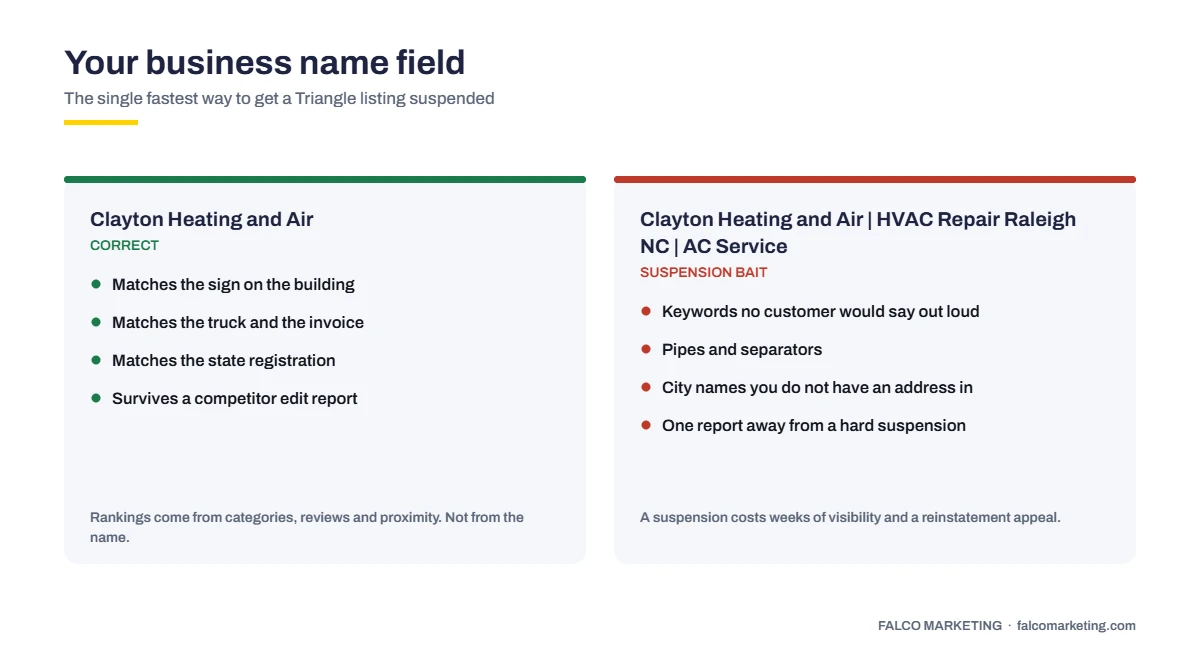
Yes, “Raleigh Plumbing and Drain” outranks “Hendricks Services” for plumbing searches in Raleigh, all else equal. The experts scored it 223 because it works. But your profile name has to match your real-world name: the one on your truck, your invoices and your state registration. Stuffing it earns a competitor’s edit request or a hard suspension, and competitors absolutely do report each other. It’s a two-minute form.
So if your legal name genuinely contains the service word, use the full legal name. “Wake Forest Heating & Air, Inc.” is fine, because that’s who you are. “Wake Forest Heating & Air | AC Repair Near Me | 24/7 Emergency HVAC” is a business asking to be turned off.
Address in the city of search (213 points)
Fourth, and scored separately from proximity. A real address inside the town someone searches from carries its own weight, so yours needs to be exact, verified, and consistent everywhere it appears. If you run two genuine locations with staff and signage, both deserve their own profile. Two profiles at one address has never worked.
Open at the time of search (189 points)
Google reorders based on whether you’re open right now. Nobody thinks of hours as a ranking factor. It’s worth 189 points.
Set them accurately, and set holiday hours in advance. A profile showing “Hours might differ” on the day someone’s heat quits is one they scroll past. And if you say you’re open until 8pm, someone has to pick up at 7:45.
That isn’t a small ask. Invoca’s 2025 benchmark report, built on more than 60 million calls, found only 61% of people who call a business from a digital marketing source reach a human. Extending hours on paper while nobody answers just moves your no-answer rate up.
Ratings and reviews (181 points)
Ratings are the sixth-strongest pack factor, and they matter more for the click than for the rank.
The rest of BrightLocal’s 2026 survey matches what we see: 68% require at least 4 stars before considering a business, and 74% want reviews from the last three months. Recency is the part everyone skips. Whitespark called review recency the most underrated local ranking factor, and five-star reviews that stop in 2023 read like a business that closed.
Getting them is simpler than owners assume: in the same survey, 83% of people who were asked left one. Nobody asks.
Just don’t try to catch up in a weekend. Sterling Sky’s data on review posting blocks found blocks correlate with bursts of 10 or more reviews in a day and with QR codes at the counter. Blocks typically run the full 30 days and survive appeals. One documented business ran 2.75 times its normal volume for three months and lost 342 of its 595 reviews.
Ask a couple of customers a week, from their own phones, after the job. Forever. That’s the whole program. Ours is on the client reviews page if you want to see what steady looks like.

Want us to look at your profile before you touch anything?
Send us your business name and we’ll run a geo-grid from the towns you serve, check your primary category against whoever’s beating you, and flag anything putting your listing at suspension risk. You get a one-page list back with the fixes in order, yours to keep either way.
See how our local SEO worksRather talk it through? Book 20 minutes and we’ll give you a straight read.The 22-point Google Business Profile checklist
Two jobs, two blocks: getting into the pack, and getting picked once you’re there. Work the first top to bottom before touching the second.
Part one: the fields that decide whether you show up
- Primary category matches what the businesses beating you use, not what sounds most specific
- Every service you sell added as a secondary category
- Business name matches your sign and your registration, with zero added keywords
- Address exact, verified, identical to your website footer and every directory listing
- Hours accurate, with holiday hours set in advance
- Special hours set for seasonal swings, since a closed profile loses ground during searches
- One profile per real location with staff, never two at one address
- Service areas match where you’ll genuinely drive, not every county in the state
- Website field points to the matching location or service page, not the generic homepage
- Profile claimed and verified under an email you control, not a former agency’s
That last one catches people. If a previous agency owns your verification, you own nothing.
Part two: the fields that decide whether they call you
- Review count above 20, then growing every week
- Newest review under 30 days old
- Every review answered, bad ones included, in a sentence or two without arguing
- At least a dozen real photos of your crew and finished work, never stock images
- Photos refreshed quarterly, because 2019 photos look abandoned
- Services list filled out, with prices where you’re comfortable publishing them
- Description written for a human, opening with what you do and where
- Attributes set honestly: family owned, veteran owned, appointments required, wheelchair accessible
- Booking or quote link connected if you take appointments online
- Q&A seeded with the questions you answer on the phone all day, answered by you
- Messaging turned on only if someone checks it inside an hour, otherwise off
- Call tracking number in the phone field, main line secondary, so you can see what the profile produces
Twenty-two items, most of them two minutes each. The two that take real effort, reviews and photos, are the two that keep working after you stop.

What a service area business should do differently
If you work out of a truck and meet customers at their homes, some of the above changes.
Hide your address. Google requires it, and putting a home address on a public profile is a bad idea anyway. Hiding it does not move your pin, so it buys you nothing in a different town. It just keeps your driveway off the internet.
Keep the service area list honest. Listing 40 towns claims ground you can’t hold in the pack. Name the towns you’d actually drive to on a Tuesday, then build a page on your site for each. Geographic keyword relevance scores 190 points as an organic factor, and organic doesn’t care about proximity the way the pack does. That’s how you reach the towns your pin can’t. Our areas we serve page is built that way.
What you can skip
Google Posts, unless you have something real to say. They expire, they don’t score, and a weekly post about seasonal maintenance is busywork dressed up as marketing. Bulk citation services too: buying 300 directory listings does nothing the 20 that matter didn’t already do.
How to tell if any of this worked
Give it 60 days, then open the profile’s performance report with the year-over-year comparison turned on. Calls and website clicks are what you’re watching, and direction matters more than the number.
One caveat on calls. Sterling Sky’s 2026 state of local search tracked 179 Google Business Profiles across 34 law firms over two years and found call clicks declining while website clicks held steady. Flat calls with rising clicks isn’t necessarily a loss.
The same report found local pack ads went from about 1% of tracked mobile results in early 2025 to nearly 22% by December, with Local Services Ads on roughly 31% of tracked queries. The free part of the map keeps getting pushed down the screen. Optimizing the profile is still the highest-return hour in local marketing. It’s no longer the whole game.
Frequently asked questions
What is the most important part of a Google Business Profile?
Your primary category. It scored 227 points in Whitespark’s 2026 study, the highest of any local pack factor, and it’s the field owners most often set wrong. Pick what the businesses already ranking use, then add the rest as secondaries.
Why am I not showing up on Google Maps?
Usually your primary category doesn’t match the search, or you’re too far from the searcher. Proximity is the #2 factor at 225 points and no optimization fixes it. Check the category first, then check whether you rank fine near your address and fail only across town.
Can I put keywords in my Google Business Profile name?
Keywords in the title score 223 points, so they work, and adding ones that aren’t in your real name violates Google’s guidelines. Competitors report it constantly. Use your full legal name. If it happens to contain a service word or a town, that’s fair game.
How many reviews do I need?
At least 20, since 47% of consumers in BrightLocal’s 2026 survey won’t use a business with fewer. After that, recency matters more than volume. 74% want reviews from the last three months, so a steady trickle beats a pile from two years ago.
How often should I update my profile?
Photos quarterly, reviews weekly, hours whenever they change. Everything else gets set once and left alone.
Do I need a physical address to rank locally?
For the map pack in a specific town, essentially yes. Address in the city of search is worth 213 points on its own. Service area businesses should hide the address, but the pin still sits where it sits. For towns you can’t reach, use dedicated service-area pages and paid search.
Not sure which of the 22 you’ve already got right?
Take us up on a 20-minute call. Pull your profile up on your screen and we’ll go field by field, so you leave knowing what’s worth fixing this week. No proposal, no follow-up sequence, no pitch deck. If it’s already in good shape we’ll say so and hand the time back.
Book a 20-minute callOr read what we actually do on the Raleigh local SEO page first.Ranking factor scores come from Whitespark’s 2026 Local Search Ranking Factors, published November 2025. Consumer figures come from BrightLocal’s 2026 survey. Current as of July 2026.