
Five Emails That Make Money for a Service Business
You already have the list. Five emails that turn past customers into repeat jobs, with the exact timing to send each one.
Every new lead you bought last month cost you money. In home services the median cost per lead on Google search is $90.92. Dental runs $72.97. Legal runs $131.63.
The people who already paid you cost nothing to reach. Their email addresses are sitting in your invoicing software right now, and most of them haven’t heard a word from you since the receipt.
So this isn’t a post about starting a newsletter. It’s five specific emails, with timing.
Email marketing for service businesses works on people who already know you, not on cold prospects. Five emails cover nearly all of it: the unsold estimate follow-up, the annual service reminder, the 18-month reactivation, the review request and the seasonal offer. Response rates hover near 1%, so treat email as a way to work your existing list rather than find new customers.
Why email marketing for service businesses beats buying another lead
Your customer list is an asset you built by doing good work, and it depreciates every month you ignore it.
Think about what a repeat job costs you. No click. No lead form. You email somebody who already had your truck in their driveway, and if they book, your acquisition cost is a fraction of a cent.
We look at a lot of accounts. The pattern we run into most often is an owner spending four figures a month on ads while sitting on 2,000 past customers he has emailed zero times. He’ll argue about a $6 keyword bid for twenty minutes and never send a note to the people who already trust him.
The honest limitation nobody selling you email software will mention
Email is bad at finding new customers. Genuinely bad.
Look at the response rate data compiled from the ANA report: email averages about 1%, while direct mail to a house list pulls 5% to 9%. Paid search sits near 2%. Social is under 1%. On return, direct mail averages 161% against email’s 44%.
So if your goal is reaching households in Fuquay-Varina who have never heard of you, a mailer beats an email badly. That’s not us talking down our own channel, it’s just what the numbers say, and it’s why we sell design and print alongside the digital work.
But read the same table the other way. That 1% is an average full of businesses blasting purchased lists. An email to somebody whose water heater you replaced two years ago is a different animal. The channel isn’t weak. It’s aimed at strangers when it should be aimed at friends.
Do not buy an email list
Ever. Purchased lists tank your sender reputation, and once your domain is flagged, the emails you send to real customers start landing in spam too. You’ll have broken the one asset this post depends on. To reach people who don’t know you, mail them a postcard.
Email 1: the unsold estimate follow-up (day 3 and day 10)
This is the one that pays for everything else.
You wrote a quote. They said they’d think about it. Then nothing, and you assumed they went with somebody cheaper. Sometimes they did. Very often the quote is buried in an inbox under 40 other emails and the job never got done at all.
Send two.
- Day 3. Subject line: Anything on the quote you want me to walk through? Two sentences. Offer to explain one line item. Do not discount anything.
- Day 10. Subject line: Should I close out your file? This is the one that gets replies, because it’s easy to answer and it gives them permission to say no.
Day 10 will feel rude the first time. Send it anyway. Half the replies will be some version of “sorry, been slammed, can you come Thursday.”
Why day 10 beats day 30
At day 10 the homeowner still remembers your name. By day 30 they’ve had two more companies out and your estimate is a number without a face attached. Buyers in this market move fast: in legal services, 50% of clients expect a same-day response.
Email 2: the annual service reminder
Every service business has a natural clock. Filters, tune-ups, cleanings, inspections, termite renewals, hearing aid checks.
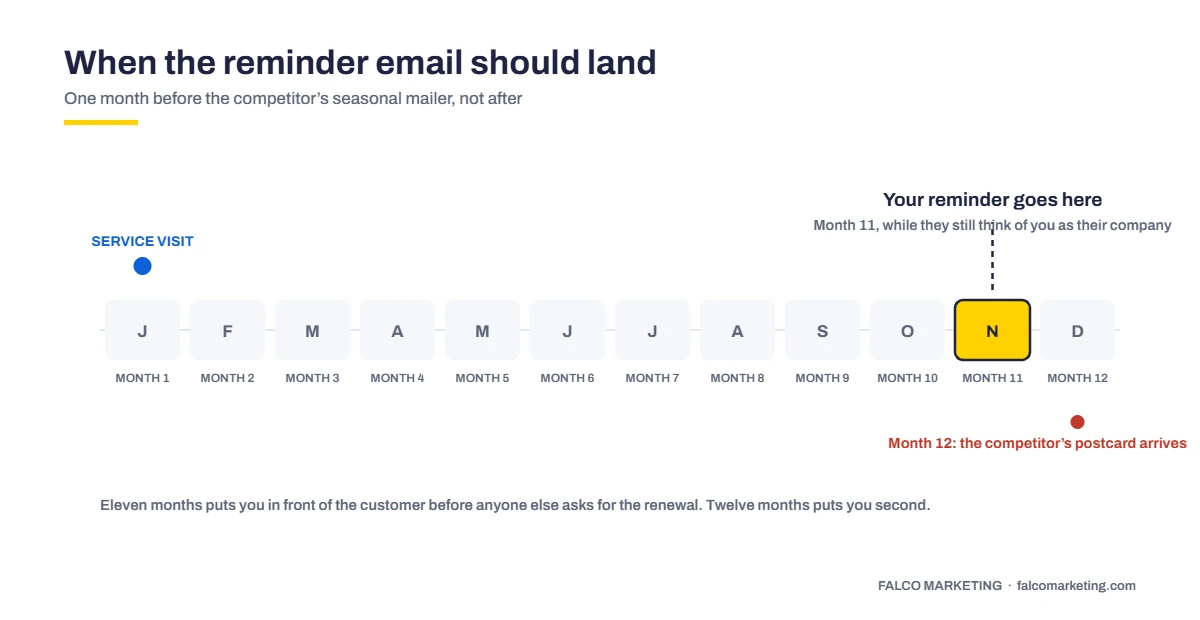
Send it at 11 months from the last visit, not 12. You want to be in the inbox before the competitor’s postcard hits the mailbox and before the busy season books out.
Subject line: Your spring tune-up is due, want your usual slot?
Two things make this work. Reference the exact date of the last visit, because it proves you keep records. And name a time instead of asking an open question. “I have Tuesday the 14th at 8am or Thursday the 16th at 1pm” gets a reply. “Let us know if you’d like to schedule” does not.
Send it Tuesday or Wednesday morning. Monday inboxes are a war zone and Friday afternoon is a black hole.
Email 3: the reactivation email to customers who went quiet
Anybody who hasn’t booked in 18 months is functionally a stranger again. Treat that as an emergency, not a fact of life.
Pull everybody with no invoice in 18 to 36 months. Send one email in a shoulder season, so late February or early September for most home services.
Subject line: It’s been a while, is everything still running right?
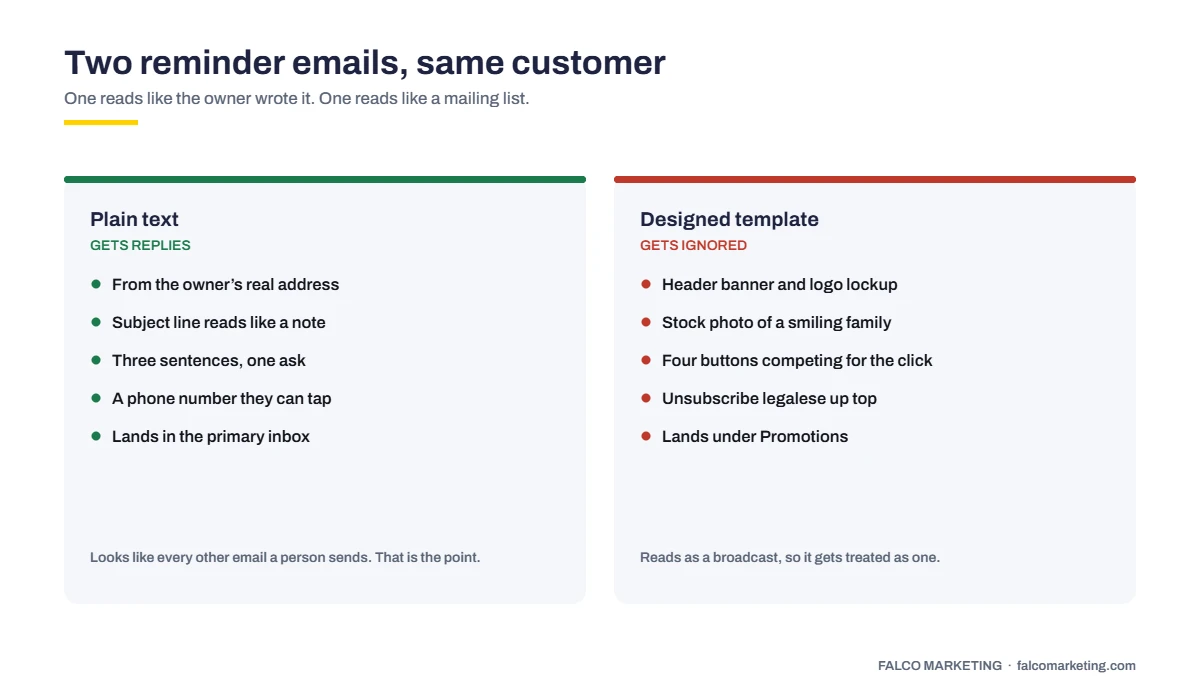
Keep it plain text. No graphics, no coupon banner. Say how long it’s been, say what typically needs attention at that interval, and give a direct phone number. Expect bounces and a few unsubscribes. Both are fine. A bounce tells you the address is dead, which is information you needed anyway.
One more thing about the Triangle. Wake County is up 11.3% since April 2020 and Johnston County is up 18.7%, so a real chunk of your quiet list moved. Plenty went from Raleigh out to Clayton or Wendell and assumed you don’t drive that far. Say in the email where you work.
Want a second opinion on where your leads come from?
Get on a 20-minute call and we’ll compare what you pay per lead by channel against what your existing customer list could produce for free. No proposal, no slide deck, no follow-up sequence afterward unless you ask for one.
Book a 20-minute callOr look at everything we handle for Triangle service businesses first.Email 4: the review request
This is the one owners are most nervous about sending, and the nervousness is misplaced. BrightLocal’s 2026 survey of 1,002 US consumers found that 83% of people who were asked to leave a review actually left one. The share who say they “always” write one when asked jumped to 28% from 16% the previous year. People are not annoyed by the ask. They’re waiting for it.
Timing: the next business morning, roughly 24 hours after the job wraps. Not the same afternoon while they’re still cleaning up, and not a week later once the relief has worn off.
Subject line: Would you mind telling people how it went?
Why this matters beyond feeling good: 47% of consumers won’t use a business with fewer than 20 reviews, and 74% want to see reviews from the last three months. A wall of five-star reviews from 2023 reads as a business that stopped caring. You only fix recency by asking continuously, which is why this is an email and not a one-time project. It also feeds your map rankings, which is the whole game in local SEO, and it’s why we treat reviews as standing work rather than a nice extra.
How review requests get your reviews deleted
Sterling Sky’s data on review posting blocks found they correlate with reviews submitted from inside the business location, QR codes at a counter, and bursts of 10 or more reviews in one day. One documented case lost 342 of 595 reviews. So don’t hand a tablet to a customer in your lobby and don’t email 400 people on the same Tuesday. Trickle them out as jobs close.
Email 5: the seasonal offer
One a quarter. Four a year. That’s the whole cadence.
Send it three to four weeks before the season turns. The first 90 degree day in Raleigh is not when you want to be pitching AC tune-ups. You want to be booked by then.
Subject line: Pre-season AC check, $89 through March 15
Put the price and the deadline in the subject line. A vague “spring savings event” gets ignored, because it makes the reader open an email to find out whether it’s relevant.
| When to send | Who gets it | |
|---|---|---|
| Unsold estimate follow-up | Day 3 and day 10 after the quote | Anybody who got a quote and didn’t book |
| Annual service reminder | 11 months after last visit | Every past customer on a service cycle |
| Reactivation | 18 to 36 months of silence, shoulder season | Lapsed customers only |
| Review request | Next business morning after job completion | Every completed job, trickled out |
| Seasonal offer | 3 to 4 weeks before the season turns | Whole active list, four times a year |
Caption: The five emails, the timing that makes each one work, and who should receive it.
Staying out of the spam folder without becoming a deliverability nerd
You don’t need to understand DMARC records. You do need four things.
Four things that keep your emails in the inbox
- Send from your own domain, not a Gmail address, and have whoever set up your email confirm SPF and DKIM are in place
- Use a real sending platform instead of BCC-ing 300 people from Outlook, which is the fastest way to get flagged
- Keep an unsubscribe link in every send and honor it immediately
- Clean bounces after every campaign, because repeatedly mailing dead addresses is the strongest spam signal you control
Plain text beats a heavy template for these five anyway. An email that looks like it came from a person gets opened like it came from a person.
What to do this week
Export your customer list and sort by last invoice date. Everybody past 18 months goes in one bucket. Everybody with an unsold estimate from the last 90 days goes in another.
Send the estimate follow-ups first. Shortest to write, closest to money.

Frequently asked questions
How often should a service business email its customer list?
Less than you think. Four of these five emails fire off an event rather than a calendar, so most customers hear from you a handful of times a year. The seasonal offer is the only scheduled send.
Does email marketing actually work for contractors?
On your own customers, yes. On strangers, no. Email averages roughly a 1% response rate against 5% to 9% for direct mail to a house list, so email the people who already hired you and mail the households that never have.
What’s the best day to send a service reminder email?
Tuesday or Wednesday morning. Monday competes with the weekend backlog and Friday afternoon gets buried until the following week.
Is it rude to ask customers for a review by email?
No. 83% of consumers who were asked left a review, and 78% got a request in the past year. What’s actually risky is asking 400 people at once, which can trigger a review posting block.
How do I email past customers without getting marked as spam?
Send from your own domain with SPF and DKIM configured, use a real sending platform, include an unsubscribe link, and remove bounced addresses after every send. Never buy a list.
What if my customer list is a mess?
Start with the last 24 months, which is where the money is anyway. Clean the older records later, and expect a lot of them to be stale addresses you’d have bounced regardless.
Grab the five-email swipe file
We’ll send the actual copy for all five emails, the trigger timing for each, and a one-page setup checklist for your sending domain. About an hour to load into whatever software you already use, and you keep the document whether or not we ever speak again.
Tell us where to send itOr see what else we do for businesses across Raleigh, Cary, Apex and Wake Forest.Benchmark figures current as of July 2026. We update this post when the studies refresh.