
The Year-End Dental Benefits Campaign: A 90-Day Plan to Fill Q4 Chairs
Most practices start reminding patients in November. By then December is gone. Here's the October-through-December sequence, week by week.
Start October 1. Not November 15.
The date matters more than the copy does. December’s schedule doesn’t fill with new patients. It fills with people who already sat in your chair this year, heard “you need a crown,” nodded, and never booked it. Pulling that list and splitting it into groups worth different messages takes two to three weeks before a single text goes out. So if your first “use your benefits” email lands the Monday after Thanksgiving, you’re fighting every other practice in Wake County over the same eleven business days.
Most practices start in November. That’s three weeks too late, and it’s the most common reason a dental year end insurance marketing push underperforms.
A dental year end insurance marketing campaign should run ninety days, not three weeks. October is for pulling and segmenting your unscheduled treatment and overdue recall lists. November is for benefit messaging with real dollar amounts attached. December is for same-week openings and a live cancellation list. Practices that wait until after Thanksgiving lose most of the December schedule.
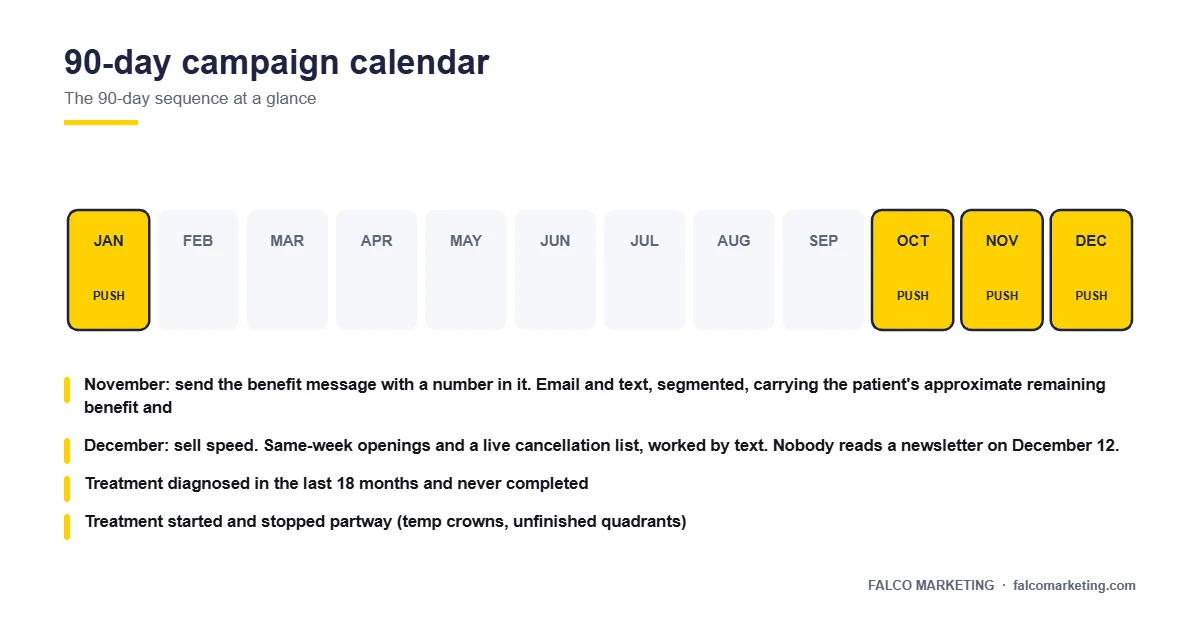
The 90-day sequence at a glance
Three months, three jobs. Don’t mix them up.
- October: build the lists and work the warmest one. Pull diagnosed-but-unscheduled treatment, then everyone with unused benefits and nothing on the books. Then start calling the treatment list, because it takes the longest to work and books at the highest rate.
- November: send the benefit message with a number in it. Email and text, segmented, carrying the patient’s approximate remaining benefit and how many covered visits are left.
- December: sell speed. Same-week openings and a live cancellation list, worked by text. Nobody reads a newsletter on December 12.
Everything else is decoration. Run those plays on those dates and you’ll seat more December production than a practice that starts buying ads December 1.
Why dental year-end insurance marketing matters more this year
For a decade this campaign was optional. Practices across the Triangle were full. Now they aren’t.
Wait times tell the same story from the patient’s side. Average time to get a new patient in the door has dropped to 12.4 days, down from 13.4 the quarter before. Shorter waits sound like good service. Usually they’re a sign of open chairs.
The money is still there. Consumer dental spending hit $208 billion in January 2026, up 4% year over year. Patients are spending. They just haven’t decided where yet.
October: the list nobody pulls
Ask a practice manager in Raleigh what her reactivation list is and she’ll say “the ones due for a cleaning.” That’s the weakest list you own.
The list that fills December is diagnosed treatment that never got scheduled. Somebody told that patient they needed a crown. They said yes with their face and no with their calendar. That’s not a cold lead. That’s a patient with a diagnosis, an insurance plan and a reason.
Pull five segments in the first week of October:
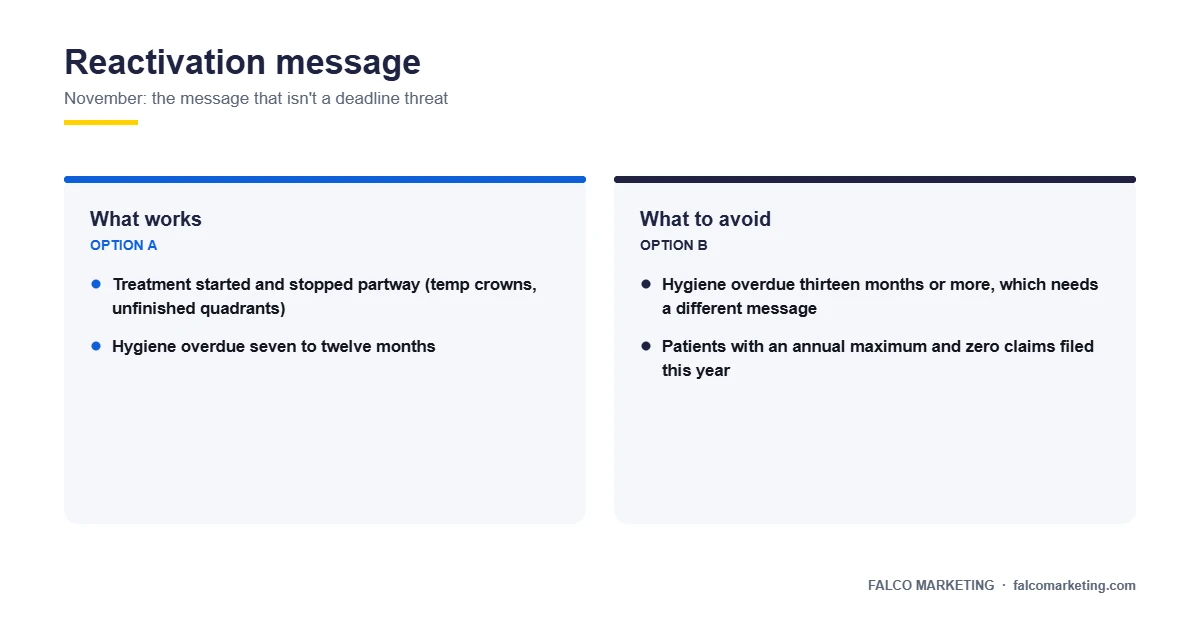
- Treatment diagnosed in the last 18 months and never completed
- Treatment started and stopped partway (temp crowns, unfinished quadrants)
- Hygiene overdue seven to twelve months
- Hygiene overdue thirteen months or more, which needs a different message
- Patients with an annual maximum and zero claims filed this year
Then clean them. Wrong numbers, dead addresses, deceased patients, people who moved to Holly Springs and told you so. We see this constantly on audits: a practice mails to a list where a fifth of the addresses are dead. Two weeks of cleanup saves real money.
Work the treatment list by phone in the second and third weeks of October. Not email. Phone, real person, two specific times offered. That call takes longer than a blast, and it’s why the campaign starts when it does.
Don’t start with a mass email
Blasting “your benefits expire” to your whole database in early October trains people to ignore you for ninety days. Your best segment gets the phone. Everyone else waits for November.
November: the message that isn’t a deadline threat
Everybody sends the same email. “Don’t lose your dental benefits! They expire December 31!” Patients have gotten that one since 2011 and it reads like a car warranty robocall.
What moves the response rate is a number. Not a threat, a number. Compare these two:
Don’t let your dental benefits go to waste! Call today to schedule before December 31.
versus
Hi Karen, our records show you have about $840 in dental benefits left this year and one hygiene visit still covered. We have Tuesday the 17th at 8am or Thursday the 19th at 3pm. Want either one?
The second one does the math the patient was never going to do. Most people have no idea what an annual maximum is, let alone how much of theirs is sitting unused. Tell them, give a range if your software won’t produce an exact figure, and offer two times instead of asking them to call.
Text carries the short version. Email carries the patients who need to see the treatment plan again. Both go out in the first two weeks of November, second touch around the 18th. Thanksgiving week is dead. Land before it.
December: same-week openings and the cancellation list
December is an operations problem, not a marketing problem.
By the first week of December your schedule is set, and every gap that opens after that is a same-week gap. A patient cancels Tuesday for Thursday. Somebody’s kid gets sick. That hour is worth your full hourly production, and it’s gone unless somebody fills it inside 48 hours.
This is where automation stops being a buzzword and starts being money. You need a standing list of patients who said “call me if anything opens up,” and a system that texts them within minutes of a cancellation instead of waiting on a front desk that won’t have a free moment in December. Two options in one text, one tap to confirm.
Two other December moves. Text anyone who opened your November email and didn’t book, on December 1, while that intent is still warm. And post your holiday hours everywhere, Google Business Profile included, before December 15. A patient searching “dentist open Friday” who sees stale hours books in Cary instead.
Want the plan built for your practice?
Send us your active patient count, your open chair hours for December, and whether you can pull an unscheduled treatment report out of your software. We’ll build you a Q4 chair-fill plan: which lists to work, in what order, the message for each and the dates they go out. One page, and your team runs it without us.
Get your Q4 planNo proposal attached, and you keep the plan either way.What to pay for a new patient in Q4
Work your own list first. But if you’re adding paid search on top, know what a lead should cost before your agency tells you.
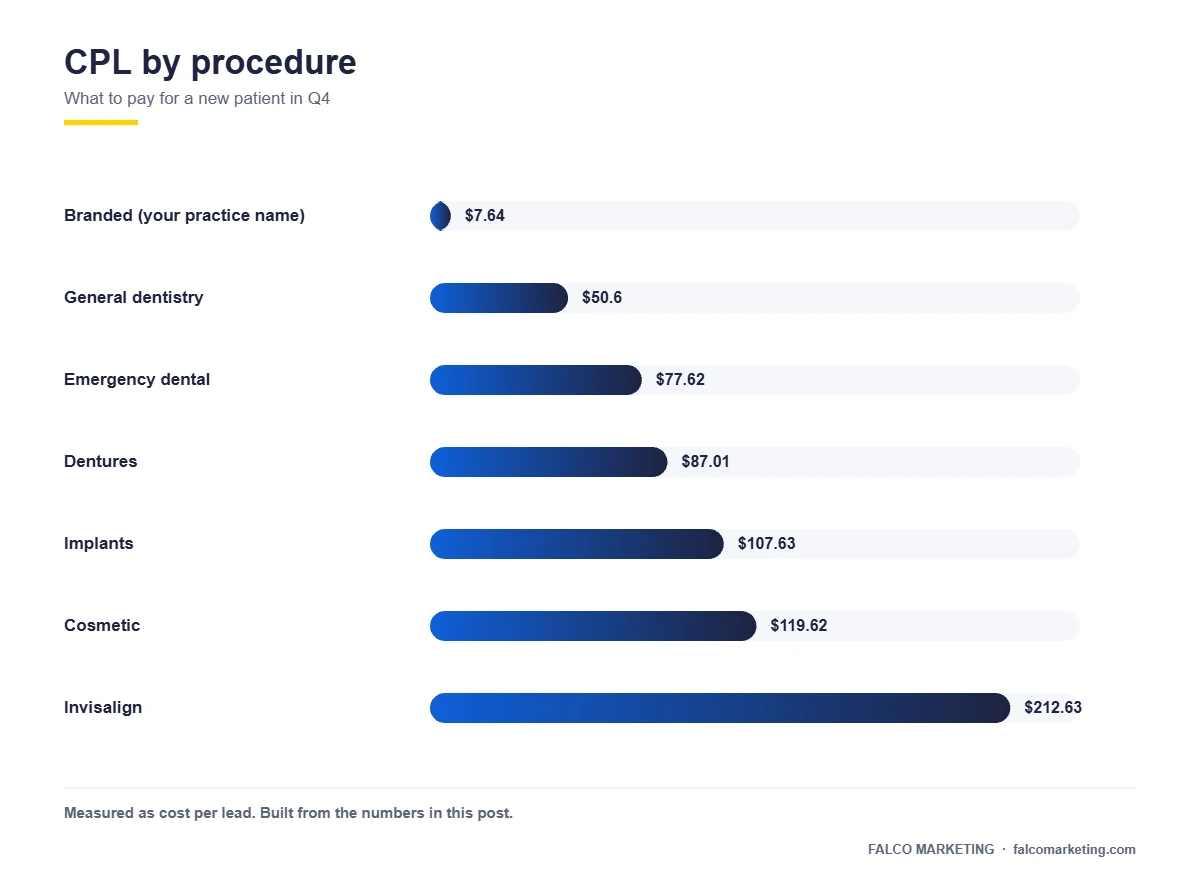
Median dental cost per lead on Google Ads sits at $72.97, on a $8.00 click and a 10.67% conversion rate. That blended number hides a huge spread by procedure.
| Search type | Cost per lead |
|---|---|
| Branded (your practice name) | $7.64 |
| General dentistry | $50.60 |
| Emergency dental | $77.62 |
| Dentures | $87.01 |
| Implants | $107.63 |
| Cosmetic | $119.62 |
| Invisalign | $212.63 |
Caption: Dental cost per lead by service type. Source: Delmain, June 2026, 180+ Google Ads campaigns on a rolling 120-day window.
An Invisalign lead costs about four times a general dentistry lead. Fine if your case value supports it, disastrous if you’re bidding Invisalign to fill hygiene. General dentistry also converts better, at 11.9%.
One quirk: Facebook lead campaigns for dental run $76.71 per lead, roughly at parity with Google search. In most industries Facebook leads come in far cheaper and far colder. In dental they aren’t cheaper, so if someone pitches social as your budget option for Q4, ask to see the numbers. Our cost per lead breakdown runs the same comparison for other industries.
Don’t buy volume you can’t seat
Here’s the part your vendor won’t say out loud, because it argues against selling you more ads.
Of practices that tried to recruit hygienists in a recent three-month window, 91.7% called it very or extremely challenging. So before you spend a dollar on demand, count your real open hours in December. Not ideal capacity. The hours you can actually staff.
If hygiene is the bottleneck, stop selling cleanings. Sell restorative work that fills doctor time you already have. Filling chair time you own beats generating demand you have to turn away, and turning people away in December is how you lose them in March.

The AI Overview problem in healthcare search
Something shifted in how patients research dental questions, and it changes what you publish this fall.
AI Overviews now appear on 92% of informational local queries and 97% of hybrid queries, but on only 15% of pure local-intent queries. Translated into dental: “does my insurance cover a crown before the end of the year” gets answered above your page and the patient may never click. But “dentist near me” and “dentist in Apex” still send the click to a map pack and a website.
Two consequences. Your Google Business Profile carries more weight on the searches that still convert, so hours, categories, photos and recent reviews are worth an afternoon in October. And your own pages should answer the benefit questions in plain language up top, because that’s what AI systems quote when they cite anybody.
The one-page Q4 checklist
Print this. Tape it behind the front desk.
Your Q4 chair-fill checklist
- Week of Oct 1: pull the five lists, clean phone numbers and addresses
- Weeks of Oct 8 and Oct 15: call the unscheduled treatment list, two specific times offered on every call
- Week of Oct 22: audit your Google Business Profile hours, categories, photos and reviews
- Week of Nov 2: benefit email and text with dollar amounts, segmented by list
- Week of Nov 16: second touch to non-responders, ahead of the Thanksgiving dead zone
- Dec 1: short text to November openers who didn’t book
- Dec 1 to 15: post holiday hours everywhere, profile and voicemail included
- All December: same-week cancellation list, text-first, confirm in one tap
- Dec 20: list everyone who declined, so January starts warm
That last line matters more than it looks. Every patient who says “let’s do it after the first of the year” is a January booking if somebody writes the name down. Most practices don’t, then start January cold. Our January playbook covers the handoff.
One warning. If you’re running ad pixels or retargeting on pages tied to patient conditions or treatment, read what practices can’t do with tracking first. Those rules are stricter than most agencies act like they are.
Frequently asked questions
When should the first message go out?
First week of October, and it should go to patients with diagnosed-but-unscheduled treatment. That group books at a far higher rate than a cold recall list, and it takes weeks to work because it’s phone work, not email.
Does the “benefits expire” message actually work?
It works when it’s specific. “You have roughly $840 in remaining benefits and two covered visits left this year” outperforms a generic expiration warning by a wide margin. The generic version has been landing in patients’ inboxes every December for fifteen years. They’ve learned to skip it.
Should I run ads too, or just work my own list?
Work the list first. It’s cheaper and it seats faster. Add paid search for procedures with real margin, knowing implant and Invisalign leads run three to four times a general dentistry lead.
What if I can’t staff enough hygiene hours to see them?
Then point the campaign at restorative work and treatment-plan completion instead of cleanings. Filling doctor time you already have beats generating demand you have to turn away.
Is it too late if it’s already November?
No, but compress it. Pull the unscheduled treatment list this week, call it next week, skip the general recall blast. A focused campaign to your best 200 patients beats a wide one to 2,000 when you’re short on days.
The December cancellation list, handled automatically
We build the recall and reactivation automations that text your ASAP list the minute a slot opens, follow up with non-responders on a schedule, and stop when someone books. It’s the piece a busy front desk cannot do by hand in December.
See how we automate recallOr tell us what your Q4 schedule looks like and we’ll tell you whether automation is your problem or your list is.Benchmarks current as of September 2026. We update this post when the ADA and WordStream figures refresh.