
“They Promised the Sun, Moon and Stars”: 11 Red Flags in a Marketing Sales Pitch
Evergreen renewals, phone-only cancellation, a website you don't own. The 11 things to check in a proposal — pulled from real complaint records.
Ask one question on the sales call and most of this sorts itself out.
“Who specifically will touch my account every week, and can I meet them before I sign?”
A good answer is a name, a role and a calendar invite. A bad answer is “you’ll be assigned a dedicated account manager during onboarding.” That one tells you the person selling you and the person doing the work have never spoken.
That’s number two on the list below. Here are all eleven, in the order they show up: sales call, proposal, contract, first ninety days.
One disclosure first. We’re a marketing agency in Raleigh. A post teaching you to distrust agency pitches is bad for the part of our business that runs on pitches, good for the part that runs on trust. We’ll take that trade.
The marketing agency red flags worth acting on are contractual, not stylistic. Watch for an evergreen auto renewal, cancellation by phone only during business hours, contract terms that live on the agency’s website, “month to month” with a committed dollar amount buried inside, and an agency that owns your website, ad account or Google profile. Results quoted before anyone audited your account is the other big one.
The eleven marketing agency red flags, in one list
- They quote results before they’ve looked at your account.
- The people in the pitch meeting won’t be on your account.
- The contract auto renews for another full term unless you catch it.
- Cancellation is phone only, business hours only.
- There’s a second part of the contract you haven’t read.
- “Month to month” with a committed portion inside it.
- The website is theirs, not yours.
- They own the ad account, the Google Business Profile or the tracking numbers.
- Reporting is a branded dashboard instead of the actual platform.
- They’re selling AEO, GEO or AISO as a separate line item.
- They cold called you.
The quotes below come from customer-filed complaints in public BBB records. They’re allegations, not findings, and companies dispute them through the BBB process. We use them because the mechanics they describe are checkable in your paperwork.
1. They quote results before they’ve looked at your account
A rep who quotes your cost per lead in the first meeting is reciting a memorized industry median. He hasn’t seen your search terms report.
Owners on r/PPC name it first: “Overpromising without a thorough audit of the account.”
Across 15,666 accounts, the average one wasted $1,127.54 a month out of $3,127.38 in spend, about 36% of budget, and 29% recorded zero conversions over 90 days. Nobody can predict what your account will do without opening it.
Ask him to look first and come back with a number. If he won’t, he isn’t selling management. He’s selling a signature.
2. The people in the pitch meeting won’t be on your account
The same r/PPC thread names it exactly: “Presenting senior talent and then giving ad account to junior person.”
Not always malicious: agencies staff sales with their best talkers. But you’re buying whoever logs in Thursday morning and decides which search terms to kill.
Ask for the name and how many accounts that person carries. Over thirty and yours gets touched monthly at best, whatever the retainer says. The hour-by-hour math is in what a marketing retainer actually buys you.
3. The contract auto renews for another term unless you catch it
The most expensive clause in local marketing, and almost nobody reads it. An evergreen renewal turns a twelve-month agreement into a twenty-four month one unless you send written notice inside a window, usually thirty or sixty days before the anniversary. Miss it by a day and you owe another year.
A complaint filed against Thryv with the BBB describes an “account…automatically renewed for multiple years with no previous cancellation requests”.
Put the notice deadline in your calendar with a reminder sixty days ahead, even with an agency you like. The calendar entry costs nothing. The missed window costs a year.

4. Cancellation is phone only, business hours only
If you can only cancel by calling a number between 9 and 5, that’s a design choice. Email creates a timestamp. A call creates a conversation one party remembers differently.
A Townsquare Interactive complaint filed with the BBB states that “cancellations had to be made during business hours to be valid”. Townsquare is headquartered in Charlotte, so plenty of owners in Raleigh, Cary and Fuquay-Varina have taken that call.
Send it in writing anyway. Dated email to a named person, and keep the reply.
5. There’s a second part of the contract you haven’t read
Some agreements incorporate terms “available at” a URL. You sign the order form. The terms that govern the deal live on a page you never opened, and the company can edit it.
A Hibu complaint filed with the BBB describes an “undisclosed portion of the contract, which is only on their website and was NEVER APPROVED”.
The same records showed 44 for Townsquare Interactive and 6 for Scorpion LLC. Counts move, so check them yourself the day you decide.
If a contract references outside terms, ask for a dated PDF. If the rep says he’ll “send the link,” the terms can change after you sign.
6. “Month to month” with a committed portion inside it
This gets past smart people because the phrase does the work.
A Scorpion complaint filed with the BBB says the arrangement was “not wholly month-to-month: $2,000 of the amount I paid was actually committed to a 12-month obligation”.
The structure is usually a cancelable management fee sitting beside a build fee or a “technology license” that isn’t. So don’t ask “is this month to month?” Ask: “If I cancel in month three, what’s the total dollar amount I still owe?” Make him write the number in an email.
7. The website is theirs, not yours
Plenty of agencies build your site on their own platform, host it, and hand you nothing when you leave. You didn’t buy a website. You rented one.
Another Townsquare complaint describes a “generic, template-based website that looked ai generated”. A template you can’t export plus a lock-in term is how a $1,200 a month relationship survives three unhappy years.
Ask before you sign: if I leave, do I get the files and the domain? A “yes” with a fee attached is a no in disguise.
8. They own the ad account, the Google Business Profile or the tracking numbers
Same problem as the website, only worse, because ad accounts carry history. Conversion history teaches Google’s bidding what a good lead looks like for you. Start fresh and it restarts.
Tracking numbers are the quiet one. If the agency owns them and you’ve printed them on trucks in Apex and yard signs in Clayton, leaving means they stop working, or keep working for somebody else.
Full handover list: what your marketing company should hand over if you fire them tomorrow. Read it before you sign, not after you’re angry.
Send us a proposal you’re considering
Including one from a competitor. We’ll mark it up and send it back with the ownership, renewal and reporting terms flagged at the paragraph level. Where the deal is fair, we’ll say so. About half the time the answer is “this one’s fine, sign it.” One day, costs nothing, no follow-up sequence.
Send us a proposalPrefer to start with your own account? The Google Ads audit works the same way.9. Reporting is a branded dashboard, not the platform
A custom dashboard with a big green “Marketing Score” is a design product. It exists so the numbers you’d ask hard questions about sit one layer further away.
You want platform access. Google Ads, Analytics, Search Console, the call log with recordings. If an agency gives you a dashboard but not a login, the dashboard is the point.
Ask for the raw search terms report for the last 90 days. That’s what people actually typed before clicking your ad, and it’s the hardest report to flatter.

10. They’re selling AEO, GEO or AISO as a separate line item
New acronyms show up every year and get sold as a new service with a new fee. This year: answer engine optimization, generative engine optimization, AI search optimization.
An owner on r/SEO who spent $4,200 on it got told: “You got scammed. AEO doesn’t exist, it’s just a made up phrase and a buzzword.”
Blunter than we’d put it, since AI results are real. But for a local service business the exposure is smaller than the pitch implies. Whitespark found AI Overviews on 92% of informational local queries but only 15% of pure local-intent queries. “How do I know if I have termites” gets an AI answer. “Pest control near me” mostly doesn’t.
And the work that gets you into AI answers is the work that already gets you into search: a real page for every service you sell, on a profile that matches reality. Ask which tasks in that line item aren’t in the SEO line already. The honest answer is usually “none.”
11. They cold called you
Not disqualifying by itself. Statistically not great either.
An electrical company owner on r/Contractor gives you the volume: “I’ve been getting around 20 calls from marketers daily pushing AI on Google…they promise the sun, moon and stars, they’re mostly scams.”
From r/smallbusiness, an estimate we think is roughly right: “less than 10% of the agencies you get approached from, or decide to hire, have an actual clue”.
Agencies good at the work tend to be busy with it. A twelve-person outbound floor calling contractors in Wake Forest and Garner exists because outbound is the business model.
And since we’re being honest: we cite WordStream data above, and WordStream is LocaliQ. Their research is good. Their client reviews are what they are. Both can be true, and hiding one would be the selective sourcing this post is about.
Green flags: what a good pitch actually sounds like
A post that’s only cynical doesn’t help you hire anybody. So, the other side.
Best signal: disagreement. From that r/smallbusiness thread: “good agencies actually push back on your ideas sometimes and explain why certain approaches won’t work”. A rep who agrees with everything is optimizing for the close, not for month eight.
The next signal is what they ask. A good pitch asks your margins, your close rate on inbound calls, your average job value and how many jobs a month you can absorb. An agency that never asks what a job is worth can’t tell you what a lead should cost.
And the good ones say when you don’t need them. If every lead comes from one referral partner, a $3,000 a month ad program is the wrong move this year.
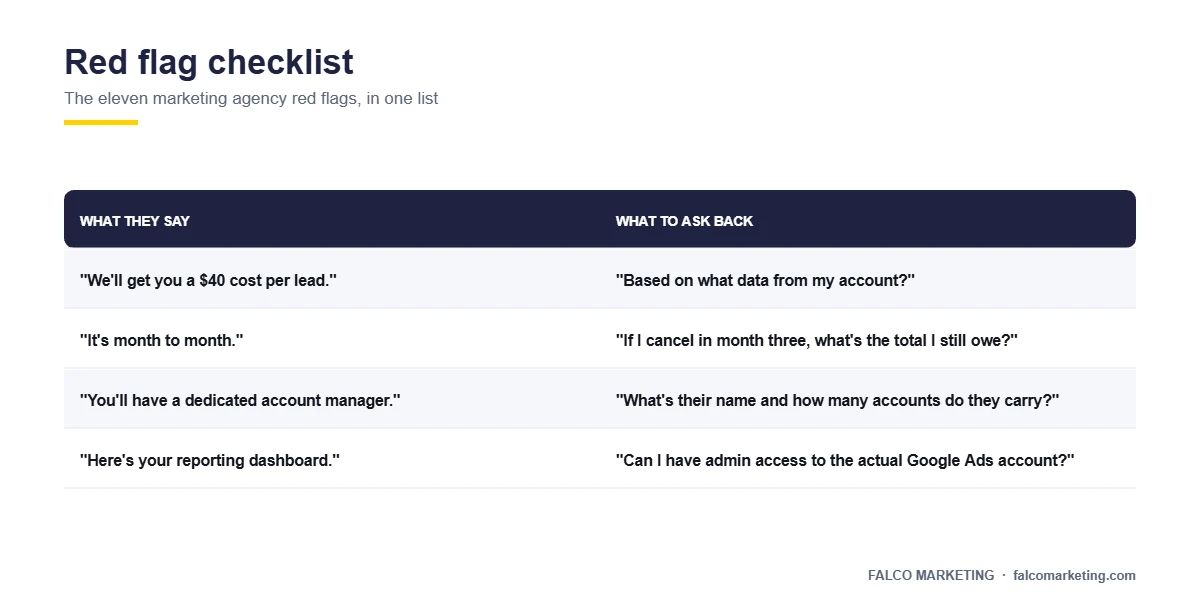
| What they say | What to ask back |
|---|---|
| “We’ll get you a $40 cost per lead.” | “Based on what data from my account?” |
| “It’s month to month.” | “If I cancel in month three, what’s the total I still owe?” |
| “You’ll have a dedicated account manager.” | “What’s their name and how many accounts do they carry?” |
| “Here’s your reporting dashboard.” | “Can I have admin access to the actual Google Ads account?” |
Caption: Four sentences that show up in almost every pitch, and the question that settles each one.
The five questions to ask before you sign
Keep these in your phone.
- Who works on my account weekly, and how many other accounts do they carry?
- If I cancel in month three, what is the total dollar amount I still owe?
- Does this renew on its own, and what’s the exact date my notice is due?
- When I leave, what do I take: website files, domain, ad account, Google Business Profile, tracking numbers?
- Can I have direct admin login to every platform instead of a dashboard?
Longer version: 15 questions to ask a Raleigh marketing agency, with the answers that should make you walk.
What we do differently, stated plainly and checkable
We’re an agency in the Triangle, so treat this with the same suspicion as everything above. All of it is checkable before you pay us a dollar.
You own everything. Website, domain, ad account, Google Business Profile, tracking numbers, in your name from day one, not handed over on good behavior when you leave.
No auto renewal, no committed term hiding inside a monthly fee. If we’re not earning it, firing us takes an email.
You get platform logins instead of a dashboard. Want to read your own search terms report on a Sunday? Go ahead.
And we’ll say when the honest answer is to spend less with us. Sometimes the right call for a $2M shop is running more of this internally, which is why we published an in-house versus agency cost comparison that doesn’t always land on “hire an agency.”
If that sounds like a pitch too, fair enough. Read more about who we are and decide.
Frequently asked questions
Is a 12-month contract automatically a bad sign?
No. Good work needs a runway, and a year is fine for SEO or a build. What’s bad is a 12-month contract you can’t exit for cause, that renews itself, and that you can only cancel by phone during business hours. Three bad signs stacked, and the term is the least of them.
What if the proposal looks great?
Proposals are the product these companies are best at. Ask for three months of raw platform data from a current client in your industry, names removed. One screenshot of a live Google Ads account beats forty pages of deck.
Should I take the free audit they’re offering?
Take it, then check every claim against your own Google Ads and Search Console. Unsolicited audits are usually a sales artifact, and the tell is a “score” out of 100 with no methodology. A real one names the campaigns and the search terms costing you money.
How do I get out of a contract I already signed?
Read the termination clause, put the request in writing on a dated email to a named person, keep every reply, and stop assuming a phone call counts. Documented cancellations that got billed anyway are the most common complaint on record, and the email chain settles it.
Does a BBB complaint mean a company is a scam?
No. Big companies collect complaints, and they dispute them through the BBB process. Read them for mechanics, not verdicts. When unrelated customers describe the same clause working the same way against them, that clause is real and it’s in the contract in front of you.
Not ready to talk to anybody yet?
Pull four things out of the contract on your desk: the renewal paragraph, the cancellation method, every fee that isn’t the management fee, and who owns your website and ad account. Twenty minutes. If any of them gives you a bad feeling, book a 20-minute call and we’ll read the paragraph with you. No proposal, no deck, no follow-up sequence.
Book a 20-minute callOr start with the longer version: 15 questions to ask a marketing agency.