
Does Blogging Still Work for a Local Business in 2026?
Two thirds of Google searches end without a click. Here's what that actually means for your blog, and the four posts still worth writing.
Your blog traffic is down and you didn’t break anything. Google changed the way it answers questions, and the answer usually doesn’t involve sending anybody to your website anymore.
We sell blog writing. We’d make more money telling you to publish twice a week forever. So read this as the version we’d give you in the cab of your truck instead of the version in a pitch deck.
Does blogging still work for local business? Not for traffic. About two thirds of Google searches now end without a click, so posts written to pull visitors mostly don’t. Blogging still works for closing. Pricing posts, comparison posts, problem posts and local posts reach people already deciding, and they’re what AI answers quote back.
Does blogging still work for local business? Here’s the honest math
The number that ended the old model: 68.01% of Google searches ended without a click in early 2026, up from 60.45% in 2024. Google answers the question on the results page. The searcher reads it and moves on.
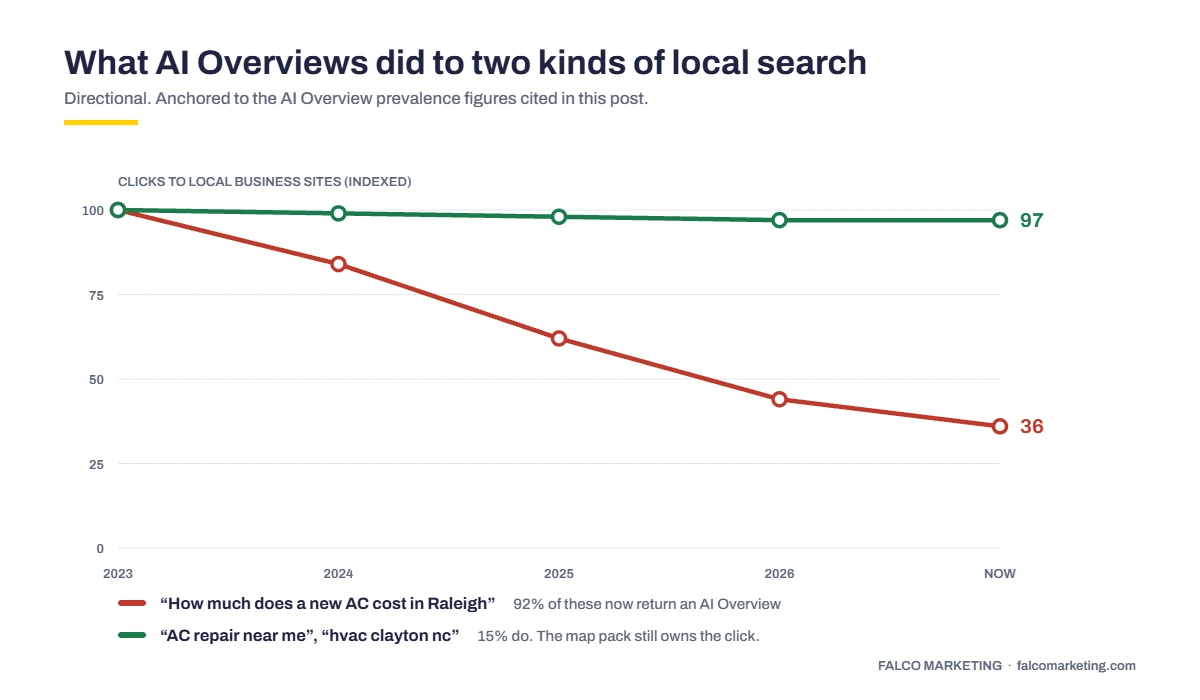
It gets worse for the kind of post most agencies sold you. Whitespark found that AI Overviews show up on 92% of informational local queries. “How often should I change my air filter.” “What causes a slab leak.” “Do I need a root canal or a filling.” “Are termites active in winter.” Those are exactly the posts sitting in your blog archive right now, and Google is answering all of them itself.
And people aren’t only asking Google. BrightLocal found 45% of consumers have used AI tools to get local business recommendations, up from 6%. That’s a lot of buying decisions happening in a chat window you can’t see in Analytics.
So yes. Blogging for traffic is mostly dead for a local service business. Anybody selling you eight posts a month to “build authority” is selling you a 2019 product.
The part nobody tells you: the money queries didn’t change
Here’s the nuance that makes this whole thing worth reading.
That same Whitespark study found AI Overviews appear on only 15% of pure local-intent queries. Somebody typing “emergency hvac repair cary nc” or “pest control fuquay varina” still gets a map pack, still gets ads, and still gets blue links. Google knows that person wants a phone number, not an essay.
Read those two numbers next to each other and the strategy writes itself. The traffic loss is concentrated almost entirely in informational content. The searches where money changes hands are largely intact.
Which means the problem was never that you had a blog. The problem is that your blog was aimed at the wrong half of the search results.
Write your service pages before you write a single blog post
This is the advice that costs us money and we give it anyway.
In Whitespark’s 2026 survey, 47 local search experts scored 187 ranking factors. The single highest-scoring local organic factor, at 210 points, was having a dedicated page for each service you offer. Geographic keyword relevance of your content came in at 190. Keywords in the landing page title tag scored 179.
Notice what isn’t on that list. Blog volume.
If you’re an electrician in Apex with one page called “Our Services” that lists fourteen things you do in a bulleted column, you don’t have a content problem. You have a page problem. Panel upgrades, EV charger installs, generator hookups and troubleshooting each need their own page with their own title tag and their own photos. That work will outrank forty blog posts for the terms that actually produce calls, and it’ll do it faster.
Build those first. We do it as part of a website build or a local SEO engagement, and it’s the first thing we look at on any audit. The pattern we run into most often is a business with a thin services page and a blog archive full of seasonal maintenance tips nobody has read since 2021.
Don’t turn service pages into blog posts
A service page has one job: get the person to call. Price ranges, service area, photos of your actual crew, a phone number that’s tappable on a phone. If it reads like an article, it’s the wrong page. Save the article voice for the blog.
The four blog posts still worth writing for a local business
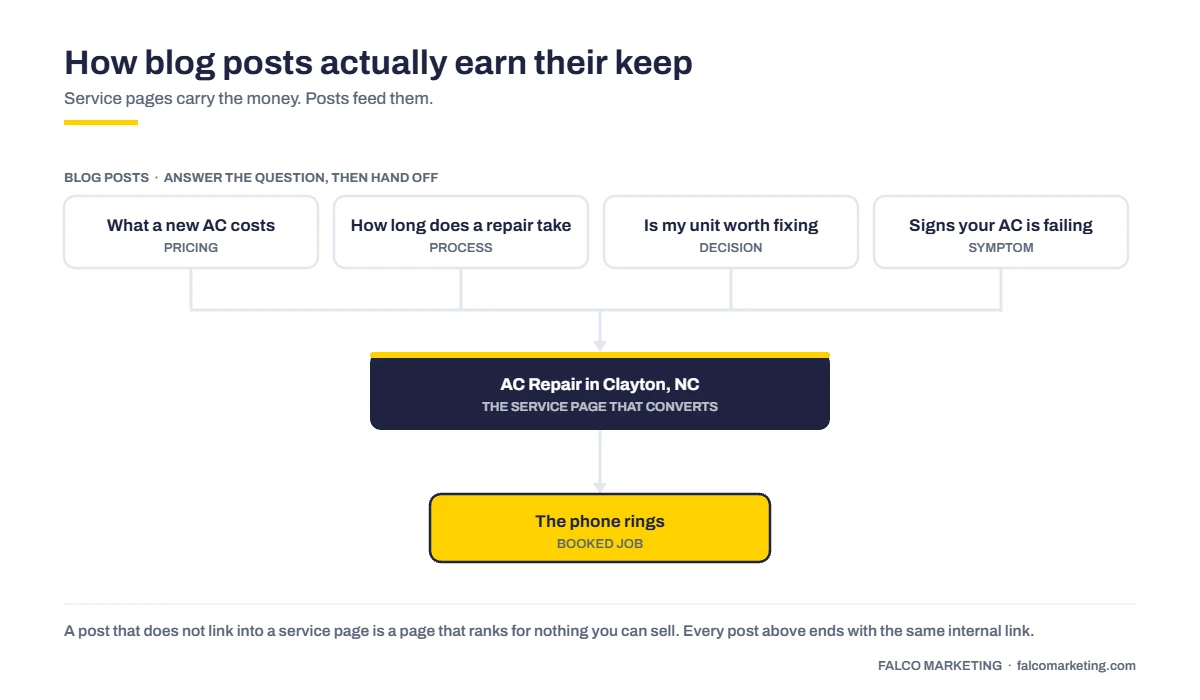
Once your service pages exist, blogging earns its spot again. But only for these four.
1. The pricing post
“What does a new HVAC system cost in Raleigh.” “How much does a roof replacement run in Wake Forest.” Nobody in your industry wants to publish real numbers, which is exactly why the post works. Give honest ranges, explain what moves the price up or down, and be specific about what’s included.
This post does two things at once. It ranks, because the competition is a wall of “it depends.” And it screens. People who can’t afford you never call, which saves you the drive.
2. The comparison post
“Repair or replace.” “Gas vs heat pump.” “Crown or filling.” “Termite bond vs one-time treatment.” Somebody in the middle of a decision reads this, and whoever wrote it becomes the expert they call.
3. The problem-diagnosis post
“Why is my breaker tripping when the AC starts.” Symptom in, likely causes out. Yes, an AI Overview may answer this one above you. Write it anyway, because these are the posts AI answers pull from, and being the source that gets quoted is how a local name enters the conversation now.
4. The local post
“Best time of year to reroof in North Carolina.” “Why crawl spaces flood in Johnston County clay.” Anything that could only have been written by somebody who works here. This is the hardest type for a national competitor to copy and the easiest for you to write, because you already know it.
| Post type | What the reader is doing | What it does for you |
|---|---|---|
| Pricing | Budgeting, comparing quotes | Ranks against weak competition, screens out tire kickers |
| Comparison | Deciding between two options | Positions you as the one who explained it |
| Problem diagnosis | Panicking at 9pm | Gets cited by AI answers, builds name recognition |
| Local | Checking whether you understand the area | Impossible for out-of-town competitors to fake |
Caption: The four post types that still earn their keep for a local service business in 2026.

Not sure which four posts you should write?
Get on a 20-minute call and we’ll go through your service pages and the questions you get asked on estimates, then tell you the exact four posts to write next. No proposal, no follow-up sequence, and you’re free to go write them yourself. Most of these calls run about fifteen minutes.
Book a 20-minute callOr look at everything we handle for Triangle service businesses first.How often should a small business blog?
Less than you’ve been told, and more consistently than you’ve managed.
One genuinely useful post a month beats twelve rushed ones in January and nothing after. Four posts a year that answer real buying questions beat fifty-two that answer nothing. The publishing treadmill was invented when traffic volume was the goal, and traffic volume stopped being the goal.
If you’re picking a cadence, pick one you’ll still be doing in October. Monthly is realistic for most owners. Quarterly is fine if each post is genuinely good.
How to tell whether a post is working
Stop opening Analytics and looking at sessions. That number is going to keep falling no matter what you do, and it was never the point.
Look at these instead.
Four signals that a blog post is doing its job
- Somebody quoted it back to you on the phone or during an estimate
- It ranks for the exact question a buyer types, even at low volume
- It shows up as an assisting page on the path to a form fill or a call
- An AI answer cites your business by name when you ask it a question in your category
Here’s the framing that changes how owners think about this. A post that gets 40 visits a month and closes two jobs beats a post that gets 4,000 visits and closes none. For a home services business, two jobs is real money. Four thousand visitors who wanted a free answer cost you hosting.
There’s supporting evidence for the pre-sell effect too. In legal marketing, 75% of clients visit two to five firm websites before contacting one. Your content isn’t winning the click. It’s winning the comparison that happens after the click.
What “citation” means and why it matters more than clicks
When an AI tool recommends a local business, it’s pulling from pages it has read. If your pricing post is the clearest explanation of what a service costs in Raleigh, it’s a strong candidate to be the source it quotes. You may never see that as a session. You’ll see it as somebody calling who already sounds sold.
Should you write them yourself or hire it out?
Honestly? You writing 500 rough words about the thing you fixed on Tuesday beats an agency writing 1,800 polished words about nothing. You know the failure modes. You know what customers get wrong. That’s the whole product.
The problem is you won’t do it. Not because you’re lazy, because you’re running a business and it’s the fourth Sunday in a row that the blog lost to payroll.
That’s the part we sell. Our blog writing service exists to take the knowledge you already have and get it published on a schedule, in your voice, aimed at the four post types above instead of the content-calendar filler that used to be standard. We’d rather write you twelve posts a year that close work than a hundred that decorate a sitemap.

And if you’d rather do it alone, do it alone. Start with the pricing post. It’s the one your competitors in Raleigh, Cary, Apex and Holly Springs are all too nervous to publish, which is exactly why it works.
Frequently asked questions
Is blogging worth it in 2026 for a small business?
For traffic alone, usually not. For closing customers who are already comparing you against two other companies, yes. The test is whether a post answers a question somebody asks right before they spend money. If it doesn’t, skip it.
Do blogs help local SEO?
Indirectly. In Whitespark’s 2026 factor study, dedicated service pages scored highest for local organic results at 210 points, well ahead of anything blog-related. Blog posts support that structure and pick up long-tail questions, but they won’t rescue a site with no real service pages.
How many blog posts should a local business publish a month?
One good one. Consistency matters more than volume now, and a single post that answers a genuine buying question outperforms four written to hit a quota.
Will AI Overviews steal the traffic from my blog posts anyway?
On informational questions, often yes. AI Overviews appear on 92% of informational local queries but only 15% of pure local-intent ones. That’s why the four post types worth writing all sit close to the buying decision rather than at the top of the funnel.
Should I write blog posts or more service pages first?
Service pages, without question. A dedicated page for each service you offer is the top-scoring local organic ranking factor. Get those built, then blog.
What should I do with the old blog posts that stopped getting traffic?
Leave the useful ones, redirect or delete the thin ones, and rewrite any that are one edit away from being a pricing or comparison post. Deleting 30 posts of filler rarely costs you anything real.
Want us to just handle it?
We interview you for 30 minutes, then write and publish posts aimed at the questions your customers ask right before they buy. You approve every topic before we write it, and you own everything we produce. No long contract and no content calendar full of filler.
See how our blog writing worksServing Raleigh, Durham, Cary, Apex, Wake Forest and the rest of the Triangle.Figures current as of July 2026. We update this post when the underlying studies refresh.