
Hiring Ads That Actually Fill Trade Jobs: Why Your Indeed Post Gets Ghosted
Applications peak at 3pm and keep coming all evening. Your screening stops at 5. That gap — not your pay rate — is why they ghost you.
Your job posting probably isn’t the problem. Your reply time is.
People apply to trade jobs on their own schedule, which means afternoons and evenings. Volume climbs through the day, spikes around 3pm, keeps landing after dinner. Your screening stops at 5. So the tech who applied at 7:40 Thursday night sits unopened until Monday, and by then somebody in Clayton booked him for Tuesday.
That’s most of this article. The rest is detail, plus what to write in the ad.
Recruitment marketing for trades works like lead generation, not like HR. The largest cause of lost applicants isn’t pay or the labor market, it’s response time. Applications peak in the afternoon and run into the evening while employer screening drops off after 5pm. Confirm inside 24 hours, write the ad to the technician instead of the personnel file, and make it work on a phone.
The short version: three fixes, in order
If you do one thing, do the first. It costs nothing and moves the number more than a raise will.
- Automate a confirmation reply. Every application gets an acknowledgment within the hour, day or night, with a link to book a phone screen. Indeed, your ATS, even a Zapier rule firing a text will do it.
- Rewrite the ad for the person doing the work. Pay range at the top. The truck, the on-call schedule, the drive time, who he’d report to. Delete every sentence that could appear in any job ad in America.
- Make it survive a phone. Seven in ten applications start on a mobile screen. If your careers page opens a PDF or asks for a login, you’ve lost most of them.
Everything below is why, in that order.
The demand you’re competing against
This part isn’t your fault. The math is against every shop in the Triangle at once.
The Bureau of Labor Statistics projects about 81,000 openings for electricians every year through 2034, on 9% growth and a median wage of $62,350. Add roughly 40,100 annual openings for HVAC and refrigeration mechanics at 8% growth and a $59,810 median. Call it 121,000 hires a year across two trades, every year, for the next decade.
Most of that isn’t new headcount. BLS is direct about it: many openings “are expected to result from the need to replace workers who transfer to different occupations or exit the labor force, such as to retire.” The guy you want already has a job. He is not browsing Indeed at 9am. He’s on a roof.
Then stack the local layer on. Wake County added 27,760 residents in 2025, fifth-most of any county in the country. The work found you before the labor did.
70% of applications come from a phone
Appcast analyzed 302 million clicks and 27.4 million applications across roughly 1,200 US employers and found mobile accounts for 70.64% of recruitment activity against 29.36% on desktop. Seven of every ten people who want to work for you are trying with a thumb, in a supply house parking lot, on lunch break.
So go apply to your own posting. Right now, on your phone, the way a candidate would. Most owners we ask have never tried it and are shocked: pinch-zoom text, a cover letter upload, an account wall, a parser that mangles everything and asks him to retype it.
A tech with fifteen years in the field has no resume file on his phone. He has a number and a story. Build the front door for that guy.

Why they abandon halfway through
They don’t hate you. They just quit the form.
A LiveCareer survey of more than 500 job seekers, reported by Talroo, found 57% had abandoned a job application midway because the requirements were complicated or time-consuming. That’s most of your funnel evaporating between “interested” and “submitted,” and it never shows up in a report, because abandoned applications aren’t recorded anywhere.
Every field you add saves your office manager time and costs you applicants. That trade is worth it when you have forty candidates. You don’t have forty candidates.
Cut the application to name, phone, and one question that actually screens: “Do you hold an EPA 608, and which type?” Collect the rest on the call.
The 24-hour rule
This is the finding that changed how we build these campaigns.
Workstream, which handles hourly hiring workflows, reports that no confirmation inside 24 hours is the strongest single predictor of an interview no-show. Not pay. Not commute. The silence. They also found applications peak between noon and 5pm with a spike around 3pm and continue into the evening, while employer screening drops significantly after business hours, and that employers automating confirmation cut no-shows by up to 75%.
Workstream sells software that does this, so read the number accordingly. The mechanism still matches everything else we see. Talroo puts it plainly on the candidate side: top candidates tend to vanish fast, and many are off the market in about 10 days.
Ten days is your whole window. If your process is “post it, check it when I get a chance, call the decent ones next week,” you’re interviewing whoever nobody else wanted and concluding there’s nobody out there.
The same owners who obsess over answering a homeowner’s call within three rings will let a journeyman electrician sit in an inbox over a weekend. Map your last hire on paper. You’ll usually find a three to five day hole between the application and first human contact.
Send us one posting you can’t fill.
Email us the job ad you’ve had running the longest. We’ll rewrite it and send it back within a day: new headline, pay framing, and the first three lines that decide whether anyone reads past the fold, plus a note on where else to run it. Post whichever version you want. If ours doesn’t pull better in two weeks, you’re out one email.
Send us a job postingOr see how we run recruitment marketing as an ongoing campaign.Before and after: one job posting rewritten
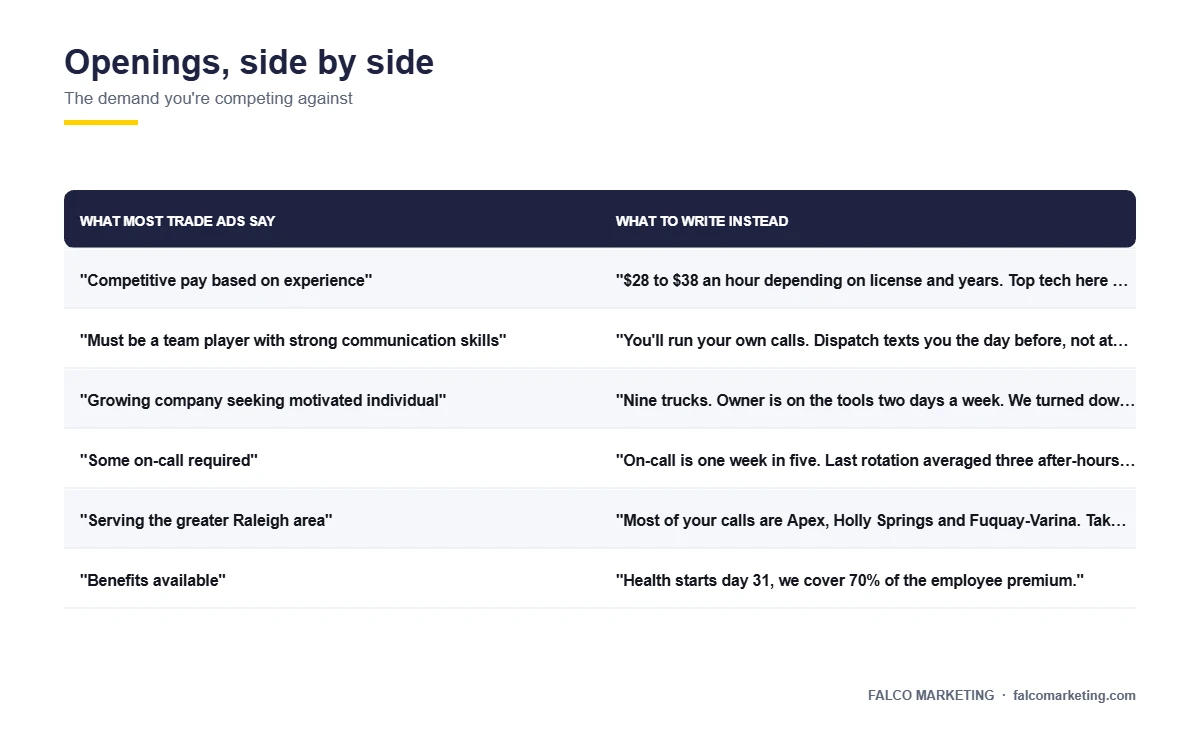
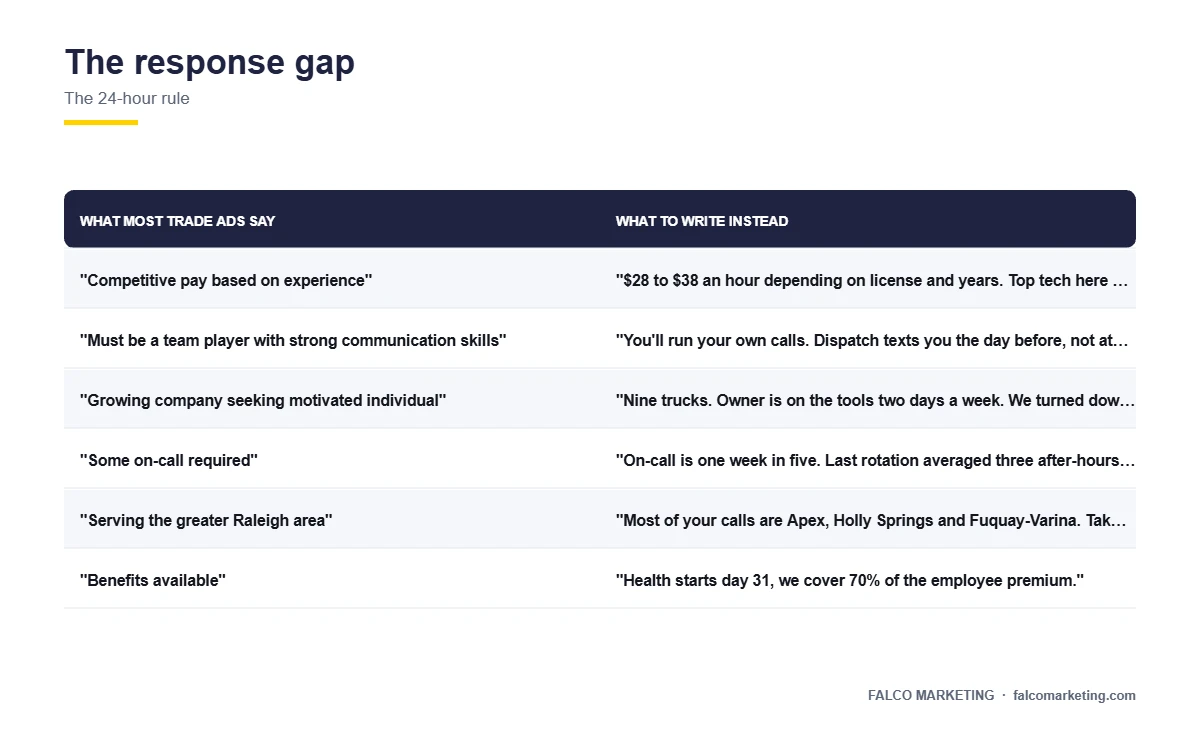
This is a composite, not any one client’s ad. You’ll recognize it anyway, because nearly every trade posting in Wake County reads like the left column.

| What most trade ads say | What to write instead |
|---|---|
| “Competitive pay based on experience” | “$28 to $38 an hour depending on license and years. Top tech here cleared $94K last year.” |
| “Must be a team player with strong communication skills” | “You’ll run your own calls. Dispatch texts you the day before, not at 6am.” |
| “Growing company seeking motivated individual” | “Nine trucks. Owner is on the tools two days a week. We turned down work last month, short two techs.” |
| “Some on-call required” | “On-call is one week in five. Last rotation averaged three after-hours calls.” |
| “Serving the greater Raleigh area” | “Most of your calls are Apex, Holly Springs and Fuquay-Varina. Take-home van, so your commute is your driveway.” |
| “Benefits available” | “Health starts day 31, we cover 70% of the employee premium.” |
Caption: The left column is invisible. The right column is specific enough to be a yes or a no.
The headline carries more weight than the body, because on a phone the headline plus two lines is all he sees before deciding. Put the money and the geography in it. “HVAC Service Tech, $28 to $38/hr, take-home van, south Wake County” beats “Join Our Team!” every time.
Owners resist posting the range because they think it costs negotiating room. The ads he’s comparing you against already show it, so leaving it out reads as “below market, and they know it.” Browsing costs him nothing. Applying costs twenty minutes he doesn’t have.
Where to run it besides Indeed
Indeed is fine. Indeed is also where every other shop in the Triangle is, bidding for the same twelve people, and sponsorship money buys position in a list he’s scrolling past. Two additions do more for the money.
Geo-targeted social to your service radius. Facebook and Instagram let you draw a circle around Garner or Wake Forest and put a 20-second video of your shop in front of every tradesman inside it. That reaches employed technicians, who never open a job board. Point it at a landing page built for a phone. Same discipline as any paid social campaign, different audience.
A referral bonus your crew will use. Most referral programs pay out at 90 days, which reads to your guys as “never.” Pay half at hire and half at 60 days, and mention it more than once. Your best techs know the other good techs here. They went to school together.
Text-first apply is the cheapest piece. Put a number in the ad and let him text HIRE to it. A guy will text you from a crawlspace. He will not fill out a form from a crawlspace.
You may not have a hiring problem
DentalPost said the quiet part about hygienists. It transfers to every trade without changing a word:
The issue isn’t that we can’t find hygienists. The issue is that we can’t keep them.
DentalPost
Hire two techs a year and lose two a year and no ad budget fixes it. You’re renting people. Keith Mercurio at ServiceTitan said it as bluntly as anyone in this industry does, that shops are “competing for labor against other companies while offering a quality of life that few would want to live.”
We’re a marketing company, so we won’t tell you how to run your shop. But we’ll tell you when an ad campaign is the wrong purchase, because selling one anyway is how agencies burn clients. If your last two techs left inside a year, spend the money on whatever made them leave.

The two-week test
Don’t overhaul everything. Run one role the new way and compare.
- Pick the opening you’ve had longest. Rewrite it using the table above, pay range in the headline.
- Set up the automated confirmation before you post, scheduling link included.
- Post it Monday. Run geo-targeted social to a 25-mile radius alongside it.
- Track four numbers: applications, confirmations sent inside an hour, phone screens held, interviews that actually showed.
- At day 14, compare the applications-to-interview-show rate against your last posting.
That ratio is the one that matters, because applications you never convert are just email. The usual result: application count barely moves, show-up rate climbs hard. You were never short on applicants. You were short on the ones still available when you called.
Frequently asked questions
Why do applicants stop responding after they apply?
Usually because somebody else replied first. The confirmation window that matters is 24 hours and most shops are three to five days out. By then he’s been contacted, screened and scheduled somewhere else.
Should I put pay in the ad?
Yes, as a range. Ads without pay get browsed, ads with pay get applied to. You’re already competing against postings that show it, so leaving it out doesn’t hide anything. It signals the number is bad.
Is Indeed enough on its own?
For a helper or apprentice role, sometimes. For a licensed tech in a market this tight, no. The person you want already has a job and isn’t on a job board, so you need geo-targeted social against your service radius plus a referral offer your crew will use.
How fast should I move from application to interview?
Automated confirmation inside the hour. Human contact the same day. Interview scheduled within three days. Long gaps between scheduling and the interview push no-shows up sharply, so book close.
We’re a nine-person shop with no HR person. Who answers within 24 hours?
Nobody, which is the point of automating it. The confirmation is a template with a scheduling link, fired by software the moment an application lands. The human part happens next morning when you see who booked. You’re not adding a job, you’re removing the four-day hole.
See what recruitment marketing looks like as a real campaign.
Job ads, a careers page built for a phone, geo-targeted social to your service radius, and the automation that answers every applicant inside the hour. Almost nobody in the Triangle sells this, which is why it works. Book a 20-minute call and we’ll tell you whether it’s worth doing at your size. No proposal, no follow-up sequence.
Look at recruitment marketingPrefer to just talk it through? Book 20 minutes.BLS wage figures are May 2024 data. Appcast figures reflect 2025 activity published in its 2026 benchmark report. Workstream is a vendor and doesn’t publish its underlying study, so we’ve attributed it by name rather than as independent research.