
Fall Pest Season in the Triangle: A Marketing Calendar for North Carolina Pest Control Companies
Fall invaders drive NC calls September through November. Here's the ad calendar most pest companies skip because they spend it all in March.
Fall is the second season in North Carolina, and most pest companies here market like it doesn’t exist.
Rodents move indoors the first week the nights drop into the fifties. Roaches and spiders follow them in. By mid-October the overwintering insects are stacked on the sunny side of every house from Wake Forest to Fuquay-Varina. That’s a demand curve, and it’s the second-biggest one you get all year.
But if your budget is front-loaded into termite swarm season, you spent it in March bidding against the whole state at peak cost. Then you went dark in September, right as the fall calls started.
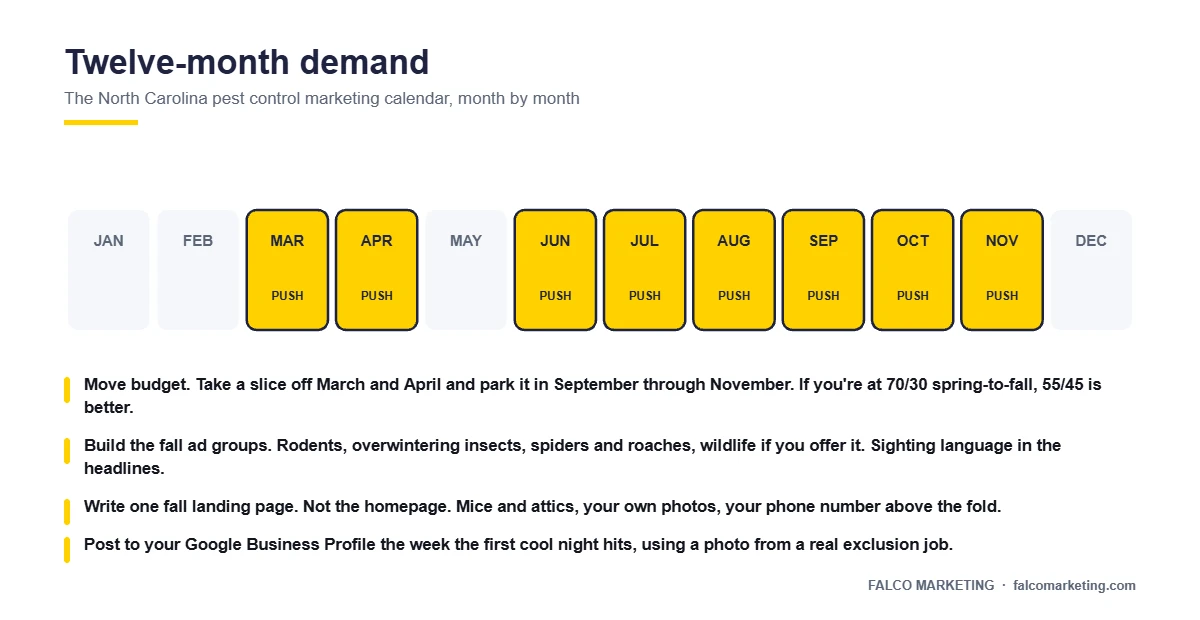
A pest control marketing calendar for North Carolina has to work around two demand peaks, not one. Spring termite and ant season runs March through June. Fall rodent and overwintering-insect season runs September through November, and it’s the window most NC pest companies skip. Turn fall campaigns on in mid-August so bidding has real data before the first cool night.
The North Carolina pest control marketing calendar, month by month
“There isn’t a true off-season for pest control in North Carolina,” is how Terminix Triad’s NC pest calendar opens. Every operator here knows that. What nobody publishes is the ad-spend version, so here it is. The column that matters is the last one.
| Months | What’s active in NC | Launch by |
|---|---|---|
| January to February | Rodents and overwintering insects still indoors; termite prep | Termite campaigns live by early February |
| March to April | Termite swarms, ants waking up | Peak spend; you’re bidding against everybody |
| May to June | Mosquitoes, ants, lawn and perimeter work | Mosquito campaigns live by late April |
| July to August | Mosquitoes, stinging insects, ant callbacks | Fall campaigns built and live by August 15 |
| September to October | Fall rodent migration indoors, roaches, spiders, wildlife | Second peak; hold budget here |
| November to December | Indoor invasion, rodents, overwintering insects | Keep rodent ads on through Thanksgiving |
Caption: Pest activity drawn from the Terminix Triad and Clegg’s NC seasonal calendars. Launch dates are ours.
The lead time on each launch date isn’t padding. A new campaign spends two weeks learning which clicks turn into calls. Switch on the day the weather breaks and you’re paying tuition during the week you needed to be converting.
Why fall gets skipped
Spring feels urgent because a termite swarm is a visible emergency. The phone rings on its own and owners open the budget.
Fall feels optional. One mouse isn’t a swarm. The homeowner waits a week, hears something in the ceiling at 2am, then finally searches. The demand is real. It just arrives quietly, one house at a time.
The other reason is simpler. The money’s gone. March and April ate it.
There’s a structural piece too. NPMA’s 2025 data puts 81.4% of US pest firms at one or two locations. So the person setting the September budget ran a route that morning and is doing paperwork at 8pm. Nobody in that spot plans a fall campaign in July. They react in October, two months late, with what’s left.
What people actually search in the fall
Here’s what breaks most pest ad accounts: in fall, the query is about the sighting, not the service.
Nobody types “rodent exclusion services.” They type “mice in attic,” “what is this bug on my window,” “scratching noise in ceiling at night.” Spring searches name the pest and the treatment. Fall searches describe a symptom.
So if your ad groups are built on service names, you won’t show up for any of it. The keyword planner won’t rescue you either, because these terms are thin on their own. They only add up as a cluster.
Build the fall groups around sighting language instead. Rodents in one, overwintering insects (stink bugs, ladybugs, boxelder bugs, cluster flies) in another, spiders and roaches in a third, wildlife in a fourth if you do exclusion. Then write the headline in the homeowner’s words. “Mice in your attic? We’ll find the entry point” beats “Comprehensive Rodent Management Solutions” every time, and it isn’t close.
The recurring-revenue math nobody puts in the ad copy
This is the number that should change how you price a fall campaign.
Almost all pest advertising is written as if the one-time job is the product. The exclusion. The callout.
It isn’t. The product is a quarterly plan, and the rodent job is how you sell it. So when you’re judging whether a fall lead costs too much, you’re comparing the wrong two numbers. Don’t measure a $200 lead against one job. Measure it against what that customer is worth over the years they stay on the plan.
The rest of the NPMA picture backs it up. US structural pest control hit $13.416 billion in 2025, up 6% from $12.654 billion, growing at more than 2.7 times US real GDP. That’s not a demand problem. It’s a distribution problem, and 66.8% of firms expect residential growth in 2026.
Want all twelve months on one page?
We built a month-by-month North Carolina pest control ad calendar: the pest, the search terms homeowners use, budget weighting and a launch-by date for every month. PDF download, and the only thing behind the gate is an email address. Take it and run it yourself. We’re fine with that.
Get the NC pest ad calendarRather talk it through? Book a 20-minute call. No proposal, no follow-up sequence.Bid schedules that match a Southeast market
Pest leads down here are expensive. One agency that tracks pest lead costs puts the termite belt at $180 to $300 and up per lead, the highest-cost region in the country, with general pest work between $140 and $220. That’s one agency’s tracked range, not an industry benchmark, so use it as a sanity check on your own numbers.
At those prices you can’t bid flat across the clock.
Fall rodent discovery has a shape. People hear the noise at night and search then or first thing next morning. They spot the stink bugs on a Saturday doing yard work. Weight the schedule toward evenings and weekend mornings, and pull back Tuesday at 2pm when the searcher is a property manager collecting quotes.
Then make sure somebody answers during the hours you just bought. At $200 a lead, a missed call in the October evening rush is the most expensive thirty seconds of your week.

Competing with Terminix and Orkin on the same keywords
You won’t outbid them on “pest control near me.” Don’t try. And bidding on their brand names is a good way to donate money to Google.
Where a two-truck operator in Clayton or Apex wins is the long tail with a town in it. “Mice in attic Fuquay-Varina.” “Squirrel in crawl space Wake Forest.” The nationals run those markets from a call center, so the homeowner gets a Tuesday slot and a technician whose name he learns when the truck pulls up. You can answer your own phone and be there this afternoon. Say that in the ad.
The organic side matters more than most pest companies think. In Whitespark’s 2026 local ranking factors survey, 47 experts scored a dedicated page per service as the strongest local organic factor at 210 points. A rodent exclusion page for Garner is a real asset. A “Services” page with eleven bullets is not. Full build-out is in a page for every service in every town you serve.
The callback problem hiding inside your ad budget
A callback is an ad dollar you spend twice. You paid to get the customer, and now a technician drives back out for free.
NPMA puts ants at 51.6% of callbacks and cockroaches at 42.6%. And 36.8% of firms say staffing shortages are constraining growth, so that truck wasn’t idle waiting for a redo.
The fix is setting the expectation in the ad and on the landing page. If your ant service takes two visits to knock down a colony, say so. A customer told to expect a follow-up is a customer on a plan. A customer who wasn’t told is a one-star review about the ants coming back.
Fall creative that works
Two things, and neither is a stock photo of a cartoon roach.
First, before-and-after exclusion photos. Steel wool packed into the gap behind the dryer vent. The crawl space door that finally shuts. Homeowners understand physical repair in a way they don’t understand “treatment,” and those shots do more work on Facebook and Nextdoor than any headline you’ll write.
Second, neighborhood targeting on the homeowner-heavy side of the Triangle. Wake County has 460,175 households and roughly 66 new residents arriving every day. Plenty of them just bought a first house with a crawl space and have no idea what October brings. That’s your fall audience in Holly Springs, Knightdale and Willow Spring.
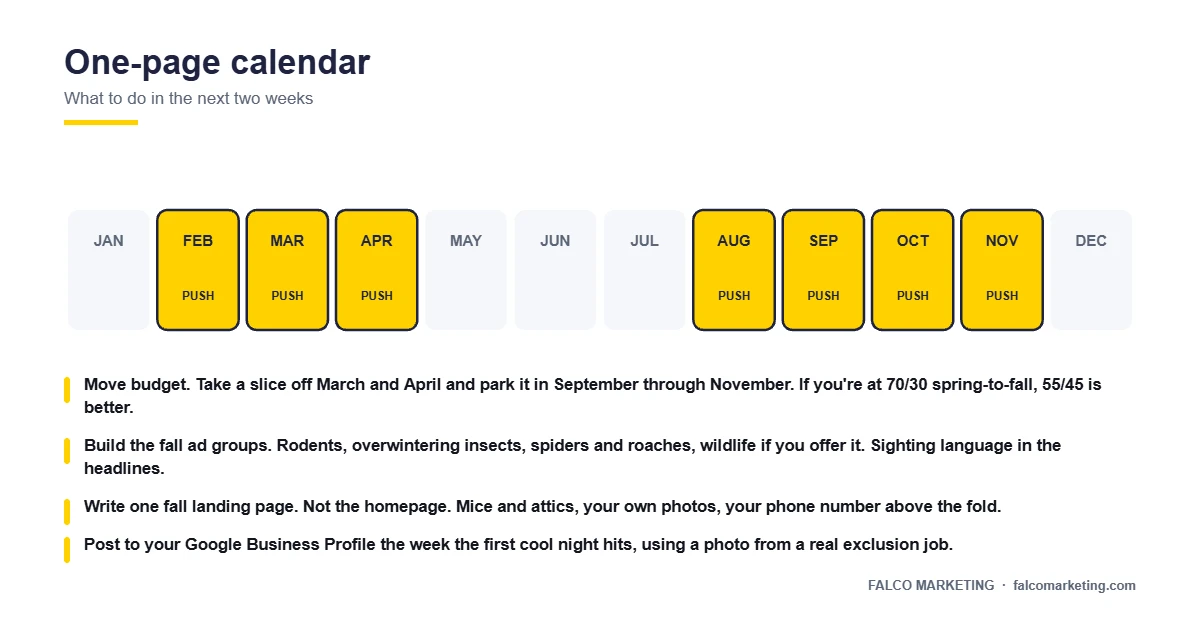
What to do in the next two weeks
- Move budget. Take a slice off March and April and park it in September through November. If you’re at 70/30 spring-to-fall, 55/45 is better.
- Build the fall ad groups. Rodents, overwintering insects, spiders and roaches, wildlife if you offer it. Sighting language in the headlines.
- Write one fall landing page. Not the homepage. Mice and attics, your own photos, your phone number above the fold.
- Post to your Google Business Profile the week the first cool night hits, using a photo from a real exclusion job.
- Set the ad schedule before the campaign starts learning, not after.
That’s an afternoon of work and the willingness to spend in a month that doesn’t feel urgent yet.
Want us to run the seasonal side for you?
Seasonal businesses are the hardest kind of Google Ads account to run well, because the right move in August is the wrong move in March. Here’s how we build campaigns that ramp on a calendar instead of a hunch, and what we hand back if you ever leave.
See how we run Google AdsPest-specific work lives on our pest control marketing page.Frequently asked questions
When should I actually turn fall ads on?
Mid-August. The first cool night in September is when calls start, and a campaign needs two to three weeks of data before it bids sensibly. Turn on in late September and you learn during the peak instead of earning during it.
Is it worth advertising against Terminix and Orkin?
On their brand terms, no. On “mice in attic Fuquay-Varina” and the town-level equivalents, absolutely. Those are the queries the nationals under-serve, where a same-day local answer wins.
How much should a pest company in the Triangle spend?
Anchor it to plan value, not a percentage of revenue. If a quarterly plan is worth roughly $500 a year and customers stay three to five years, a $200 lead converting at 25% is still profitable. Painful, but profitable.
What about mosquito and termite season?
Different windows, different posts. Termite ads have to be live in February, before the March swarms: see the NC termite season playbook. Mosquito and lawn season gets its own calendar in the Wake County mosquito post.
Can I just send fall traffic to my homepage?
No. Whitespark’s expert panel ranks a dedicated page per service as the strongest local organic factor, and it converts better too. A homepage has to cover every pest you treat at once, so it covers none of them well in October.