
Google Ads vs Facebook Ads: Where a Triangle Service Business Should Spend First
A straight comparison for local service businesses, with real 2026 cost-per-lead numbers and a rule for deciding in about five minutes.
Every owner who calls us about paid ads has already had this argument in his own head. His buddy in Apex swears by Facebook. His last agency dumped everything into Google and burned eleven grand teaching him nothing. Here’s the part nobody says out loud: Google Ads and Facebook ads are not competing products. They do two different jobs, and putting the first dollar in the wrong one costs you a quarter.
Google Ads vs Facebook ads comes down to intent. If people are already searching for what you sell, start with Google Ads, where the median cost per lead across industries is $66.69. If nobody knows they need you until they see it, start with Facebook and Instagram, where the median lead runs $27.66 but shows up cold. Job value and urgency break the tie.
The one question that settles it for most Triangle businesses
Ask what your customer was doing sixty seconds before they called you.
If the answer is “standing in a hallway staring at a thermostat that reads 84 degrees,” they’re searching. Google Ads puts you in front of that person while the problem is on fire. That’s demand capture.
If the answer is “sitting on the couch scrolling,” nobody has a problem yet. Meta ads interrupt that person with a reason to care. That’s demand generation. It works, but on a slower clock, and it costs you patience instead of money.
Most service businesses in Raleigh, Cary and Durham sell into demand that already exists. Somebody’s AC dies. Somebody chips a tooth. For them the first paid dollar belongs on search, full stop. The exceptions are real, and we’ll get to them.

Google Ads vs Facebook ads, side by side
| Google Search Ads | Meta ads (Facebook and Instagram) | |
|---|---|---|
| What the person is doing | Typing a problem into a search bar | Scrolling past you on the way to something else |
| Intent | Already shopping, often today | None yet, you have to create it |
| Median cost per lead, home services | $90.92 | $41.26 |
| Median cost per lead, dental | $72.97 | $76.71 |
| Median cost per lead, legal | $131.63 | $18.17 |
| How warm the lead arrives | Warm to on fire | Cold, barely aware of you |
| How long it stays warm | Days at most, they’re hiring this week | Weeks, but it was never hot |
| Time to first lead | Hours to a few days | Days to a few weeks |
| Creative you need | Ad text, a phone number, a fast page | Photo or video, refreshed constantly |
| What breaks first | Budget, eaten by broad match and missing negatives | Creative fatigue, then lead quality |
| Ceiling | Search volume in your service area | How many people you can make care |
Those Google numbers come from 13,474 US search campaigns run between April 2025 and March 2026. The Meta numbers come from lead campaigns in the same categories. Read the legal row again. It’s the one that sends owners running the wrong direction.
Why the cheaper lead is usually the colder lead
A law firm can buy a Facebook lead for $18.17 and a Google Search lead for $131.63. Seven to one. If cost per lead were the whole story, no attorney in Wake County would touch search again.
But the person who clicked “motorcycle injury lawyer” is hurt right now. The one who filled out a form under a Facebook video was scrolling between innings. One signs a retainer this week. The other doesn’t remember your firm by dinner. That gap isn’t a discount. It’s a measure of how cold the lead is.
Cost per lead is not cost per client. If your Meta leads close at a fifth of the rate your search leads do, that $18.17 lead is the expensive one, and the ads dashboard will never tell you. Your calendar will.
Dental is the exception worth knowing. Google runs $72.97 per lead, Meta $76.71, near enough to parity that the platform stops mattering and the offer starts mattering. If you own a practice in Holly Springs or Wake Forest, run both and judge them on booked exams.
The honest problems with Google Ads
It’s expensive and it punishes neglect. Home and home improvement clicks run $8.33 apiece, up 6.1% year over year. Legal clicks run $9.87, up from $8.58. You pay that whether the click was a customer or a competitor checking your ad.
And most accounts bleed. The average one wastes $1,127.54 a month out of $3,127.38 in spend.
The mechanism is boring. A quarter of accounts have never added a single negative keyword. Accounts with at least one negative average a 13% monthly conversion rate against 4.6% for accounts with none. Nearly 29% recorded zero conversions across 90 days, which usually means tracking was never set up right.
The encouraging part: accounts spending under $1,000 a month convert 32% better than accounts over $10,000 (18.8% against 14.2%). You don’t need a big budget to make search work. You need a tight keyword list and somebody reading the search terms report.
The honest problems with Facebook and Instagram ads
Creative dies. A Google keyword performs the same in month nine as it did in week one. A Meta ad gets ignored by the same audience after a few weeks, your cost per lead climbs, and you assume the platform stopped working. It didn’t. Your photo got old.
Lead-form ads are the bigger trap. They make submitting almost too easy, so people submit without thinking, and unless somebody calls fast the lead is worthless. Invoca analyzed over 60 million calls and found only 61% of callers actually reach a human when they call a business from a digital marketing source. If four in ten of your warmest callers can’t get a person, your cold Facebook leads have no chance.
If you can’t commit to calling a Meta lead inside five minutes, run traffic to a page instead and let people self-select.
Where Meta budgets quietly go to die
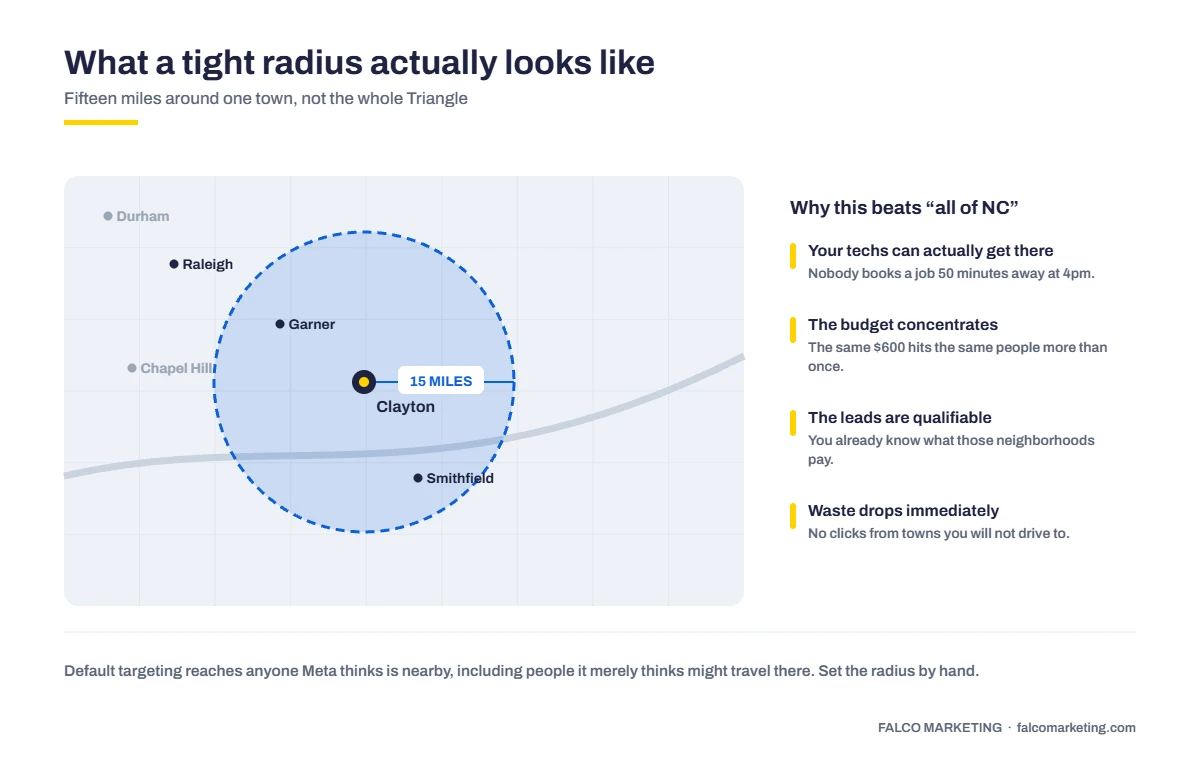
Boosting posts. The boost button optimizes for engagement, so it buys likes from people who will never hire you. Spend inside Ads Manager instead, with a lead or conversion objective and a radius that matches where your trucks actually go.
The decision rule, in about five minutes
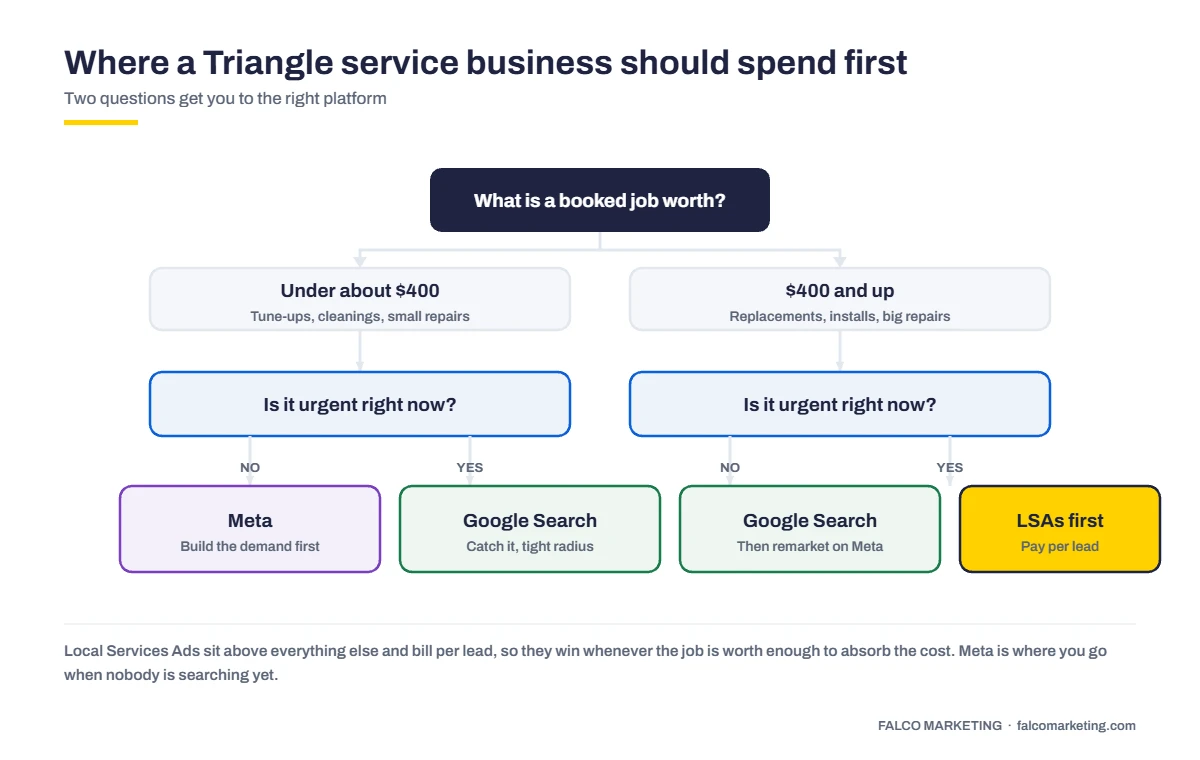
Forget the platform debate. Look at two numbers: what an average job is worth to you, and whether your customer can wait.
Average ticket under $300 with no urgency (a cleaning service, a lawn plan): Meta usually wins. Search leads at $66.69 don’t math out on a $200 job unless you close nearly everybody, and that customer wasn’t looking for you anyway.
Average ticket over $1,500 with urgency (HVAC replacement, roofing, legal, implants): Google usually wins. A $90.92 lead on a $12,000 system is rounding error, and the guy searching at 11pm in July is not waiting for your Instagram reel.
In between, look at search volume. If people in Garner and Clayton type your service into Google every day, take that demand first. If they don’t, you have to go create it, and that’s Meta.
Before you spend a dollar on either platform
- Conversion tracking that fires on a real form submission and a real call, not a page view
- The most you’ll pay for a booked job, written down before the campaign starts
- Somebody who answers the phone during the hours your ads run
- A landing page that loads fast and says the town name out loud
Find out which one is already wasting your money
Give us read-only access to your Google Ads account for a week and we’ll send back a one-page benchmark: your cost per lead against your industry median and the biggest sources of waste we find. About 20 minutes of your time, and you keep the document whether or not we ever speak again.
Get a Google AuditNot running ads yet? Tell us what you sell and we’ll tell you where to start. No proposal.The third option most owners forget: Local Services Ads
If you’re a home service business, there’s a cheaper door than either one, and half the owners we talk to have never opened it.
Local Services Ads sit above the regular search ads with a Google Guaranteed badge, and you pay per lead instead of per click. A SearchLight benchmark covering 888 contractors and 126,650 leads puts electrical at $39 a lead, HVAC at $51, plumbing at $57 and drain and sewer at $59. Blended, $53 against $90.92 for the same category on regular search.
And they’re everywhere now: Sterling Sky’s tracking shows LSA on roughly 31% of tracked queries, up from 11% at the start of 2025.
| Where the lead comes from | Home services cost per lead | What you’re paying for |
|---|---|---|
| Local Services Ads | $39 to $59 depending on trade | A phone call, charged per lead |
| Google Search Ads | $90.92 median | Clicks, whether or not they convert |
| Meta lead ads | $41.26 median | A submitted form, quality varies wildly |
The catch: LSA requires background checks and license verification, and disputing junk leads takes real effort. It’s still the best first dollar most home service owners in the Triangle can spend.

What changes in August 2026
This matters if you run LSA today. Starting in August 2026, Google is folding Local Services Ads into Google Ads for home and storefront service advertisers, including plumbing, HVAC, electrical, roofing and pest control.
Google’s own language: “You will no longer be able to access your original Local Services Ads dashboard.” Historical reports do not carry over, and manual bidding goes away. Search Engine Journal covered it in July 2026.
So export your LSA lead history now, before the dashboard disappears. And if you’ve never had a Google Ads account, you’re about to need one.
If you’re going to run both, split it like this
Start with one. Give it 90 days and enough budget for 20 leads a month, because you can’t read a campaign off six conversions.
Once it’s profitable, add the second for a job it does better. For most home service businesses, search or LSA carries the emergency work while Meta ads sell the planned, higher-margin stuff nobody searches for: duct sealing, generator installs, surge protection, water heater replacement before it fails.
Run retargeting on Meta either way. Reaching somebody who already visited your site costs a fraction of buying that click twice on Google.
Wake County is adding about 66 new residents a day. None of them know you exist yet. That’s the argument for eventually running both. It is not an argument for running both badly in month one.
Twenty minutes and you’ll know which platform to fund
Tell us your average job value and where your trucks go. We’ll tell you where the first dollar belongs and what a lead should cost in your category. You keep the worksheet either way. No proposal, no follow-up sequence.
Book a 20-minute callAlready running ads? Start with the Google Ads audit instead.Frequently asked questions
Should I run Google Ads or Facebook ads first?
Whichever matches how your customers behave. If they search for your service when they need it, start with Google Ads. If they don’t know they need you until something catches their eye, start with Meta. Home services and legal almost always start on search.
Are Facebook ads cheaper than Google Ads?
Per lead, usually yes: $27.66 against $66.69 across all industries. Per booked job, often no, because a search lead already wants what you sell. Judge both on closed revenue.
How much should I budget to test one platform?
Enough for about 20 leads a month for 90 days, so your industry’s cost per lead times 20. Below that you’re reading noise. Small budgets are fine: accounts under $1,000 a month convert 32% better than accounts over $10,000.
Do Local Services Ads replace Google Ads?
Not entirely. LSA covers emergency calls at $39 to $59 a lead for most trades, but volume is capped by local demand and only certain categories qualify. Most Raleigh home service businesses run LSA first, then add search ads to catch what LSA can’t.
What happens to my Local Services Ads in August 2026?
They move into Google Ads. The standalone dashboard goes away and historical reports don’t transfer. Export your lead history before the switch.
Why is my Google Ads account not producing leads?
Usually tracking or negative keywords. Almost 29% of accounts record zero conversions over 90 days, and 25% have never added a negative keyword. Read the search terms report before you blame the platform.
Benchmark figures current as of July 2026. Medians vary by market.