
What Your Marketing Company Should Hand Over If You Fire Them Tomorrow
Nine logins you should already own. Where to check each one in 15 minutes — and what to do if your agency says the account is "proprietary."
You can check this in fifteen minutes, and you should do it while you’re calm, not the week you decide to leave.
Open Google Ads. Click the tools icon, go to Admin, then Access and security, and read the access level next to every email listed. If your business isn’t sitting there as the owner, you don’t own your ad history, your conversion data, your search terms report, or the Smart Bidding learning you paid three years to build.
One owner on r/smallbusiness got quoted $7,500 this month to take possession of accounts he had already funded. Not to build anything. Just to be handed the keys.
Marketing agency account ownership means your business holds the owner role on nine assets: your domain, DNS, hosting, website files, Google Business Profile, Google Ads account, Google Analytics and Tag Manager, Meta Business Manager, and your call tracking numbers. Your agency should sit on each one as a manager you can remove yourself, without asking permission.
The short answer: nine things you should already own
Own, not “have access to.” Access gets revoked by whoever holds the owner seat. Ownership doesn’t.
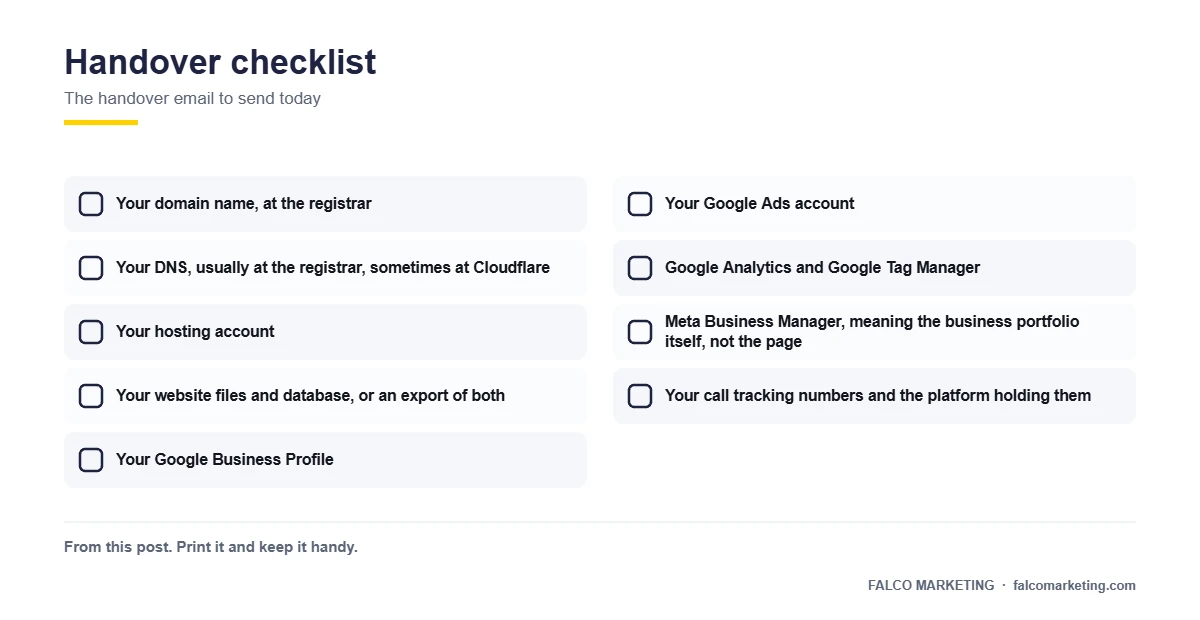
- Your domain name, at the registrar
- Your DNS, usually at the registrar, sometimes at Cloudflare
- Your hosting account
- Your website files and database, or an export of both
- Your Google Business Profile
- Your Google Ads account
- Google Analytics and Google Tag Manager
- Meta Business Manager, meaning the business portfolio itself, not the page
- Your call tracking numbers and the platform holding them
On audits the owner usually holds the domain and assumes the rest follows. The domain is the one agencies rarely fight over. The other eight turn into a negotiation.
Marketing agency account ownership comes down to one setting: owner, admin or manager
Google, Meta and the call tracking platforms use one idea with different labels. A seat at the top can remove everybody else, and every other seat can be removed by that one.
In Google Ads that’s account-level Admin, plus which manager account yours sits under. In Google Business Profile it’s the Primary Owner. In Meta it’s the Business Portfolio.
The right arrangement is boring. You own the core accounts, your vendor gets added as a manager on their own email, and when the relationship ends you delete a row. Backwards isn’t automatically malice. Plenty of shops set it up that way because it was faster on day one, and what you learn is in the answer when you ask them to fix it.

How to check each of the nine, screen by screen
Fifteen minutes, if you have your passwords handy.
Domain and DNS
Check the account holder and registrant contact at your registrar. Can’t log in? Run a WHOIS lookup and see whose organization is listed. Then check the nameservers, because DNS decides where your site and email go.
Hosting and website files
Confirm the hosting is billed to you. Then answer one question: can you download the whole site today, files and database? If that means asking your agency, you don’t have it.
Google Business Profile
Open profile settings, find People and access, and look for your name on the Primary Owner row. This is the worst one to lose, because it holds your reviews, and in Raleigh those reviews are the ranking.
Google Ads
Tools icon, Admin, Access and security. Users tab for admin emails, Managers tab for the linked agency account. Then confirm the payment profile under Billing is yours. Agency-billed accounts are where unspent money gets awkward.
Analytics and Tag Manager
In GA4, Admin, then account and property access management. In Tag Manager, Admin, then User Management. Losing GTM hurts, because your conversion tags fire from there.
Meta Business Manager
Business settings, Users, People, and look for Full control. Then check which portfolio owns your page and ad account. If the page lives in theirs, your ad history does too.
Call tracking numbers
See whose card is on file in CallRail or whatever they use. The number on your trucks and yard signs in Apex is portable, but only if you can prove you hold the account.

While you’re in the ad account, look at what it’s doing. Accounts nobody outside the agency ever opens tend to have both problems.
Get the one-page handover checklist
All nine assets, the menu path for each, and the handover email below, on one sheet you can print and work through at your desk. No email address required. Just ask.
Ask us for the checklistSuspect the ad account is where the money goes? Start with the Google Ads audit.“It’s on our proprietary platform”
Sometimes it’s literally true. Some shops build on a closed system that can’t be exported to your own hosting. An owner on r/smallbusiness put it plainly: “They build your site on their ‘Proprietary platform’ so you end up handcuffed.”
The word gets stretched, though. An owner in r/PPC reported that “our Google ads account is somehow owned by agency and agency will not transfer ownership since it is proprietary account.” A reply in that thread put it as bluntly as it can be put: “Nothing is secret sauce or proprietary to the agency.”
Correct. A Google Ads account is a Google product, and your keywords, negatives, conversion actions and search terms report are standard fields in somebody else’s software. Ad copy written for you may be a contract question. The account isn’t.
If your site does sit on one, take what moves: the domain, the copy, the photos and the URL structure. Then budget for a rebuild, using what a website actually costs in Raleigh.
The $7,500 transfer fee, and why you probably don’t owe it
Here’s the part nobody else in the Triangle will publish.
An agency that quotes you a fee to release accounts you already paid to build and fund isn’t enforcing a contract. It’s charging a ransom and calling it onboarding. That owner said it out loud: “$7500 is so much for a one time fee just to get set up and ownership.” He also named the feeling that gets people to pay: “I feel like I’m held hostage because I don’t have access to everything.”
Can they ask? Sure. A real transfer clause with a real number in it is a question for your attorney. More often there’s no clause and the fee gets invented at the exit. Ask for the paragraph that authorizes it, in writing.
And your fallback is better than owners assume. If an ad account can’t be pried loose, open a new one in your own name today and lose the history instead of the business. Painful, not fatal. The domain and the Google Business Profile are what genuinely hurt, which is why those come first.
What the complaint records actually show
The same pattern repeats in public complaint files.
A customer review on the BBB profile for Scorpion states “Once the contract ended they left us with no website.” Scorpion’s posted response disputes it, so read both sides. What matters is the failure mode: a site you rented rather than owned, switched off on the last day of a term.
A BBB complaint against Web.com describes being “charged me for renewal on the account that, by their own admission, I do not own.” A Yodle complaint reads, “I have my existing web address on all my trucks…they assigned me a totally new web address without my consent.” If your domain is painted on six vans in Durham and Fuquay-Varina, that isn’t a marketing decision. That’s your fleet.
One new wrinkle in 2026: your Local Services Ads history won’t transfer
If you run Local Services Ads, export your reports this week.
Starting in August 2026, Google is folding LSA into Google Ads for home and storefront service advertisers: plumbing, HVAC, electrical, roofing and pest control. Google’s own documentation says “You will no longer be able to access your original Local Services Ads dashboard,” and historical performance reports do not carry over.
Read that with a handover in mind. Once the old dashboard goes dark your lead history is unverifiable, and if your agency holds that login you can’t reconstruct what you paid per lead. LSA leads ran a blended $53 across 888 contractors in SearchLight’s 2026 benchmark. That’s the number you lose the ability to check.
The handover email to send today
Send it now, while nothing is wrong. What comes back tells you who you’re working with.
Copy and paste this
Subject: Account ownership and access confirmation
Hi [name],
I’m auditing our marketing assets. Please confirm in writing, within 30 days, that our business is listed as owner or primary owner on all nine accounts below, and transfer ownership to [your email] where we aren’t, keeping your team on as managers.
Domain registrar, DNS, hosting, website files and database, Google Business Profile, Google Ads, Analytics and Tag Manager, Meta Business Portfolio, call tracking numbers.
If one can’t be transferred, tell me which and why. Please also send an export of the website files and our Local Services Ads lead history.
Thanks, [you]
Two things make it work. It’s in writing, so the answer becomes a record, and it carries a date, which turns “we’ll get to that” into something you can point at.
What a clean handover looks like
Here’s our standard, so you can hold anybody to it.
Day one, accounts go in the client’s name. If a client needs a new Google Ads account, we walk them through creating it on their own email, then request access from ours. Billing goes on their card.
Last day, whenever that comes, offboarding is us removing ourselves from a list. No fee, because there’s nothing to transfer. It was already yours. That’s what marketing agency account ownership should look like from the first week.
That costs us leverage, and that’s the point. An agency that keeps you because you can’t leave has stopped selling marketing and started selling a lock. How we price the work is in what a marketing retainer actually buys you.
We’ll walk your nine accounts with you
Send us the name of your current provider and we’ll go through all nine assets on a screen share and tell you what you actually own. No proposal, no follow-up sequence. You get a one-page list of what’s in your name and what isn’t. Most of these run under 20 minutes.
Book an ownership auditNot ready to talk? 11 red flags in a marketing sales pitch covers what gets promised before any of this.Frequently asked questions
Does my agency legally own my Google Ads account?
Ownership follows whoever created the account and holds the owner-level login, not whoever paid the invoices. The fix is usually administrative rather than legal. Create your own account and grant them manager access.
Can they charge me to transfer my accounts?
They can ask. Whether you owe it depends on what you signed. Most “setup and ownership” fees show up at the exit rather than in the agreement, which makes them leverage rather than something you agreed to.
What if my website is on their proprietary platform?
You probably can’t move the site itself. The domain, the content, the photos and the URL structure all move, and that’s most of what matters. Get the domain first, then budget for a rebuild.
What should I screenshot before I give notice?
Access lists on every ad account, Google Business Profile user roles, the last 24 months of performance, and the recovery email on file for each login.