
The Missed-Call Audit: How Much Revenue Your Phone Ate Last Month
A 20-minute audit using data you already have. Four lines of math, one dollar figure. One HVAC owner's answer was $8,000 in a single month.
Pull up your call log for last month. Count two things: the calls that never connected, and the calls that died in under fifteen seconds. That second batch is somebody hearing four rings, deciding you’re closed, and hanging up.
Now multiply that count by your close rate. Multiply again by your average ticket.
That’s the whole audit. An HVAC owner on r/smallbusiness ran it on his own numbers and came out past $8,000 in lost jobs for a single month, which is more than plenty of Triangle contractors spend on marketing in a quarter. His words: the math is sickening.
A missed-call audit takes about 20 minutes and uses data you already have. Count last month’s unanswered and sub-15-second calls, multiply by your close rate, then by your average ticket. That dollar figure is your leak. Most missed call statistics small business owners see online have no real source behind them, so run the number on your own call log instead.
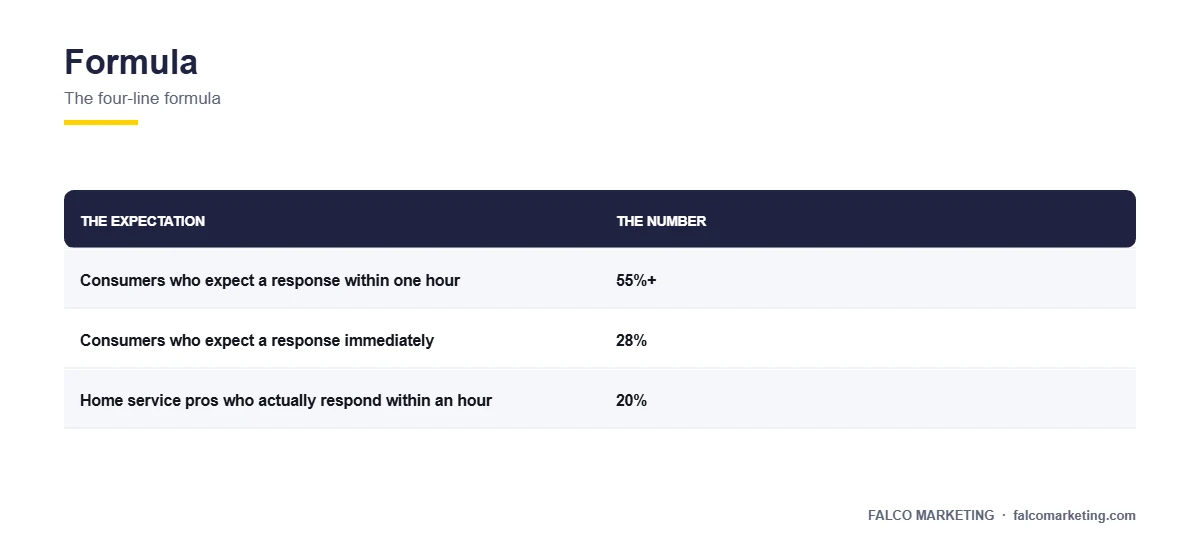
The four-line formula
No software required. Four lines on the back of an invoice:
- Missed and abandoned calls last month (anything unanswered, plus anything under about 15 seconds).
- Your close rate on the calls you do answer.
- Your average ticket.
- Line 1 × line 2 × line 3.
Say you run an HVAC company out of Apex. Forty calls last month either rang out or hung up in twelve seconds. You close about 40% of the calls your office actually picks up. Your average ticket is $450.
Forty times 0.40 is sixteen jobs. Sixteen times $450 is $7,200. Gone, in a month, from a phone you already pay for.
Those inputs are illustrative, so plug in yours. But notice how forgiving the formula is. It prices a missed call at $180 when WebFX puts HVAC customer lifetime value at $15,340, because a first repair turns into a maintenance plan and then a system replacement eight years later.
It also ignores what you paid to make the phone ring at all. Same WebFX data puts the average HVAC cost per lead at $153. Every abandoned call is a lead you bought and threw away at the door.
Where to get each number in 20 minutes
You don’t need a call tracking platform to run this the first time. You need four logins you probably already have.
Your phone carrier’s portal
This is the one that matters. Every business line, VoIP or cellular, has a call detail log in the online account: date, number, duration, direction. Export last month, then filter for inbound calls at zero seconds and inbound calls under 15 seconds. Fifteen seconds is about four rings plus a hello. Under that, nobody had a conversation.
Google Ads call reporting
If you run search ads, the platform already tracks call length. Open the campaign report, add the “Phone calls” column, then check your call conversion setting. Anything shorter than your minimum call length is a call that happened and converted nothing. Those are ad dollars, at $8.33 a click in home and home improvement, landing in a voicemail box.
Google Business Profile call history
Under Performance, Google shows the calls placed from your profile by day and hour. It won’t tell you whether they connected. It will tell you the hours people are calling, which is usually the more useful surprise. Most owners guess wrong about lunch.
Your CRM or job board
Now match. Line last month’s connected calls up against booked jobs. That ratio is your real close rate, not the one you feel like you have. Owners tend to overestimate by ten points or so, which is fine, because a worse close rate makes the leak look smaller and you still won’t like the number.
Nobody leaves a voicemail anymore, and most missed call statistics are junk
You’ll see figures thrown around claiming some enormous share of callers never leave a message. We won’t repeat them, because we can’t find a real study underneath any of them, and this is a post about doing your own math.
Here’s a number with a study underneath it. Invoca analyzed more than 60 million calls and found that only 61% of callers actually speak with a person when they call a business from a digital marketing source. Nearly four in ten people who clicked your ad, tapped your number and waited never reached a human being.
The behavior behind that number is not complicated. Somebody’s water heater is leaking. They open Google, tap the first three listings in order, and go with whoever picks up. As one contractor put it in that same Reddit thread: people aren’t shopping for the best guy, they’re shopping for the first response.
An agency owner in another r/smallbusiness thread described asking a plumber what happens when someone calls after 5pm. The answer: “uh… voicemail i think?” That’s most of the market, and it’s why speed matters more than polish. We wrote about that separately in speed to lead.
What the response-time data actually says
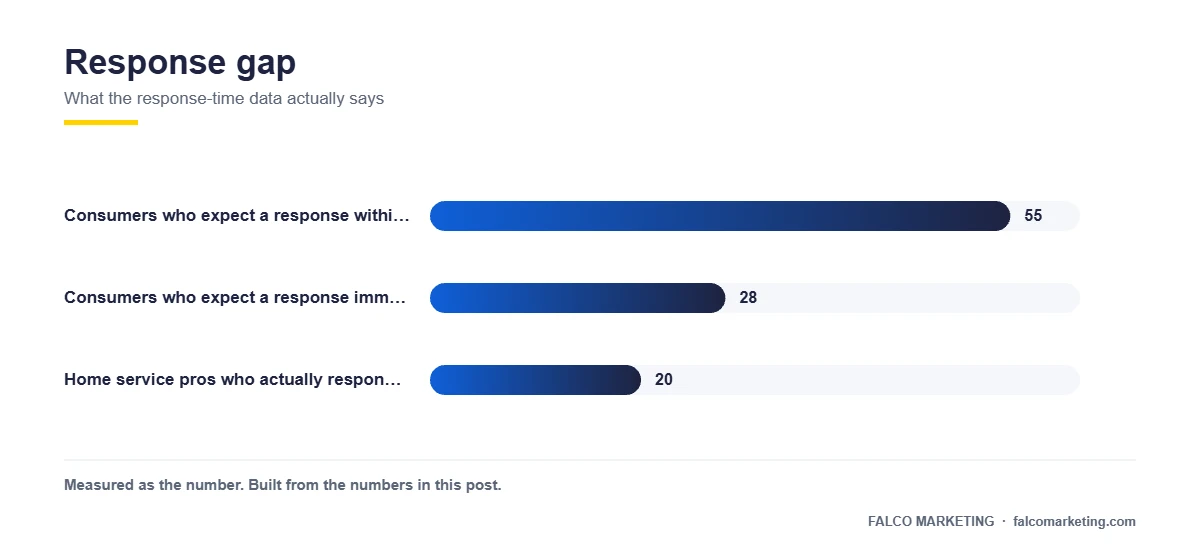
Jobber surveyed 1,050 consumers and home service pros for its 2026 trends report, and the gap is wide enough to drive a truck through.
| The expectation | The number |
|---|---|
| Consumers who expect a response within one hour | 55%+ |
| Consumers who expect a response immediately | 28% |
| Home service pros who actually respond within an hour | 20% |
Caption: Jobber 2026 Home Service Trends Report, n=1,050.
Read that bottom row again. Four out of five contractors miss a bar that more than half of customers are holding up. Which is good news, oddly, because the standard you have to beat in Wake Forest or Clayton is not high. Answer inside an hour and you are already outperforming most of your competition.
HVAC’s 27% missed-call rate, and what August does to it
WebFX’s home services benchmarks put the HVAC industry missed-call rate at 27%. Better than a quarter of calls, gone, as an annual average.
Annual average is the phrase to sit with. That figure blends February, when the office picks up on the second ring, with the first 98-degree week in August, when every phone in the Triangle rings at once and your dispatcher is already on two lines. Your peak-season miss rate isn’t 27%. It’s whatever 27% looks like when demand triples and staffing doesn’t.
That’s also the week your leads are worth the most. A no-cool call in August closes far better than a tune-up call in April, because the customer has no patience left and no interest in shopping around.
The second leak nobody counts: quoted and never followed up
Missed calls are the leak you can measure. The bigger one, usually, is the estimate you already drove out to write.
ServiceTitan’s 2026 roofing and exteriors report found that only 16% of roofing contractors follow up the same day on an unsold estimate, and 32% have not adopted same-day follow-up at all. So a third of the industry writes a proposal, hands it over, and waits.
You paid for the lead. You paid for the drive to Fuquay-Varina. You paid an hour of a good technician’s time to measure and write. Then the follow-up, the only free step in the whole sequence, doesn’t happen.
Add that column to your audit. Count last month’s quoted-and-not-sold jobs, and count how many got a phone call within 24 hours. That second number is usually zero, and it usually costs more than the missed calls do.
Want the routing and follow-up handled for you?
We build the boring plumbing: after-hours call routing, missed-call text-back that fires in under a minute, and a follow-up sequence on unsold estimates so nothing sits in a truck console for a week. It’s the least glamorous work we do and it’s the fastest to pay for itself.
See how we set it upNot sure what you need yet? Tell us what’s going on and we’ll say if this is even your problem.Four fixes, cheapest first
Start at the top. Do not buy software until the first two are done, because software layered on broken routing just fails faster.
- Fix routing and overflow. Costs nothing. Most phone systems let you ring a second and third device after four rings, then a cell phone, then an answering service. Half the missed calls we find on audits are calls that only ever rang one desk phone in an empty office.
- Turn on missed-call text-back. When a call goes unanswered, an automatic text fires inside sixty seconds: “Sorry we missed you, this is Dale at the shop, what’s going on?” Most VoIP providers include it now. It converts because the customer is still holding the phone.
- Give texts and form fills one place to land. A shared inbox, not somebody’s personal cell. When the message goes to one person’s phone and that person is under a house in Garner, the lead waits.
- Then consider an AI answering layer. Last, not first, and with your eyes open. See below.
The AI receptionist argument, honestly
Here’s where most agency blogs sell you a bot. We’ll give you the uncomfortable version instead.
People do not want to talk to your robot. SurveyMonkey’s December 2025 survey of 2,017 US adults found 79% strongly prefer a human over an AI agent, 50% would cancel a service that was entirely AI-driven, and 23% lose confidence the moment they’re stuck in an AI loop. That’s a real cost and anybody who tells you otherwise is selling.
Now the other side. Voicemail converts at zero. A caller who hits an automated system and hangs up in frustration is exactly as lost as a caller who hits voicemail, and the voicemail is worse because at least the bot tried.
So the honest answer is a hybrid, and the details decide whether it works. An AI layer that answers on the second ring, gets a name and the actual problem, books the routine tune-up, and hands anything urgent to a human inside thirty seconds beats a machine that says “we’re closed, call back Monday.” An AI layer that traps a woman with no heat in a menu tree is worse than nothing. We went deeper on that split in AI receptionists for home services, and on where else this automation earns its keep in AI agents for operations.
One rule if you buy one: the vendor must show you transcripts of the calls that went badly, not a highlight reel of the good ones. Any vendor who won’t is hiding the part you need to see.
The answering service trap
An answering service that takes a message is voicemail with a salary. If the person or system answering your phone cannot get onto your schedule and book the job, you’ve added a delay and a monthly bill without changing the outcome. Book, or transfer to someone who can book. Nothing in between is worth paying for.
What to do Monday
Four moves, none of which require buying anything.
Run the export and get your number. Twenty minutes, and it’s the only part that changes behavior, because “we miss some calls” is easy to live with and “$7,200 last month” is not.
Then call your own business at 12:30 on a Tuesday and again at 6:15pm, from a number nobody there recognizes. Listen to what a stranger hears.
Then add one ring destination. A cell phone, a second desk, anything. Free, five minutes, and it usually catches the biggest slice.
Last, pull the unsold estimates from the last 60 days and call them yourself. Not a text. You’ll book a couple this week, and you’ll stop arguing about whether the follow-up column belongs in your audit.
Frequently asked questions
How do I find out how many calls I’m actually missing?
Your carrier’s online portal has a call detail log with duration on every inbound call. Anything at zero seconds or under about 15 seconds almost never reached a person. Pair that with your ad platform’s call reporting and you have a defensible count in ten minutes.
What’s a missed call actually worth?
Your average ticket times your close rate. A Triangle HVAC company at a $450 average ticket and a 40% close rate is losing roughly $180 every time the phone rings out, before any maintenance plan or replacement revenue behind that customer.
Should I just hire an answering service?
Sometimes, and the math is easy to run against the number you just calculated. The trap is a service that takes a message instead of booking the job. If they can’t get onto your calendar, you’re paying monthly for a nicer voicemail.
Will an AI receptionist make my customers hang up?
Some of them, yes, and you should go in knowing it. SurveyMonkey found 79% of Americans strongly prefer a human. The version that works answers fast, gets the caller and the problem, books routine work, and hands anything urgent to a person quickly.
What if it rang and someone picked up but nobody was really there?
Count it. A call answered by a hold queue or a menu that ends in a hangup is a lost job, and it’s the category owners leave out most often when they run this themselves.
Does this apply outside home services?
Yes. Dental practices lose their heaviest call volume over the lunch hour, and 61% of law firm inquiries arrive by phone. Only the ticket size changes.
Figures current as of August 2026, with every source linked inline. We left several widely quoted missed-call numbers out of this post because we could not trace them back to an actual study. If we can’t source it, we don’t print it.
Want us to run the audit for you?
Give us 20 minutes and read-only access to whatever call data you have, carrier log or Google Ads call reporting or both. You get back one page: calls missed, your estimated close rate, the dollar value of the leak, and the cheapest fix first. Plenty of these come back small, and when they do we tell you so and leave you alone.
Book a missed-call auditRunning paid search too? The Google Ads audit pairs with this one.