
Chiropractic Marketing After the New-Patient Special
The $49 exam fills chairs with people who never come back. Here's the retention math, and the reactivation sequence that runs itself.
Your $49 new patient exam works. That’s the problem.
The schedule fills inside a week. You adjust a lot of new spines. Eight weeks later you’re looking at a Tuesday with four names on it, so you run the offer again. If your new patients average three visits, you aren’t building a practice. You’re renting a schedule, one promotion at a time.
The offer is doing exactly what you paid it to do. The eleven days after visit one are where the practice actually gets built or lost.
The highest-return move in chiropractic marketing is almost always retention, not another new-patient offer. If a $49 exam brings in 30 patients and they average three visits, you bought a busy week. Raise that average from three visits to six and you double collections from identical ad spend, with no increase in cost per patient and no new campaign.
Why retention beats acquisition in chiropractic marketing
Run the arithmetic on your own numbers before you argue with this.
Take whatever you collect per visit. Multiply by your patient visit average. That product, not the number of new patients, is what your marketing actually produces. Getting more new patients multiplies one side of that equation. Getting patients to stay multiplies the other side, and the second one is free.
A practice at three visits per patient needs to double its ad budget to double revenue. A practice that moves from three visits to six doubles revenue with the same budget and the same front desk. One of those requires money you may not have. The other requires messages you already know how to write.
This is why almost every chiropractic marketing article on page one annoys me. They all sell you more front end: more spinal screenings, more Facebook offers, more $49 exams, more booth space at the 5K. Very few of them do the multiplication that shows a practice with a low visit average cannot buy its way out of the hole.
Where the money actually leaks: the billed versus collected gap
The 2025 Chiropractic Economics Salary and Expense Survey put the average chiropractor at roughly $723,000 billed and about $450,000 collected. That’s a 62% collection rate. Thirty-eight cents of every dollar you produce never lands in the account.
Marketing does not fix a collections problem. But that gap should change how you value a patient. When you calculate what a new patient is worth, use the collected number. Practices that budget off billed production always think their ads are working better than they are.
Why $73,000 of fixed overhead changes the math on a $49 offer
The same survey puts fixed non-payroll overhead near $73,000 a year: office around $30,800, loan payments around $16,000, supplies around $11,700, technology around $7,500, malpractice around $3,100 and continuing education around $3,900. That’s roughly $6,000 a month before payroll and before you take a dollar. Average chiropractor salary in that survey came in at $106,586, and practitioners in their thirties averaged closer to $75,000.
Now put a $49 exam next to that. It is not a discount. It’s a customer acquisition cost, and it only makes sense if enough of those people come back.
Here’s the honest version. If half your $49 patients rebook past visit three, the offer is a bargain. If a quarter do, you are working Saturdays to subsidize your own advertising. Nobody can tell you which one you are without your rebook rate, and 57% of chiropractors run solo, which means nobody else in the building is tracking it either.
The trap in a front-end offer
A cheap exam attracts two kinds of people: the ones in real pain who would have paid full price, and the ones shopping the price. The second group inflates your new-patient count and destroys your visit average. If your new-patient number is up and your collections are flat, that’s what happened.
Where patients drop off after visit one, and what to send at each point
Almost all the loss happens in a window you can cover with four automated messages.
Hours 0 to 24: confirmation and what to expect
The single most common reason a patient doesn’t come back is that they got sore and thought something went wrong. Nobody told them that happens.
Send a text within an hour of visit one. Confirm the next appointment with the date and time in the message body, then say plainly that soreness over the next day or two is normal and here’s what to do about it. End with a real phone number and a name. That message alone rescues appointments you’re currently losing to silence.
Day 3: the no-show and reschedule catch
Visit two is where the schedule breaks. Somebody cancels Monday morning, the front desk is on the phone, and it never gets rebooked.
Automate a same-day text on any missed or cancelled appointment offering two specific times this week. Not “call us to reschedule.” Two times, with a reply-to-book. Most people will take one of them because you removed the phone call. If you want to see what phone tag is costing you, we walked through the arithmetic in the missed-call audit.
Day 30 and day 90: reactivation, not “we miss you”
“We miss you” is a message about you. It gets ignored.
Reactivation works when it references the complaint. “Hey Dana, it’s been a month since we worked on that left shoulder. How’s it holding up?” That’s a question a human asks, and people answer questions. Send one at thirty days and one at ninety days, then stop. Two messages a quarter is care. Six is harassment, and it’s why people block practice numbers.
Want to know where your patients are actually dropping off?
Send us your last 90 days of new patients and how many came back after visit three. We’ll map the drop-off point and write the first reactivation sequence for you, in your words, ready to load. It takes us about an hour, and you can run the whole thing yourself without ever hiring us.
Get my retention auditPrefer to look at the ads side first? Start with a Google Ads audit instead.Automating it without sounding like a robot
Automate the timing, not the personality.
Every message above should read like the front desk typed it, because the front desk should have written it once, in their own voice, before anything was scheduled. What the software does is decide when it goes out and who it goes to. That’s the part humans are bad at.
Be careful about how far you take this. In a December 2025 survey, 79% of Americans said they strongly prefer dealing with a human over an AI agent, and 14% said they lose trust the moment they find out AI was used without being told. A health practice has less room for that than a plumbing company does. Use automation for reminders and reactivation. Keep clinical questions and anything about pain routed to a person.
The phone matters here too. Invoca’s 2025 report on more than 60 million calls found only 61% of people who call a business from a digital marketing source actually reach a person. If your reactivation texts work and your phone doesn’t, you’ve just automated a bounce. This is the piece we build most often for practices in Cary and Apex, and it’s what our AI and automation work is mostly for.
What to measure instead of new patients
Two numbers. Patient visit average, and the percentage of new patients who show up for visit four.
Mark Sanna, DC, writing in Chiropractic Economics, calls patient visit average “a particularly telling metric because it blends clinical necessity with patient engagement.” That’s the reason it’s uncomfortable to look at. It’s partly about your care plan and partly about whether people believe you.
Sanna also says benchmarking matters because “numbers remove emotion from decision-making.” That’s the whole argument for tracking rebook rate weekly instead of feeling out how the month went. If you want the short list of what belongs on a marketing report, we laid out the only seven numbers worth arguing about.
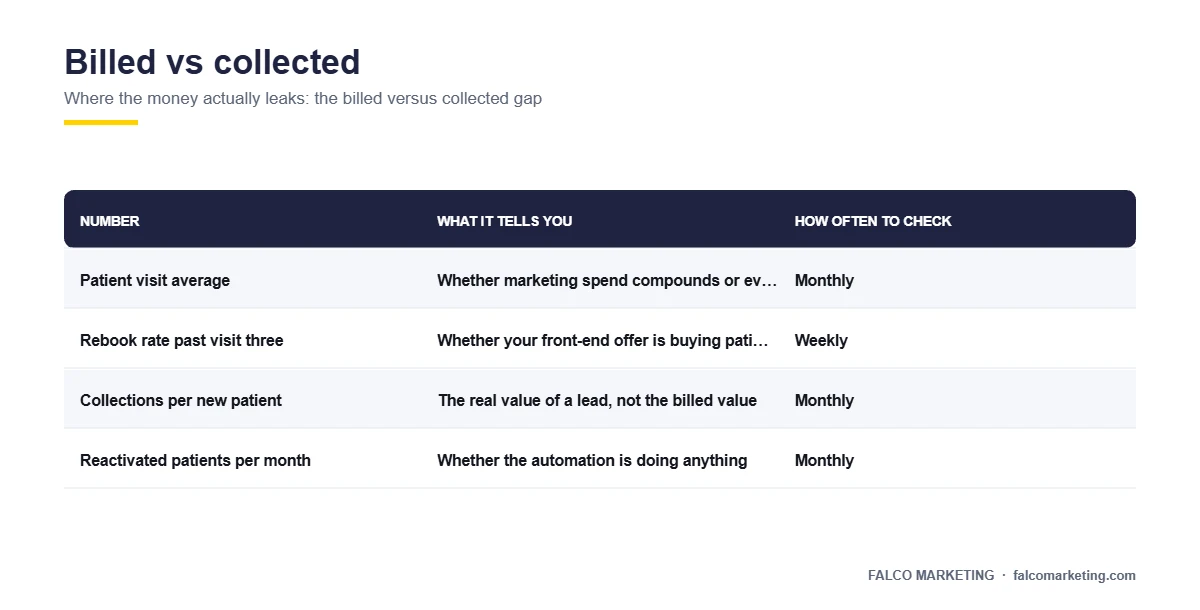
| Number | What it tells you | How often to check |
|---|---|---|
| Patient visit average | Whether marketing spend compounds or evaporates | Monthly |
| Rebook rate past visit three | Whether your front-end offer is buying patients or visits | Weekly |
| Collections per new patient | The real value of a lead, not the billed value | Monthly |
| Reactivated patients per month | Whether the automation is doing anything | Monthly |
Caption: Four numbers that tell you more than a new-patient count.
Where paid ads still belong, and where they don’t
Ads still belong on high-intent searches. Somebody typing “chiropractor near me open Saturday” at 8am with a locked neck is a real buyer, and you should be there.
Where it falls apart is broad targeting on a solo budget. You have one table and one set of hands. Filling a schedule you can’t service is a good way to burn money. WordStream’s 2026 benchmark data across 13,474 search campaigns puts the all-industry median cost per lead at $66.69 with a $5.42 median cost per click, and physicians and surgeons come in at $40.04. Chiropractic isn’t broken out in that data, so treat those as neighborhood context rather than your number.
One finding from WordStream’s account study is worth acting on this week: accounts spending under $1,000 a month convert 32% better than accounts spending over $10,000, 18.8% against 14.2%. Small and tight beats big and sloppy. That same study found a quarter of accounts had never added a single negative keyword. If yours hasn’t, you’re paying for “chiropractor salary” and “chiropractic school.” Our Google Ads page covers how we structure a small local budget.
The review timing trick: ask after the visit that felt best
Most practices ask for the review after visit one, when the patient is polite but hasn’t decided anything yet. Ask after the visit where they told you they slept through the night.
The asking part is what moves the needle. BrightLocal’s 2026 consumer survey found 83% of consumers who were asked for a review left one, and 28% now say they always write one when asked, up from 16% the year before. The same survey found 74% of people want to see reviews from the last three months, so a steady trickle beats a burst. Pick the moment in your care plan where patients typically feel the shift, and make that the trigger.

What we won’t tell you: nobody has a credible chiropractic cost-per-lead benchmark
We looked. There is no cost-per-lead or patient visit average benchmark for chiropractic marketing that we can trace to a real dataset and put our name on.
So we’re not printing one. Any agency that quotes you “the industry average PVA” or “the average chiropractic cost per lead” made it up or repeated somebody who did. That’s not a small thing, because those invented numbers are what proposals get built on.
If you want to know why practice owners are suspicious of our whole industry, read the r/Chiropractic thread titled “Are most marketing companies charlatans?” from May 2025. It’s not flattering to anybody selling marketing, us included. It’s also fair.
Your benchmark is your own last 90 days. Beat it.
A 30-day plan for a solo practice
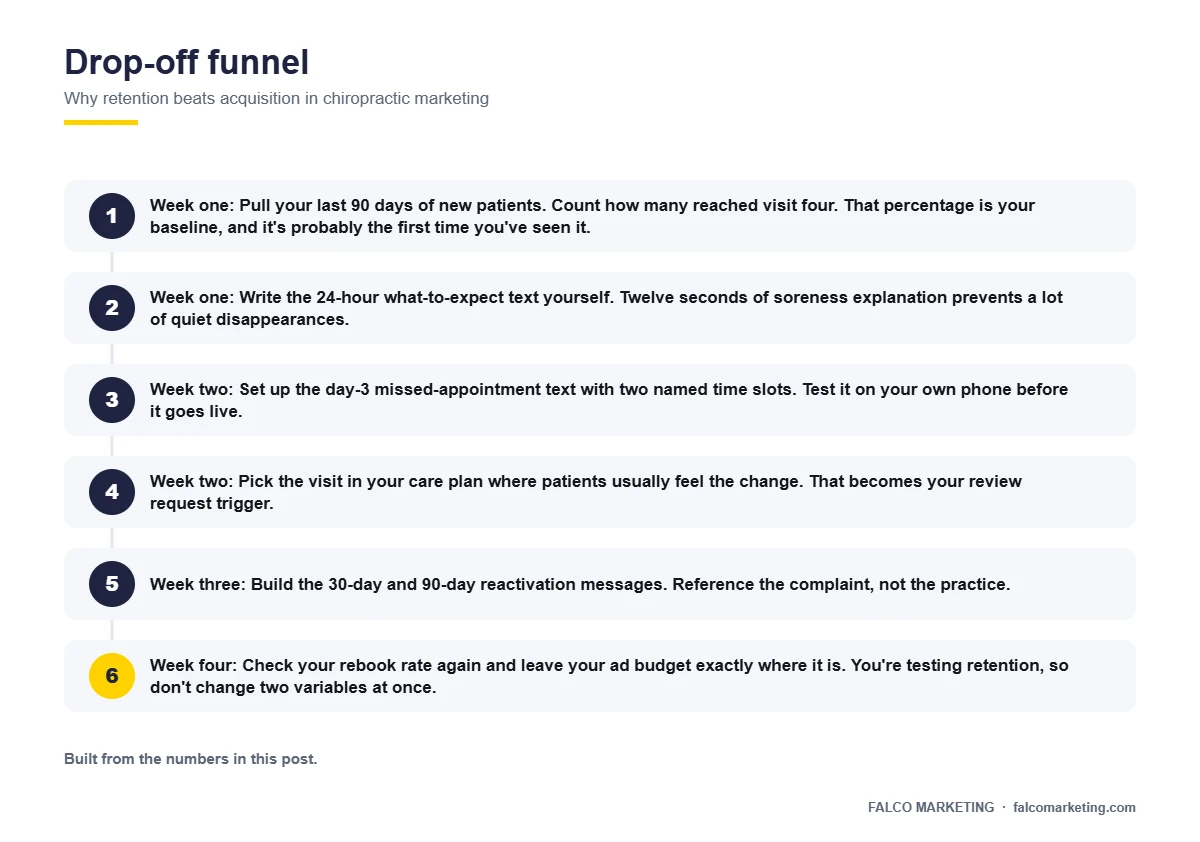
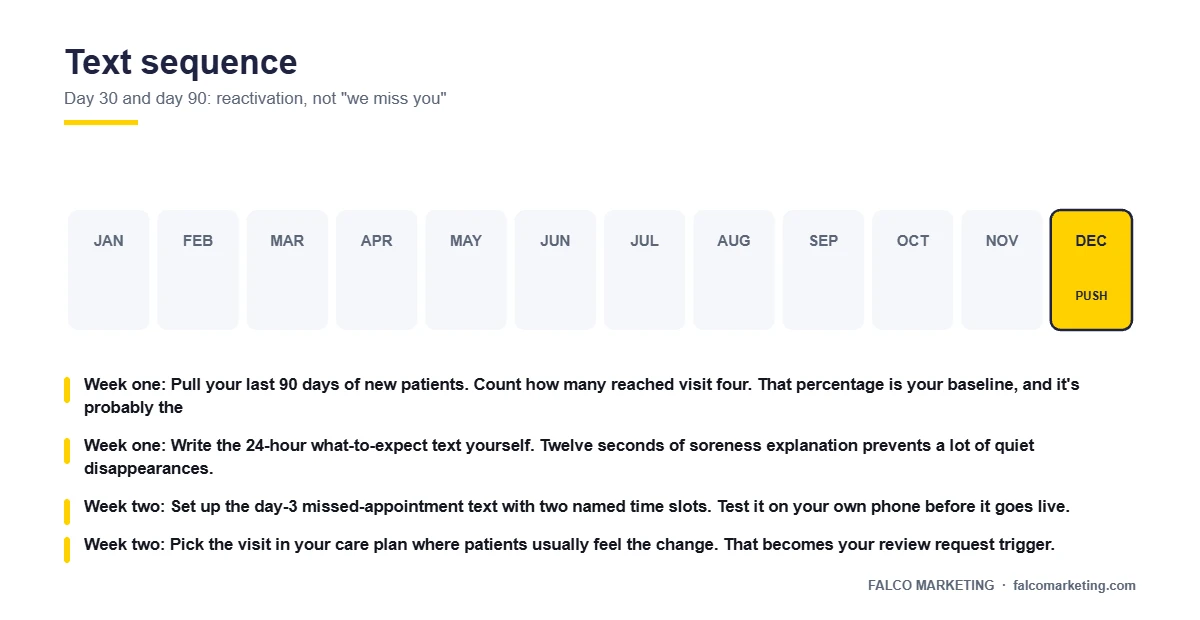
- Week one: Pull your last 90 days of new patients. Count how many reached visit four. That percentage is your baseline, and it’s probably the first time you’ve seen it.
- Week one: Write the 24-hour what-to-expect text yourself. Twelve seconds of soreness explanation prevents a lot of quiet disappearances.
- Week two: Set up the day-3 missed-appointment text with two named time slots. Test it on your own phone before it goes live.
- Week two: Pick the visit in your care plan where patients usually feel the change. That becomes your review request trigger.
- Week three: Build the 30-day and 90-day reactivation messages. Reference the complaint, not the practice.
- Week four: Check your rebook rate again and leave your ad budget exactly where it is. You’re testing retention, so don’t change two variables at once.
Thirty days of that will tell you more about your practice than another quarter of new-patient offers. If January is your big push, plan it against the January playbook for dental and chiropractic practices so the retention system is running before the traffic arrives.
See what the automation actually looks like
Book a 20-minute call and we’ll screen-share the reactivation and recall setup we build for practices in Raleigh, Cary, Apex and Wake Forest. You’ll see the message triggers, the timing, what it costs to run and what it can’t do. No proposal and no follow-up sequence.
See how the automation worksOr just tell us what’s going on and we’ll tell you whether this is even your problem.Frequently asked questions
Is the $49 new patient special worth running at all?
Yes, if you know your rebook rate. Treat it as a customer acquisition cost rather than a discount. If fewer than half of those patients rebook past visit three, you’re buying visits instead of patients, and running the offer harder makes the problem bigger.
How do I get patients back without sounding desperate?
Be specific. Reference the complaint they came in with instead of saying you miss them. Two messages, thirty days apart, then stop. The practices that get ignored are the ones sending generic monthly blasts to everyone who ever walked in.
Should a solo practice run Google Ads?
Usually a small budget on high-intent terms only. Broad “chiropractor near me” spend gets expensive fast when you have one table and no front desk. WordStream’s data shows small accounts converting better than large ones, so tight beats big here.
What’s a good patient visit average?
There’s no published industry benchmark we’re willing to point you at. Track your own for 90 days, then beat it. Anyone who quotes you a specific number for chiropractic is guessing, and you should ask them for the source.
When should I ask for the review?
After the visit where the patient tells you something got better, not after visit one. Ask directly and in person, then follow with a text link. BrightLocal found 83% of people who get asked actually leave a review, so the ask is most of the work.
Figures from the 2025 Chiropractic Economics Salary and Expense Survey and 2026 WordStream benchmarks. We update this post when the surveys refresh.