
Where a $5,000-a-Month Triangle Service Business Should Actually Put Its Marketing Budget
A $5,000 monthly budget split line by line for a Raleigh service business, with the math behind each split and the two lines owners always overfund.
Here’s the whole answer before the argument, because you’re busy.
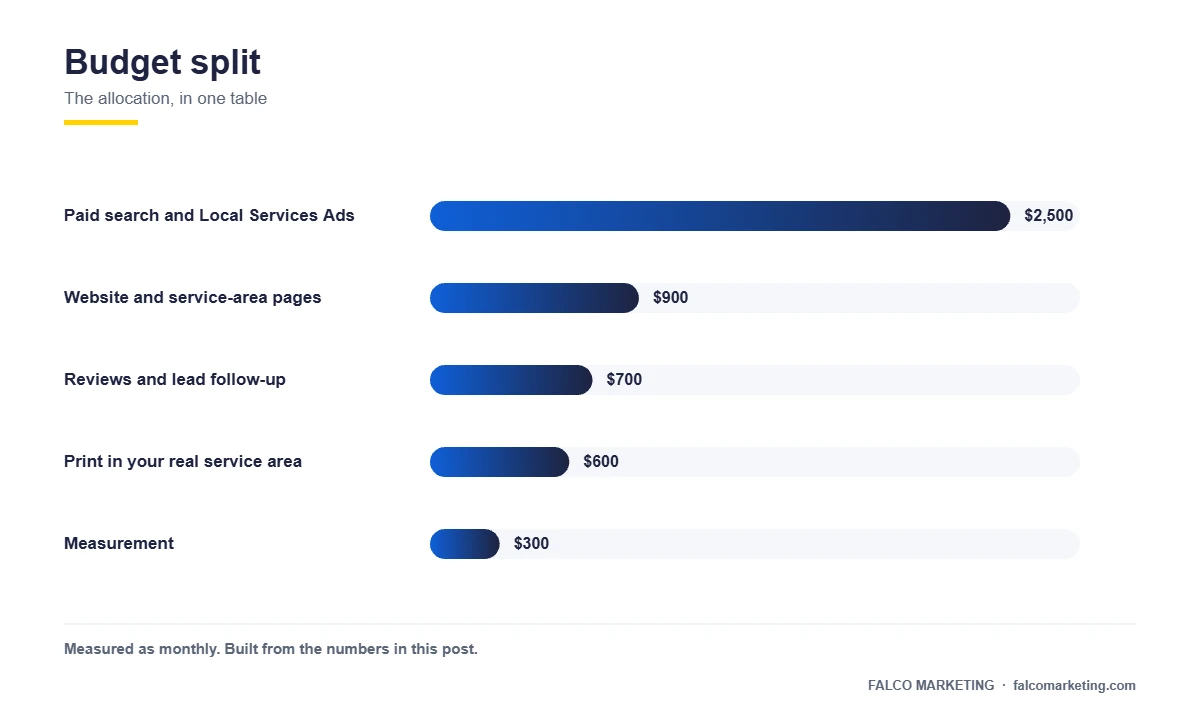
On $5,000 a month, a Triangle service business should put about $2,500 into paid search and Local Services Ads, $900 into the website and service-area pages, $700 into reviews and lead follow-up, $600 into print in the ZIP codes you actually drive to, and $300 into measurement.
That’s the split. Everything below is the math that produced it, plus the two lines almost every owner overfunds and the two nobody funds at all.
Small business marketing budget allocation on $5,000 a month in the Triangle: $2,500 to paid search and Local Services Ads, $900 to the website and service-area pages, $700 to reviews and lead follow-up, $600 to print, $300 to measurement. Build the split backward from the booked jobs you need, not from a percentage somebody put on a slide.
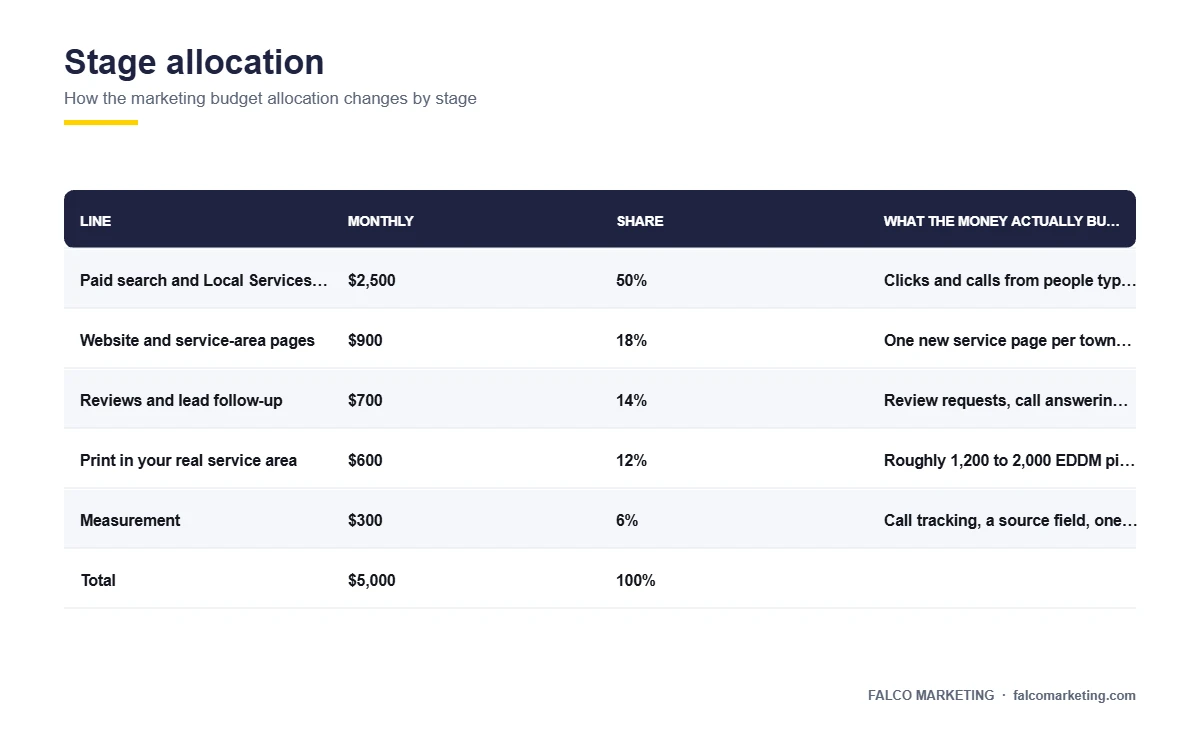
The allocation, in one table
| Line | Monthly | Share | What the money actually buys |
|---|---|---|---|
| Paid search and Local Services Ads | $2,500 | 50% | Clicks and calls from people typing your service today |
| Website and service-area pages | $900 | 18% | One new service page per town per month, plus fixes |
| Reviews and lead follow-up | $700 | 14% | Review requests, call answering, a 5-minute callback |
| Print in your real service area | $600 | 12% | Roughly 1,200 to 2,000 EDDM pieces a month |
| Measurement | $300 | 6% | Call tracking, a source field, one hour of reconciling |
| Total | $5,000 | 100% |
Caption: A $5,000 monthly marketing budget allocation for a Raleigh-area service business doing $1.5M to $4M.
Every competitor post gives you percentages with no denominator. Forty percent paid, thirty percent SEO, thirty percent brand. That’s a pie chart, not a plan, and 30% into “brand” for a plumbing company in Garner is a line you will never be able to audit.
Dollars force an argument. So let’s have it.
Start with jobs, not percentages
The number driving this should not be a percentage of revenue. It’s the extra booked jobs you need next month. Work backward from there.
- Write down how many additional booked jobs you need. Not want. Need, to keep trucks full or chairs occupied.
- Write your close rate on a cold inbound lead. Most owners guess high. If you’ve never measured it, use 40%.
- Divide jobs by close rate. That’s how many leads you need.
- Multiply leads by the cost per lead in your category. That’s your paid number, and it’s usually bigger than you hoped.
Say you need 14 more jobs a month and you close 40% of cold leads. That’s 35 leads. In Home and Home Improvement the median Google Ads cost per lead is $90.92, per WordStream’s 2026 benchmarks across 13,474 US search campaigns. Thirty-five leads at that rate is $3,182, more than the $2,500 in the table above.
That gap is the whole point. Either you raise the budget, tighten the geography, or fix the close rate. Percentages never tell you that. Backward math tells you in ten minutes on the back of an invoice.
Paid search and Local Services Ads get the biggest slice, and here’s the benchmark
Half the budget goes here because it’s the only line where somebody is already typing your service with intent to hire this week. Nobody wakes up wanting to see your logo. They wake up with water in the crawlspace.
The medians worth knowing, all from that same WordStream set: all industries $66.69 cost per lead, Home and Home Improvement $90.92, Dental $72.97, Attorneys and Legal $131.63, Physicians and Surgeons $40.04.
Local Services Ads run cheaper. SearchLight’s February 2026 benchmark, covering 888 contractors and 126,650 leads, puts blended LSA cost per lead at $53. Electrical came in at $39, HVAC $51, plumbing $57, drain and sewer $59.
So for an HVAC, electrical, plumbing, roofing or pest company, the $2,500 splits roughly $1,200 into LSA and $1,300 into search. That’s about 22 LSA leads and 14 search leads. Thirty-six leads. At a 40% close rate, 14 jobs.
For a dental practice, a chiropractic office, an audiology practice or a law firm, there’s no LSA to buy, so the whole $2,500 goes into search. At the dental median that’s about 34 leads a month.
Two things about that math nobody selling you a retainer will bring up.
First, since August 2026 Local Services Ads have been folded into Google Ads for home and storefront service advertisers, per Google’s own documentation. The separate LSA dashboard is gone and manual bidding went with it. Historical performance reports did not transfer either, so if your agency still reports LSA as a standalone silo, ask them to show you the account.
Second, small budgets aren’t the disadvantage you were told. WordStream found accounts spending under $1,000 a month convert 32% better than accounts spending over $10,000, 18.8% against 14.2%. Tight geography beats volume, which is exactly why “we’ll expand you into the whole Triangle” is a pitch, not a strategy.
Why the website line is smaller than agencies tell you (and what it should buy)
Nine hundred dollars a month. Not a $22,000 rebuild.
Here’s the uncomfortable version. Most agency website proposals are priced off design hours, and design hours are the easiest thing in this industry to bill and the hardest thing to tie to a booked job. Your site doesn’t need to be beautiful. It needs to load, say what you fix, say where you work, and put a phone number where a thumb lands.
What the $900 should buy is pages. In Whitespark’s 2026 Local Search Ranking Factors, where 47 experts scored 187 factors, a dedicated page for each service you offer is the number one local organic factor at 210 points. Not blog volume. Not a redesign. A real page for each service, and ideally each service in each town you actually serve.
At $900 a month you fund roughly one properly written service-area page per month, plus hosting and the small fixes that pile up. Twelve pages a year. Across Apex, Holly Springs, Fuquay-Varina and Clayton, that’s a real footprint. We broke down what a website actually costs in Raleigh if you need the full build number.
The rebuild trap
If somebody’s answer to “my phone isn’t ringing” is a full site rebuild, ask which pages currently rank and what happens to those URLs. A rebuild that changes every URL without redirects can cost you rankings you already paid for. Get the redirect map in writing first.
The line nobody budgets: answering and following up
Seven hundred dollars a month, and it’s the line owners cut first because it doesn’t feel like marketing. It is the highest-return money in the table.
Jobber’s 2026 Home Service Trends Report found that more than 55% of consumers expect a response within an hour, while only 20% of home service pros actually deliver one. And Invoca’s 2025 analysis of more than 60 million calls found only 61% of callers from a digital marketing source ever speak to a person.
Read that against the paid line. You’re paying $90.92 for a lead and then roughly four in ten of them hit a voicemail. That’s not a marketing problem. That’s a $2,500 line item leaking out the back.
The same $700 covers review generation, which is cheaper than owners assume. BrightLocal’s 2026 survey of 1,002 US consumers found 83% of people who were asked to leave a review did so. Asking works. And it matters at the point of decision: 47% won’t use a business with fewer than 20 reviews, and 74% want reviews from the last three months. A stack of glowing reviews from 2022 reads like a business that stopped caring.
So the $700 buys an answering service or a paid slot on somebody’s calendar to return calls inside five minutes, plus a review request after every completed job. Boring. Effective. Nobody’s putting it in a pitch deck.
For the ugly number on your own shop, we walked through how to audit your missed calls with a spreadsheet and your phone records.

Not sure what each of those lines actually buys?
Every service page on our site says what the work is and who it’s wrong for. Read the two that match your biggest budget lines before you sign with anybody, including us. Takes about ten minutes, no form and no email required.
See what each line buysOr tell us what’s going on in two sentences and we’ll tell you which line is your problem.Print isn’t dead, it’s just unattributed
Six hundred dollars a month, and this is the line where people argue with me.
Direct mail averages a 161% ROI, against 44% for email, 23% for digital display and 21% for paid social, per the ANA Response Rate Report. Nobody believes it because mail doesn’t show up in an analytics dashboard. The lead calls, says “I saw something,” and gets logged as a phone call.
At typical all-in EDDM pricing of $0.30 to $0.50 a piece, $600 buys roughly 1,200 to 2,000 households a month. Pick the four or five carrier routes where your best jobs already come from. Wendell and Zebulon are cheap to saturate. Cary is not. Don’t buy the whole county because the printer offered a volume break.
We ran the Wake County numbers route by route in our EDDM cost breakdown.
Measurement is 6% of the budget and it’s the only line that protects the other 94%
Three hundred dollars. Smallest line, and the one I’d fight hardest to keep.
WordStream’s study of 15,666 accounts found the average Google Ads account wastes $1,127.54 a month out of $3,127.38 in spend. That’s 36% of the budget going to searches that will never turn into a job. Same study: 25% of accounts have never added a single negative keyword, and 29% recorded zero conversions across 90 days.
Thirty-six percent of your $2,500 paid line is $900 a month. Spending $300 to protect $900 is not a hard call.
What “measurement” actually means
Not a dashboard. Not a 40-page PDF. Four things:
- A tracking phone number per channel, so a mailer call and an LSA call are distinguishable without asking the customer.
- A required source field in whatever you use to schedule jobs, filled in by whoever answers.
- One hour a month reconciling booked revenue against spend by channel.
- A negative keyword list touched monthly, not once at setup.
That’s it. If your reporting can’t tell you what a booked job cost by channel, you don’t have measurement, you have decoration. We wrote a full walkthrough on where your leads actually come from if you want to build it in an afternoon.
How the marketing budget allocation changes by stage
The $5,000 split above is for a growing business with a few years of history. Move the money if you’re not that.
| Line | New (year 0 to 2) | Growing | Established |
|---|---|---|---|
| Paid search and LSA | $2,000 | $2,500 | $2,200 |
| Website and service pages | $1,400 | $900 | $700 |
| Reviews and follow-up | $700 | $700 | $900 |
| $600 | $600 | $900 | |
| Measurement | $300 | $300 | $300 |
Caption: Marketing budget allocation by business stage, all totaling $5,000 a month.
A new practice with no reviews and four pages needs the website line heavier, because there’s nothing for the ads to land on. An established six-truck operation with a decade of pages behind it should shift toward follow-up and print, because its cheapest remaining growth sits in customers it already served and streets it already works.
One truck versus six changes the geography more than the mix. One truck buys two towns. Six trucks can hold eight. And the Triangle is a decent place to be doing this: Raleigh-Cary ranks number four among large US metros for small business growth. More competitors, but also more roofs.
Two lines to cut first when the month is tight
Social media management goes first, and I say that as somebody whose agency will happily sell you paid social advertising. Different products. Paid social buys reach against a targeted list and produces a measurable cost per lead. Posting four times a week on Facebook for a pest control company in Knightdale produces a content calendar.
Second cut: “SEO” that turns out to be a monthly blog post package. Blogging has a job, and we write blogs for clients, but blog volume is not what moves local organic rankings. Service pages are, per Whitespark’s scoring above. If your SEO invoice lists four blog posts and no new service or town pages, ask for the sitemap and count how many pages got added in the last six months.
Neither line is worthless forever. They’re what you fund at $8,000 a month, not at $5,000.
What we’d do with your actual $5,000
The table at the top is a default, not a prescription. The version that fits you depends on four things: your close rate, your average job value, how many towns you can actually service, and how many reviews you already have.
Order of operations if you’re rebuilding the budget tomorrow. Fix the phone first, because it’s nearly free relative to everything else. Set the paid number from your job math, not from what’s left over. Fund one service-area page a month and don’t skip a month. Print and measurement come out of the remainder, and measurement never gets cut.
If your current agency can’t tell you which of those five lines your money is sitting in, that’s the answer to the question you came here with.
Want the version of this table built for your business?
Send us your last three months of spend by channel and roughly how many jobs came from each. We’ll build the allocation model for your numbers and send it back as a one-page PDF, usually inside three business days. No proposal attached, and we won’t call unless you ask us to.
Get my budget modelPrefer to start with the paid line? The free Google Ads audit covers the waste side in about a week.Frequently asked questions
Is $5,000 a month enough to compete in Raleigh?
For one service line across three or four towns, yes. For six service lines across the whole Triangle, no. Narrow the geography before you raise the budget. Two towns done properly beats twelve done thinly.
How much of that $5,000 goes to the agency versus the ads?
Ask for it in writing as two line items, management fee and media spend. If the management fee is more than about a third of total spend at this level, ask what the extra buys and expect a specific answer with hours attached.
Should I do SEO or Google Ads first?
Ads, if you need jobs this quarter. Ads produce leads in week one and SEO doesn’t. But fund the service pages at the same time, because those pages make the ads cheaper in month nine and keep producing when you pause spend.
What if I only have $2,000 a month?
Cut geography, not channels. At $2,000 that looks roughly like $1,100 paid, $400 pages, $300 follow-up and $200 measurement, with print waiting until the paid line is producing.
How do I know if the allocation is working?
Look at cost per booked job by channel, not cost per lead, and give it 90 days. If a channel can’t be tied to booked revenue after a full quarter, that’s either a measurement failure or a channel failure, and the lead count tells you which.
Benchmark figures current as of November 2026. We update this post when the underlying reports refresh.