
EDDM Direct Mail in Wake County: Costs and Response Rates
What a Wake County EDDM drop actually costs per piece, what response rates the ANA data supports, and the break-even math on your average ticket.
A competitor’s postcard lands in your mailbox. Same trade, same town, better offer than the one on your truck. And the first thought isn’t “nice design.” It’s “what did that cost him, and is he getting anything back?”
EDDM direct mail cost in Wake County runs roughly $0.30 to $0.50 per piece all in, which puts a 5,000-piece drop between about $1,500 and $2,500. USPS postage is a fixed $0.234 per piece of that. Printing, design, bundling and drop-off make up the rest. At a $450 average ticket and a 25% close rate, that drop breaks even at about six jobs.
Almost every EDDM number online was published by somebody who sells printing. Across the Triangle agency blogs we’ve read, print is a near-total void, so an owner in Apex researching a drop reads a sales page and calls it research. We run design and print in-house, so we have no reason to hide the postage line.
What EDDM direct mail costs, per piece and per drop
Two numbers make up an EDDM piece. Postage is the easy one: the USPS EDDM Retail rate is about $0.234 per piece, and it doesn’t care whether your postcard is beautiful or ugly. Oppizi, a delivery vendor publishing its own campaign data, puts a typical all-in campaign at $0.30 to $0.50 per piece including printing and delivery, with a 6.25 by 9 format starting near $0.31. Treat that as directional, not a quote.
Everything else is where the printer makes money and where you have control: stock, coating, size, how many versions you run, who bundles the pieces and hauls them to the post office.
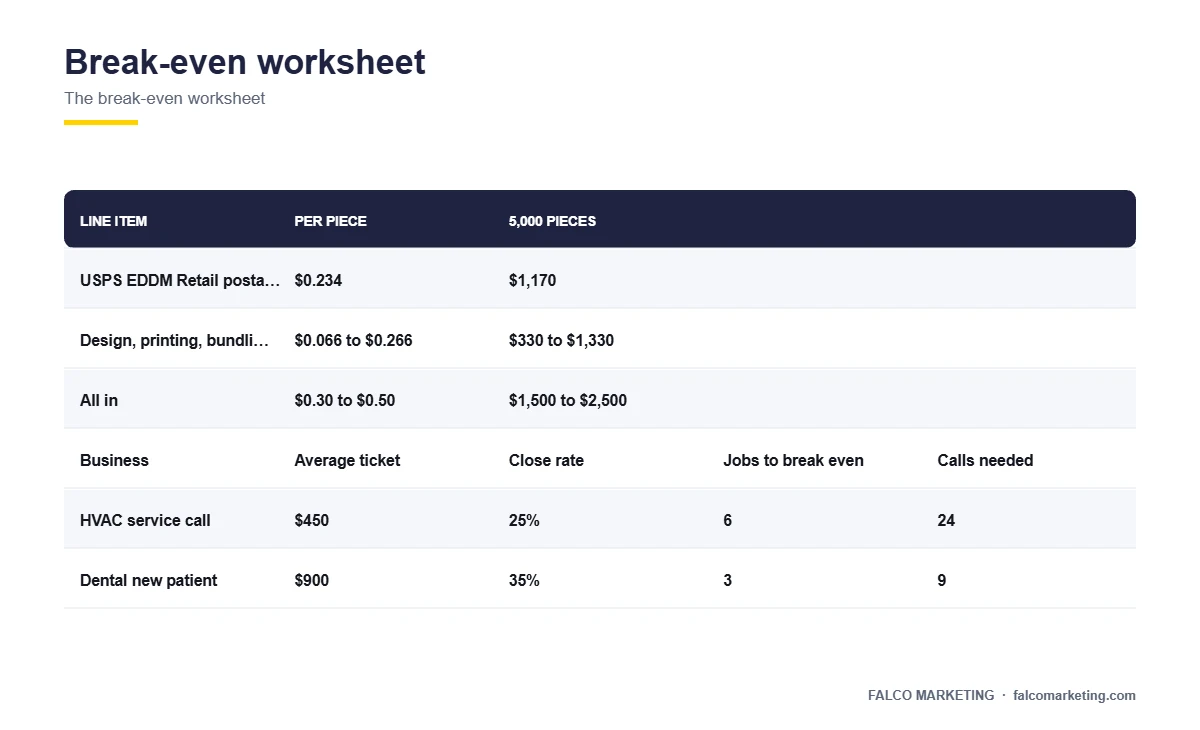
| Line item | Per piece | 5,000 pieces |
|---|---|---|
| USPS EDDM Retail postage | $0.234 | $1,170 |
| Design, printing, bundling, drop-off | $0.066 to $0.266 | $330 to $1,330 |
| All in | $0.30 to $0.50 | $1,500 to $2,500 |
Caption: Postage is fixed. The spread in any quote is almost entirely print and handling. Per-piece ranges per Oppizi.
When one printer quotes 48 cents a piece and another quotes 33, they’re bidding identical postage and very different cardstock.
How EDDM routes actually work
EDDM isn’t a mailing list. You’re buying carrier routes, and the carrier walks every address on one whether the resident fits your business or not.
You pick routes on the USPS tool by typing a ZIP and drawing on a map. Each route shows a household count and a business count, plus demographic averages. Go residential-only almost every time. The businesses on a route rarely pay for their own postage on an HVAC or pest offer.
Two things nobody mentions until you’re at the counter. EDDM Retail caps you at 5,000 pieces per ZIP code per day, so a big drop across Wake Forest and Rolesville becomes multiple ZIPs or multiple days. And the piece has to be flat-size, bigger than a standard postcard. The 6.5 by 9 workhorse exists because of that rule, not because designers love it.
Route selection is the part owners rush and then blame the postcard for. A route of 1994 homes in Garner behaves nothing like one built in 2024, a bad bet for roof replacement and a good one for pest and lawn.

What response rate to expect, honestly
The number people quote comes from the ANA Response Rate Report, compiled at PostcardMania. House lists, meaning your own past customers, run 5-9%. Cold lists run 4-5%.
Now the caveat the printer skips. A saturation route is colder than a cold list, because a prospect list got selected on something and a mail route got selected because a carrier walks it. Plan on the bottom of that range or below.
Same source puts average direct mail ROI at 161%, against 44% for email and 21% for paid social. You’ll also see a “$42 back for every $1” figure from aggregators. We don’t publish that one. The arithmetic mashes two different ANA metrics together and doesn’t reconcile.
The break-even worksheet
Break-even isn’t a response rate. It’s a number of jobs. Take the cost of the drop, divide by your average ticket, then work backwards to the response rate that produces them. Here’s the expensive end, a $2,500 drop of 5,000 pieces.
| Business | Average ticket | Close rate | Jobs to break even | Calls needed | Response rate needed |
|---|---|---|---|---|---|
| HVAC service call | $450 | 25% | 6 | 24 | 0.48% |
| Dental new patient | $900 | 35% | 3 | 9 | 0.18% |
| Pest control annual plan | $600 | 30% | 5 | 17 | 0.34% |
Caption: Illustrative tickets and close rates, not benchmarks. Swap in your own numbers and the shape holds.
Read that last column again. A cold route has to pull under half a percent to pay for itself on an HVAC ticket. The ANA benchmark is 4-5%. You don’t need to hit it. You need about a tenth of it, which is the honest case for print.
Break-even on revenue is not break-even
Those columns use gross revenue, because that’s what everyone quotes. Run it on margin instead: at 45% on a $450 ticket you clear $202 a job, and six jobs becomes thirteen. Thirteen jobs means about 52 calls off 5,000 doors, right at 1%, so the drop usually survives the honest version. Run the honest version anyway.
Want the real routes and the real math for your ZIPs?
Send us the towns or ZIP codes you want to hit. We’ll send back a route map and cost estimate: actual USPS routes, actual household counts, cost per piece at your size, plus break-even math against your average ticket. Takes us a day. If the math doesn’t work, the estimate will show that, and we’d rather you saw it first.
Get your EDDM route mapAlready have a printer’s quote? Send it over and we’ll mark which lines are postage and which are margin.Why print still lands
Some of this data is old, so here are the years attached.
Canada Post research from 2016 put brand recall at 75% for direct mail against 44% for digital ads, and found mail took 21% less cognitive effort to process. MarketReach in 2020 found 87% of people consider mail believable, against 48% for email. The 2025 State of Direct Mail report had 84% of consumers reading their mail the same day. All compiled at the PostcardMania roundup.
On format, DMA data from 2018 still gives postcards the highest response at 4.25%, ahead of dimensional mailers at 4% and catalogs and letter envelopes at 3.5%. Eight-year-old data, and still the most-cited format comparison anyone has. We’d rather flag that than pretend it’s fresh.
None of this makes print magic. It makes print a channel where nobody has to click for you to reach them, in a market where 68% of Google searches end without a click. USPS moved nearly 3 billion EDDM pieces in fiscal 2025, $617,161,072 worth of postage.
EDDM versus a targeted list
Saturation beats selection when nearly everyone on the route is a plausible customer and reaching the wrong ones costs a quarter. That’s most residential work here: pest, lawn, HVAC maintenance, plumbing, electrical, general dentistry. It’s especially true in a new subdivision in Fuquay-Varina or Willow Spring, where every house is the same age, the builder warranties expire on the same schedule, and none of those people have a guy yet.
A targeted list wins when your fit is narrow and your ticket is big. Whole-home generators, implant dentistry, commercial roofing, estate planning above a certain asset level. Paying 23 cents to reach a renter who’ll never buy a $14,000 system is fine at scale and dumb when you need forty of the right people.
Two more cases for saturation. A competitor’s ZIP, because you can’t buy a list of people who used the other guy but you can mail every door around his shop. And storm routes: after hail or wind you can mail the exact routes that took damage within days, while adjusters are still on those streets. Routes are geography and so are storms. Just be the roofer who shows up honestly, which we covered in the storm season roofing post.
The tracking setup that makes this measurable
Here’s the real reason owners say “I killed print, I couldn’t track it.” Nobody set it up. Print is trackable, just not retroactively. Four things, before the file goes to press:
- A tracking number per route group. Not one for the campaign. One per cluster, so you can see the Knightdale routes pulled and the Clayton routes didn’t. Forward them all to the same phone.
- A vanity URL short enough to type. yourcompany.com/fall, not a UTM string nobody will key in. Point it at a page matching the postcard’s offer word for word.
- A QR code to a route-specific page. Or the same page with a different query string. Just don’t send it to your homepage.
- A code on the piece and a field in your CRM. Your CSR has to ask, and there has to be somewhere to put the answer. This is the step that breaks, every time.
Then hold spend steady everywhere else through the drop window. Launch a new Google Ads campaign that same week and you’ve given up on knowing anything. Where your leads come from is solvable, and mail is easier to isolate than most, because the timing spike is obvious.
What we won’t tell you
Two numbers show up everywhere in this category, and we’re not printing either one.
The first is a door hanger response rate. Every version traces back to a blog citing a blog, and we could not find a primary study behind it. The second is the “30,000 to 70,000 daily impressions” figure for vehicle signage. The pages that supposedly carry it are dead or from 2015, and a range that wide isn’t a measurement anyway. It’s a brochure line.
Both channels can work, and we sell both. What we won’t do is hand you a response rate we can’t source, in a post whose point is that you should stop trusting numbers from whoever wants the order.
If you want to know what a door hanger does for you, measure it. One neighborhood, one tracking number, one code, thirty days, nothing else changing in that geography. We walk through that setup in attributing a door hanger to a booked job.
A first drop worth running
Wake County has 460,175 households and a population up 11.3% since 2020. You’re not mailing Raleigh. Start with 5,000 doors you can service profitably.
Your first EDDM drop
- Pick 4 to 6 contiguous residential routes in your best-margin service area
- Mail 6.5 by 9, full color both sides, phone number readable from three feet
- Put a real offer on it with an expiration date, not “call for a free estimate”
- Tracking number per route group, vanity URL, QR to a matching page, code on the piece
- Hold everything else steady through the drop window
- Read results at 30 days and again at 60, because mail has a long tail
At 30 days you’re counting calls, not jobs. At 60 you’re comparing closed revenue against the drop cost. Then re-mail the routes that worked before you go find new ones. If that second drop beats the first, you found a neighborhood, and that’s worth more than the campaign was.
Frequently asked questions
What does a 5,000-piece EDDM drop cost in Wake County?
Roughly $1,500 to $2,500 all in, depending on size, stock, quantity and whether you print locally. Postage is about 23 cents per piece of that and doesn’t vary.
What response rate should I plan on?
Plan on the low end of the ANA cold-list range, around 4%, and treat more as a good week. Mailing your own past customers does better, with house lists at 5-9%. Break-even usually sits under 1% anyway.
How do I know if it worked?
Only if you set it up first: a phone number per route group, a vanity URL or QR pointing at a route-specific page, a code on the piece, and a CRM field to hold the answer your front desk gets. Without those you’ll eventually kill a channel that was working.
Is EDDM better than a targeted list?
For a dense residential route where nearly everyone is a prospect, like a new subdivision or a neighborhood you already service, saturation wins on cost. For high-ticket, narrow-fit work, a list wins.
See what we actually print
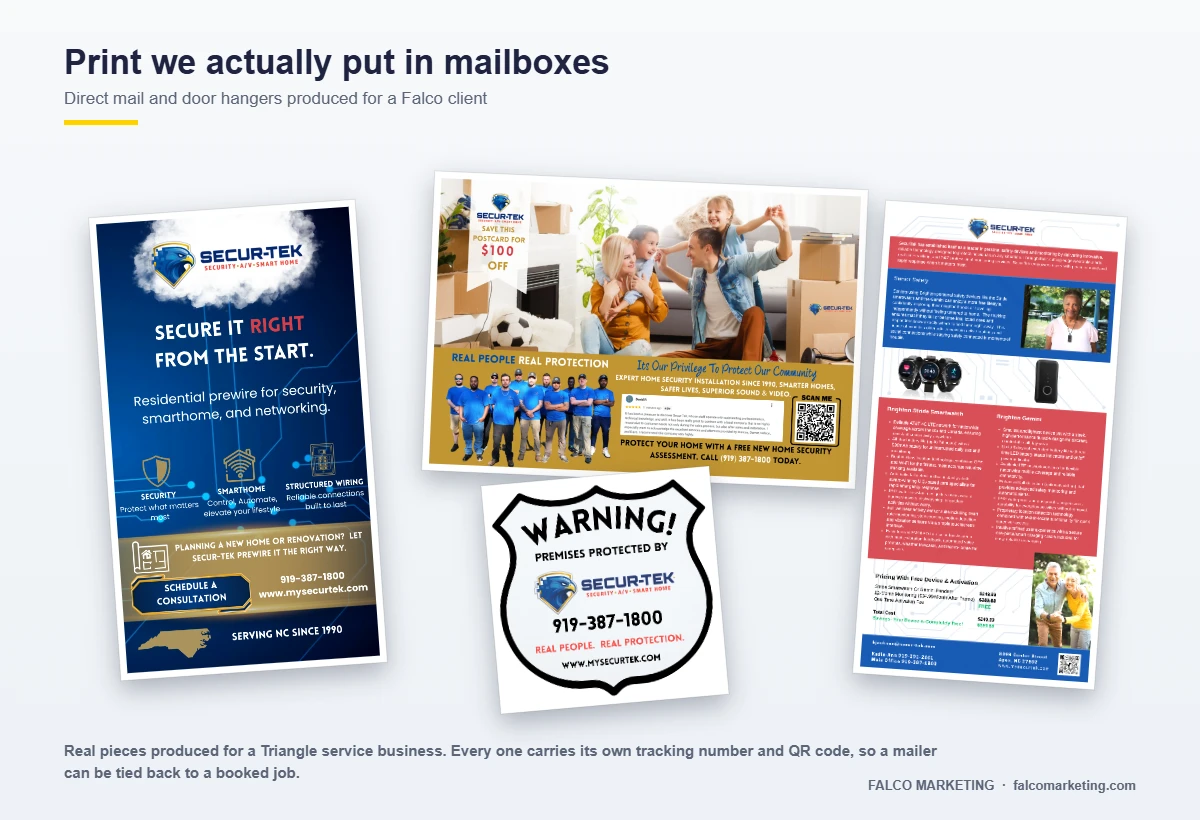
Design and print live under one roof here, so the person laying out your postcard is the one who knows what the press does with heavy ink coverage. Look at the pieces we’ve made for Triangle service businesses, then send us your offer and we’ll say straight out whether it belongs on a postcard. Costs you an email.
See our print workNot sure print is where your next dollar goes? Read where a $5,000-a-month budget should land first.